
Reviewed · FOOD & DRINK
Private group Lisbon Roots, Food & Cultural Walk
Lisbon’s food story makes the most sense on foot, moving from Rossio into Mouraria, the city’s birthplace of Fado and one of its most mixed neighborhoods. This private walk pairs more than 10 tastings with churches, squares, memorials, and local history, so you are not simply eating your way from one restaurant to another.
I like two things right away. First, your group gets a private guide, with hosts such as Pedro, Dani, Daniel, and Ricardo praised for their humor, local perspective, and easy conversation. Second, the route gives real weight to Mouraria, including the Chapel of Our Lady of Health and the 1506 Jewish massacre memorial, places many first-time visitors miss.
The main consideration is the price: $325.60 per person is a serious spend for a 3.5-hour walk, especially if your group is small. You also need moderate fitness, since Lisbon supplies cobblestones, steps, and uphill streets whether you ask for them or not.
In This Review
- Key points at a glance
- Starting at São Domingos, where Lisbon’s stories collide
- São Domingos Church and the weight of old Lisbon
- Rossio and the city’s everyday meeting place
- Food stops that turn sightseeing into a meal
- Santa Justa and the city’s vertical problem
- Mouraria, Fado, and the sound of a neighborhood
- Praça da Figueira and Martim Moniz
- Churches, theater, and the Rossio Station façade
- The Chapel of Our Lady of Health
- Largo de São Domingos and the 1506 massacre
- The guide makes the difference
- Walking conditions and practical planning
- Is $325.60 per person good value?
- Who should book this Lisbon walk?
- Should you book it?
- FAQ
- How long does the Lisbon Roots, Food & Cultural Walk last?
- How far do you walk?
- Is this a private tour?
- What food and drinks are included?
- Where does the tour start and end?
- Can dietary restrictions be accommodated?
Key points at a glance
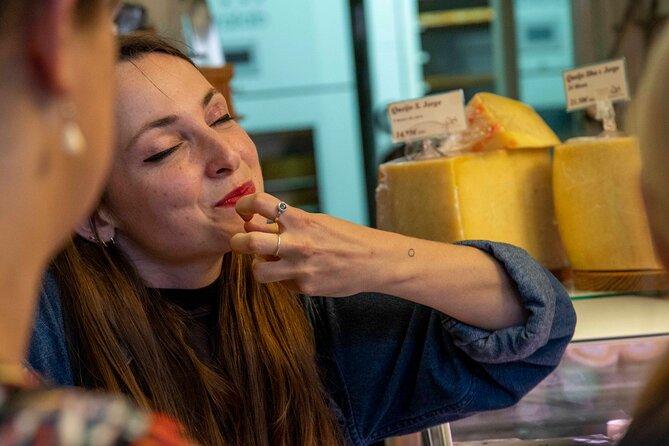
- Six food stops and 10-plus tastings: Expect a broad sampling of Portuguese food and drink, including savory dishes, sweets, coffee, and wine.
- Mouraria is the heart of the route: You visit the neighborhood linked with Fado, Maria Severa, and Lisbon’s multicultural identity.
- Private group format: The walk is exclusive to your party, allowing more room for questions and dietary planning.
- History comes between bites: São Domingos Church, Rossio, the 1506 massacre memorial, and the Chapel of Our Lady of Health give the food a larger context.
- About 1.2 miles of walking: The distance is modest, but hills, steps, and uneven paving make the physical level moderate.
- Best for a first or second day in Lisbon: A local guide can help you understand where food, neighborhoods, and later independent meals fit into the city.
Starting at São Domingos, where Lisbon’s stories collide
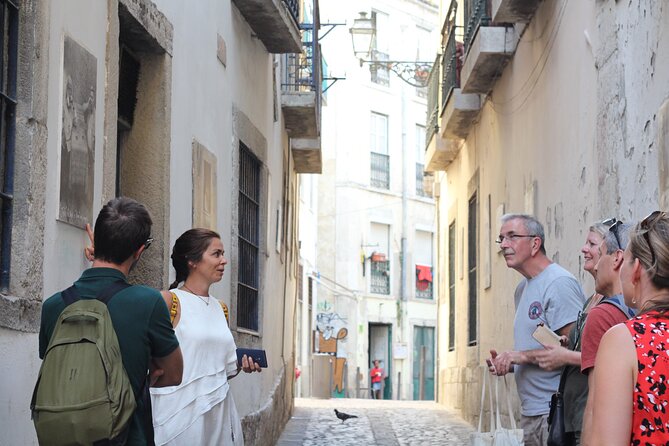
The walk begins at Largo de São Domingos, a small square near Rossio. This is a useful meeting point because it puts you at the seam between central Lisbon and Mouraria, with cafés, shops, public transport, and major sights close by.
The setting also tells you something about the tour’s tone. São Domingos is not just a convenient starting place. Its square recalls the 1506 massacre of Lisbon’s Jewish population, and the nearby church carries the scars of earthquake damage and a major fire. You begin with a city that is attractive and social, but also marked by hardship, intolerance, and disaster.
That balance matters. Lisbon food tours can easily become a parade of pastries and wine. Here, the historical stops give you a clearer sense of how Portuguese food culture developed through faith, poverty, migration, overseas trade, and neighborhood life.
More Food Tours in Lisbon
- Winner 2025 Undiscovered Lisbon Food & Wine Tour by Eating Europe
★ 5.0 · 6,390 reviews - Lisbon: Food and Wine Small Group Walking Tour
★ 4.9 · 4,082 reviews - Lisbon Small-Group Food Tour with 18 Tastings in Alfama District
★ 5.0 · 1,967 reviews
São Domingos Church and the weight of old Lisbon
The Church of São Domingos dates to the 13th century and has been damaged repeatedly by earthquakes and fire. The 1959 blaze left the building closed for decades, and its later restoration kept much of the plain, fire-marked interior rather than trying to make it look freshly polished.
You spend only about five minutes here, but that is enough for a guide to explain why the church feels different from Lisbon’s more ornate religious buildings. The blackened surfaces and simple restoration make the building’s past visible.
I like this as an early stop because it sets the tour apart from a standard sightseeing stroll. You are not merely being pointed toward pretty façades. You are being shown how Lisbon’s disasters remain part of the city’s appearance and character.
Rossio and the city’s everyday meeting place
From São Domingos, the route takes in Rossio, officially Praça de D. Pedro IV. This broad square has served as a gathering place since the Middle Ages, hosting celebrations, revolts, bullfights, and executions. Today, its role is more ordinary: people cross it on their way to work, meet friends, shop, and pause beside the flower sellers.
Rossio is a good place to understand Lisbon’s central geography. It connects the lower downtown streets with the hills rising toward Mouraria and the castle. You will also see the familiar wave-pattern pavement that makes the square attractive, though it can be less friendly to hurried feet.
The tour does not treat Rossio as a photo stop alone. Its past helps explain the contrast between the polished center and the older working neighborhoods nearby. Keep an eye on the buildings around the square, especially the ornate Rossio Station entrance, which appears later in the route.
Food stops that turn sightseeing into a meal
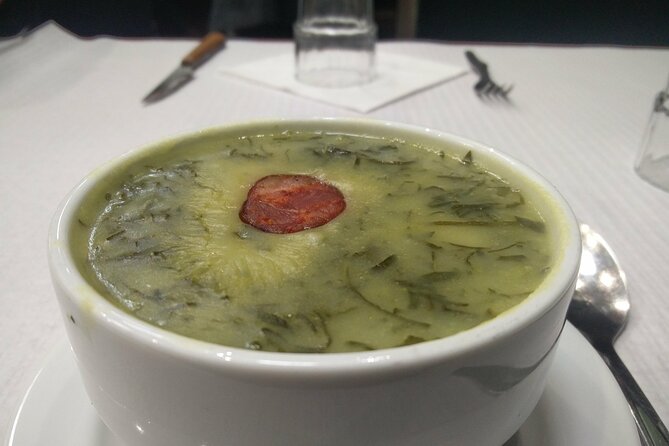
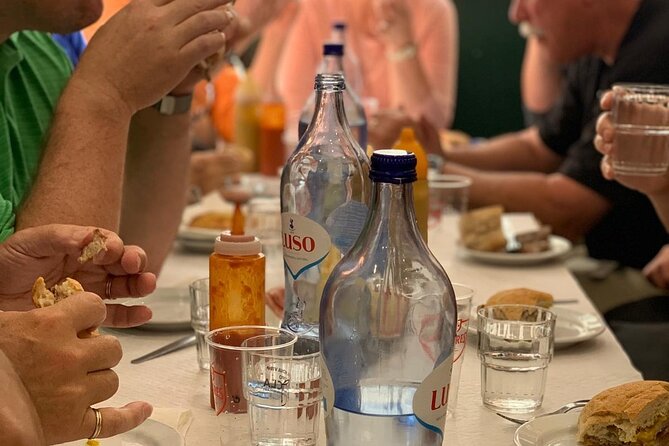
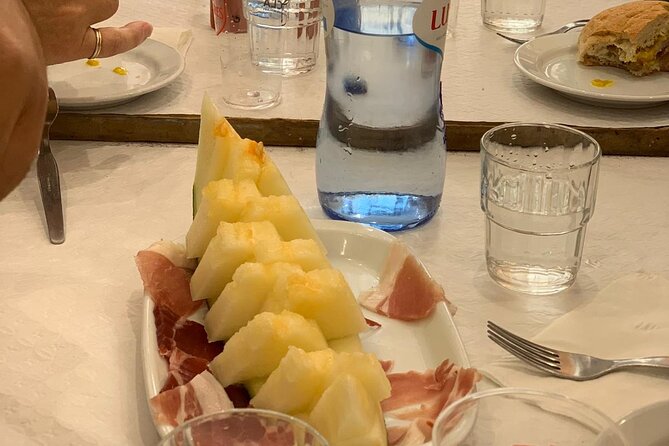
The food is spread across six stops, with more than 10 tastings. The exact dishes are not specified in advance, so you should think of this as a guided survey rather than a fixed restaurant menu.
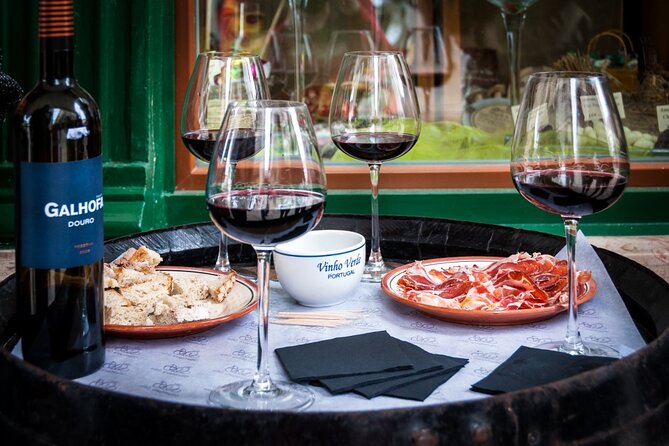
The tasting range described for the experience includes appetizers, soup, tapas, port, dessert, coffee, tea, snacks, wine, and other alcoholic drinks. That is enough variety to give you a working introduction to Portuguese eating habits rather than one oversized plate.
You should arrive hungry. Several hours of small portions can add up, and the food is intended to replace a meal for many people. At the same time, do not expect a formal sit-down lunch with one long period at a table. The rhythm is stop, taste, talk, and walk again.
Alcohol deserves attention. Wine tasting is included, and the food experience can include alcohol at several stops. If you do not drink, state that when booking and remind your guide at the start. Dietary restrictions must be supplied on the booking form because the tastings cannot be adapted on the day if the company has not been told ahead of time.
Vegetarians have been accommodated on this route, but that does not mean every dietary need can be handled. The safest approach is to provide clear details before payment and confirm them when you meet.
More Walking Tours in Lisbon
- Lisbon: History, Stories and Lifestyle Walking Tour
★ 4.8 · 10,902 reviews - Best of Lisbon Small-Group Guided Walking Tour
★ 5.0 · 4,869 reviews - Best of Lisbon Walking Tour: Rossio, Chiado & Alfama
★ 4.9 · 2,700 reviews - Age of Discoveries Walking Tour in Belém
★ 5.0 · 1,513 reviews
Santa Justa and the city’s vertical problem
The Santa Justa Lift is one of Lisbon’s famous landmarks, and it appears as a quick orientation stop rather than a ride. Built in 1902 by Raoul de Mesnier du Ponsard, a Portugal-born architect who apprenticed with Gustave Eiffel, the 45-meter iron structure links the lower downtown area with the higher Bairro Alto.
The tower’s Gothic details and Eiffel-like metalwork make it easy to recognize. From the top, visitors can look across Rossio, toward the castle and the river, but admission to the lift is not included in this experience.
That last point is important. The tour gives you context and a look at the structure, but you should not assume you will ride it or climb to its viewpoint. If the lift is a priority, plan a separate visit and account for the ticket and possible wait.
Mouraria, Fado, and the sound of a neighborhood

The route then turns toward Mouraria, whose name comes from the old Moorish quarter. This is the part of the walk that gives the title Roots, Food and Culture real meaning.
Mouraria is linked with the beginnings of Fado, the Portuguese music known for its longing, drama, and expressive singing. The neighborhood is associated with Maria Severa, often described as the first great Fado diva, and with Fernando Maurício, a major 20th-century Fado singer. The Monumento Mouraria Berço do Fado honors this tradition with a carved Portuguese guitar.
A local guide can add something that a plaque cannot: how a music associated with poor residents and hard lives became one of Lisbon’s defining cultural forms. Guides Pedro and Dani are repeatedly singled out for making this sort of history lively, while Pedro has even been encouraged to sing by previous customers. Singing is not a guaranteed part of the walk, but a musically inclined guide can give this stop extra personality.
The neighborhood is also known for its many communities and languages. Food here is not presented as a sealed-off national tradition. It reflects contact with Africa, India, Brazil, and other parts of Portugal’s long trading and migration story.
Praça da Figueira and Martim Moniz
Praça da Figueira follows, another central square with a practical past. Before the 1755 earthquake, the site held Lisbon’s All-Saints Hospital. After the rebuilding of downtown under the Marquis of Pombal, it became the city’s principal food market.
The covered market disappeared in the 1950s, and today the square is lined with hotels, shops, and cafés. The statue of King João I gives the open space a focal point, but the more interesting detail is the change in function. A place once used to distribute food to the city now serves as a transport and meeting hub.
From here, the walk continues toward Martim Moniz, a gateway into Mouraria. The square has a strongly multicultural feel and is often described as a small Chinatown, though that label simplifies a much broader mix of communities.
Martim Moniz is also the starting point for Tram 28, the famous route through Lisbon’s oldest districts. If you hope to ride it, do not count on joining the tour and boarding immediately. Lines can be long, and the tour itself is on foot.
Churches, theater, and the Rossio Station façade
The route includes another historic church, a 19th-century theater, and Rossio Station. The church survived the 1755 earthquake, though only parts of earlier construction remain after later rebuilding. It is a brief encounter, but it adds another layer to the city’s repeated cycle of damage and repair.
The theater offers a different angle on Lisbon’s social history. Built when formal culture was mainly for elites, it is now open to the public and includes guided visits, a bookstore, and a café or restaurant. The main hall has large portraits of famous actresses painted on its walls.
Rossio Station is worth a pause even if you have no train to catch. Its façade uses Manueline-inspired details, including two horseshoe-shaped entrances, turrets, and decorative pinnacles. The station connects central Lisbon with Sintra and serves as a reminder that grand architecture is not always found in a museum. Sometimes it is the place where you buy a ticket and wait for a train.
Because some of these stops are short, the guide’s explanations matter more than the time spent inside. If you prefer long museum visits, this is not that sort of tour. If you want a well-connected introduction to central Lisbon, the quick pace works better.
The Chapel of Our Lady of Health
The Chapel of Our Lady of Health is one of the route’s most distinctive stops. Built in 1505 by Lisbon artillerymen, it was first dedicated to Saint Sebastian, who was linked with protection from war, famine, and plague.
The chapel took its current name in 1569 and received an image of Our Lady of Health in 1662. It was damaged in the 1755 earthquake, while its portal dates to the early 18th century and is attributed to João Antunes.
This is exactly the sort of modest building that is easy to miss when you are rushing between the castle, cathedral, and major viewpoints. The chapel also remains part of living local tradition. A thanksgiving procession takes place on the first Sunday of May, continuing a custom that began in the 16th century.
I find this stop valuable because it links food and public health in a very direct way. In earlier Lisbon, hunger, disease, war, and religious protection were not separate subjects. They shaped the way people lived, prayed, gathered, and ate.
Largo de São Domingos and the 1506 massacre
The walk returns to Largo de São Domingos, where the city’s past becomes especially difficult. The square honors the Jewish victims of the Lisbon Massacre of 1506, when a crowd attacked New Christians and Jewish residents during a period of drought, hunger, and plague.
A mural installed in 2008 carries the words Lisbon, City of Tolerance in 34 languages. The message is simple, but the history behind it is not. This was also an area associated with the Portuguese Inquisition, where people condemned to death waited before being taken to Rossio.
The square remains a social place, with cafés, shops, and a strong connection to Lisbon’s African community. That mix of ordinary daily life and painful memory is one of the more honest parts of the walk.
You may also see A Ginjinha, the famous cherry-brandy shop near the square. Its presence fits the tour’s focus on local drinking culture, though the included tastings are not listed item by item, so do not assume every stop includes a sample of every named product.
The guide makes the difference
A private food walk succeeds or fails largely on the guide. The company uses several hosts, including Pedro, Dani, Daniel, Ricardo, Daniela, and others, so you cannot safely book on the assumption that one particular person will lead your group unless that is confirmed.
The strongest guide qualities reported for this experience are clear storytelling, humor, local knowledge, and attention to dietary needs. Pedro is often praised for combining warmth and facts, while Dani is described as energetic and especially good with families. Daniel is noted for arriving early and offering a strong introduction to Lisbon’s history and food culture.
Those details matter because a three-and-a-half-hour walk can feel long if the guide simply recites dates. A personable host can connect a soup, a church fire, a Fado singer, and a multicultural street into one understandable story.
The private format also helps. You can ask why a dish matters, stop for clarification, or adjust the pace within reason. It is not a fully custom tour, since the route and tastings are established, but it should feel more personal than a large scheduled group.
Walking conditions and practical planning
The stated distance is about 1.2 miles, or 2 kilometers. That sounds easy, but Lisbon’s terrain makes distance a poor measure of effort. Expect uphill walking on cobblestones and steps leading down through old streets.
Wear shoes with reliable grip. The physical level is moderate, and the tour is not a good fit if uneven paving, hills, or stairs are difficult for you. Since the experience lasts about 3 hours and 30 minutes, allow enough time to eat slowly and remain on your feet.
Pickup is listed as offered, but hotel pickup and drop-off are not included in the price. The published meeting point is Largo São Domingos, and the end point is Confeitaria Nacional at Praça da Figueira. The route is near public transportation, so it is easy to continue sightseeing afterward.
Mobile tickets and confirmation at booking make the practical side simple. Cancellation is free up to 24 hours before the start time. Inside that window, the amount paid is not refunded, and late changes are not accepted.
Is $325.60 per person good value?
At $325.60 per person, this is not a bargain food crawl. The value depends heavily on your group size and how much you want a private guide.
You are paying for six tasting stops, more than 10 samples, alcoholic drinks, coffee or tea, a local host, and a structured walk through central Lisbon and Mouraria. You are also paying for the convenience of keeping the experience exclusive to your own companions.
For a couple, the total price can feel steep. For a family or group splitting the cost of a private guide, the arrangement may make more sense, especially if you value conversation and a flexible atmosphere over the lowest possible per-person rate.
The tour is also more useful early in your stay. You can return to places you liked, use the food guidance to choose later meals, and understand neighborhoods that might otherwise seem like a blur of hills and tiled façades.
Who should book this Lisbon walk?
I would recommend it most strongly to first-time visitors who want food and history together. It suits people who prefer small tastings across several locations instead of one restaurant meal, and it is a good choice for families or friends who want a private outing.
It also works for repeat visitors who have already seen the major monuments and want more context about Mouraria, Fado, migration, and local traditions. The route is not only about famous sights, so it can add depth to a return visit.
I would hesitate if you want a cheap introduction to Portuguese food, a relaxed seated meal, or a tour with no hills. I would also think twice if your group has complex dietary requirements that cannot be communicated clearly in advance.
Should you book it?
Book this tour if you want a meal-sized tasting experience tied to Lisbon’s neighborhoods and history, and if a private guide is worth the extra cost. The strongest reasons are the Mouraria route, the mix of food and difficult history, and the chance to ask questions without being lost in a large group.
Skip it if your priority is the Santa Justa Lift ride, a long visit inside monuments, or the lowest-cost way to sample Portuguese dishes. For everyone else, especially on your first days in Lisbon, this is a practical way to get your bearings, eat well, and see why the city’s food cannot be separated from its streets.
FAQ
How long does the Lisbon Roots, Food & Cultural Walk last?
The experience lasts approximately 3 hours and 30 minutes.
How far do you walk?
The route covers about 1.2 miles, or 2 kilometers. It includes uphill walking on cobblestones and steps, so the physical level is moderate.
Is this a private tour?
Yes. Only your group participates in the activity.
What food and drinks are included?
Food tasting, snacks, wine tasting, alcoholic beverages, coffee, and tea are included. The experience includes six stops and more than 10 tastings, with examples including appetizers, soup, tapas, port, dessert, and coffee.
Where does the tour start and end?
The meeting point is Largo São Domingos in Lisbon. The tour ends at Confeitaria Nacional, Praça da Figueira 18B.
Can dietary restrictions be accommodated?
You must provide dietary restrictions on the booking form. The tastings cannot be adapted on the day if the company is not informed in advance.
More Food in Lisbon
- Lisbon: Baixa District Food Tour with Dinner and Drinks
★ 4.9 · 1,870 reviews - Devour Lisbon: The Ultimate Portuguese Food Tour
★ 5.0 · 1,782 reviews - Lisbon Food Tour with 10+ Tastings of Local Delicacies & Wines
★ 5.0 · 1,339 reviews - Award-Winning Original Lisbon Food Wine Tour: 19 Curated Tastings
★ 5.0 · 1,288 reviews
Recently reviewed around Lisbon
- Lisbon: Catamaran Luxury Sunset and Wine Tour★ 5.0 · 119 reviews
- Lisbon’s authentic Food and Wine tour with a Winemaker★ 5.0 · 67 reviews
- Morning Sailing Tour in Tagus River from Lisbon★ 5.0 · 68 reviews
- Lisbon: Belem Walking Tour with Jeronimos Monastery Tks Included★ 5.0 · 115 reviews
- PRIVATE Unforgettable Full Day Tour to Sintra from Lisbon★ 5.0 · 236 reviews
- Discover Lisbon’s Alfama: Secrets of the Old Town★ 5.0 · 104 reviews
- Sesimbra Wild Beach Tour from Lisbon★ 5.0 · 57 reviews
- Private Jeep Tour from Lisbon – Arrábida, Sesimbra & Beach Picnic★ 5.0 · 48 reviews
Food & Drink, compared.

Douro Valley w/ Boat Tour, Wine Tasting & Lunch
Read our review →
Winner 2025 Undiscovered Lisbon Food & Wine Tour by Eating Europe
Read our review →
Cálem Cellar Tour, Interactive Museum & Wine Tasting
Read our review →
Douro Valley Small-Group Tour with Wine Tasting, Lunch and Boat
Read our review →

Browse the lists this tour appears in