
Reviewed · LISBON TOURS
Lisbon: 3-in-1 Hop-On Hop-Off Bus and Tram Tours
Lisbon’s famous hills make a sightseeing bus more useful than it may sound. This 48-hour ticket combines two open-top bus routes with a historic tram ride, letting you cover far more ground before deciding where to spend your walking time. The tram is the characterful part: it passes Alfama, Mouraria, Graça, and other old quarters while the driver explains details such as cable changes and the tram’s mechanics.
I like the freedom to hop off at Belém’s monuments, the Tile Museum, or the Oceanarium, then continue when you are ready. I also like the included access to Yellow Carris trams and the free Carris Museum entry, which add practical value beyond a standard sightseeing loop. The main catch is timing: the final departures are around 5:00 to 5:30pm, and traffic, roadworks, narrow streets, and waiting times can eat into your day.
In This Review
- Key points to know before you go
- What the 48-hour ticket really gives you
- Starting at Restauradores Square
- Belém route: Lisbon’s grand riverfront sights
- Modern Lisbon route: from the center to Parque das Nações
- The Hills Tramcar Tour through old Lisbon
- Using the Yellow Carris trams
- Audio commentary, staff, and day-to-day comfort
- How to use the two days well
- Who will get the most from this ticket
- Should you book the Lisbon 3-in-1 tour?
- FAQ
- How long is the ticket valid?
- Where do the bus tours begin?
- Where does the Hills Tramcar Tour start?
- Does the tram tour stop so I can get off?
- Which languages are available for the audio guide?
- Are museum and monument admission fees included?
Key points to know before you go
- Three ways to see Lisbon: Use the Belém route, Modern Lisbon route, and Hills Tramcar Tour within 48 hours.
- The vintage tram is a ride, not a hop-on route: It begins and ends at Praça do Comércio and does not stop along the way.
- Belém is the strongest sightseeing route: Jerónimos Monastery, Belém Tower, the Monument to the Discoveries, MAAT, and the Coach Museum are all covered.
- The Modern route reaches the eastern riverfront: You pass the Tile Museum, Oceanarium, Vasco da Gama Shopping, and Vasco da Gama Tower.
- Audio commentary is included: Choose from Spanish, Chinese, Dutch, English, French, German, Italian, Japanese, Portuguese, or Russian.
- Plan around the clock: Buses and the tram generally stop running in the late afternoon, so start early if you want to get off several times.
What the 48-hour ticket really gives you
At $44 per person, this works best when you treat it as both a sightseeing pass and a short-term transport tool. If you simply ride one loop and take a few photos, the price is harder to justify. If you use all three tours, ride Yellow Carris trams, and return to one or two areas on the second day, the value improves considerably.
You have 48 hours of access to the Belém Lisbon Bus Tour, the Modern Lisbon Bus Tour, and the Hills Tramcar Tour. You can use the first day for a broad city overview, then spend the second day revisiting the places that caught your eye.
The ticket also includes discounts at selected museums, restaurants, and bars, plus free admission to the Carris Museum when you show a valid ticket. Entrance to major sights such as Jerónimos Monastery and Belém Tower is not included, so budget separately if you want to go inside.
The buses are yellow, but the route signs matter. Look for the blue sign for Belém and the pink sign for Modern Lisbon in the front window. This small detail saves confusion at Restauradores Square, where both routes begin near the Eden Theatre.
Other Lisbon days travellers weigh against this one:
- Lisbon City Center Tour – The Unmissable Lisbon
★ 5.0 · 22,234 reviews - Lisbon: Sintra, Pena, Regaleira, Cabo da Roca & Cascais
★ 4.7 · 19,656 reviews - Sintra: Pena Palace and Park Entrance Ticket
★ 4.2 · 17,410 reviews
Starting at Restauradores Square

Both bus tours begin at Restauradores Square, a handy central location near Rossio and Avenida da Liberdade. The meeting point is close to the Eden Theatre, and buses on both lines depart about every 30 minutes during their stated operating hours.
The Belém route begins at 9:00am, with the last departure at 5:30pm. The Modern Lisbon route runs from about 9:15am to 5:15pm, also every 30 minutes. Those hours look generous, but Lisbon’s traffic and the time spent at stops can make a full day feel short.
I recommend beginning with one complete loop if you are new to Lisbon. Stay on board and use the commentary to understand how the central squares, grand avenues, old neighborhoods, and riverfront fit together. Then use the remaining time for one or two carefully chosen stops.
The audio guide is available in several languages, including English, Portuguese, Spanish, French, German, Italian, Dutch, Russian, Japanese, and Chinese. The English track is described as detailed, though the content can be uneven. You may pass an interesting building with only a brief explanation, and the background music does not always match what you are seeing.
Belém route: Lisbon’s grand riverfront sights
The Belém route is the essential line if this is your first visit. It links the central city with Lisbon’s western riverfront, where Portugal’s maritime past is represented by large monuments and historic buildings.
From Restauradores, the bus passes Rossio Square, Marquês de Pombal, El Corte Inglés, Eduardo VII Park, Amoreiras, and the Basilica da Estrela. These early stops show you several sides of Lisbon beyond the old center: formal squares, shopping areas, leafy parkland, and residential districts.
The route then reaches Pilar 7 and the Coach Museum before continuing to Jerónimos Monastery. The Coach Museum is one of the unusual stops on the route, especially if you enjoy royal carriages and decorative transport. It is also a useful choice when you want an indoor museum rather than another outdoor monument.
Jerónimos Monastery is one of the major reasons to choose this route. Its ornate exterior and connection with Portugal’s seafaring era make it one of Belém’s key sights. The bus drops you close enough to explore the surrounding area, but admission is extra and queues can take time.
Next comes Belém Tower, the small fortified landmark set beside the Tagus. It is one of Lisbon’s most recognizable sights, but you should allow time for the walk around the riverfront and for photographs. The bus is useful here because it removes the need to cover the full distance from the center on foot.
The Monument to the Discoveries follows. Its bold shape and riverside position make it a strong photo stop, and its large scale helps explain the patriotic tone of Belém’s monuments. You can combine it with the monastery and tower, but trying to enter everything during one circuit will leave little time for the rest of Lisbon.
The route also serves MAAT, the Museum of Art, Architecture and Technology, and the Docas Cruise Terminal. MAAT gives the Belém outing a modern counterpoint, while the docks offer places to pause by the water. Jardim da Estrela appears later in the loop before the bus returns to Restauradores.
Belém is spread out, so hopping off is worthwhile. Just remember that the route operates on a schedule, and the last bus leaves in the late afternoon. If you spend a long time inside one museum, you may need to use regular public transport or wait for the next Yellow Bus.
Modern Lisbon route: from the center to Parque das Nações
The Modern Lisbon route takes you east from the historic center toward the newer riverfront districts. It begins at Restauradores, then passes Rossio, Avenida da Liberdade, and the Lisbon Cruise Terminal.
The route’s most useful feature is the change in scenery. Instead of repeating the old center, you see Lisbon’s newer commercial and exhibition areas, along with the wide spaces created for the 1998 World Expo. This makes the line a good contrast to the Belém route.
The Tile Museum is one of the most worthwhile stops for art and Portuguese design. Lisbon’s painted tiles are not just decoration. They appear on facades, inside churches, and throughout the city, so this museum gives you context for details you will keep noticing afterward.
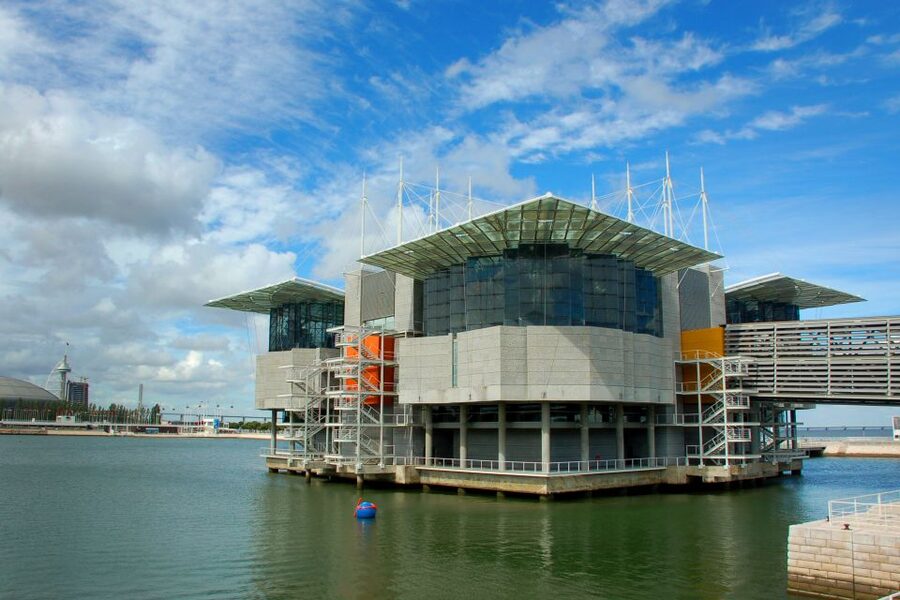
The Oceanarium is the major eastern stop. It is one of Lisbon’s best-known attractions, but admission is not part of the bus ticket. The route is particularly handy if you do not want to arrange separate transport from the center.
After the Oceanarium, the bus continues to Vasco da Gama Shopping, FIL, and the Vasco da Gama Tower and Myriad Hotel. This section feels much newer and more open than Alfama or Baixa. It is useful for a change of pace, shopping, dining, or a look at Lisbon’s contemporary riverfront.
The Modern route returns toward Rossio. One practical limitation is that the route is not always as frequent or convenient as the other line. A complete circuit can take substantial time, and waiting at a stop may be longer than expected. Start early if you want to visit the Oceanarium or Tile Museum rather than simply view them from the bus.
A different kind of day out, same corner of Portugal:
- Lisbon: Jerónimos Monastery Entrance Ticket
★ 4.1 · 14,164 reviews - Lisbon: History, Stories and Lifestyle Walking Tour
★ 4.8 · 10,902 reviews - Lisbon: Sunset Boat Party Cruise with DJ and Open Bar
★ 4.5 · 10,378 reviews - Lisbon: Pena Palace, Sintra, Cabo da Roca, & Cascais Daytrip
★ 4.7 · 9,981 reviews
The Hills Tramcar Tour through old Lisbon
The Hills Tramcar Tour is the most distinctive part of the package. It uses a historic tramcar, the traditional vehicle associated with Lisbon’s steep streets and old neighborhoods.
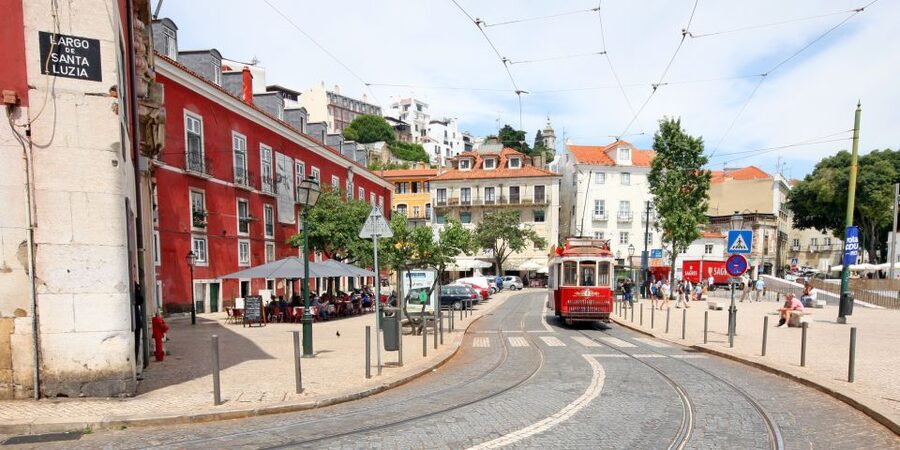
The tram starts at Praça do Comércio, close to the arch, and returns to the same square. Unlike the bus tours, it has no hop-on, hop-off stops. You ride the full circuit, so it is best understood as a scenic historic ride rather than a transport route.
The tram passes viewpoints and old quarters including Portas do Sol, Lisbon Cathedral, Graça, São Vicente, the National Pantheon, and Martim Moniz. It also runs through or near Alfama, Mouraria, and Baixa, where narrow streets, tiled houses, churches, and small squares give Lisbon much of its character.
This ride provides a sense of how the city works on its hills. A driver has explained the mechanics of changing cable lines and other operating details, which can make the journey more engaging than a simple recorded loop. The tram experience also gives you views that feel more connected to street life than those from a large double-decker bus.
Departures begin at about 9:30am and continue until around 5:05pm, roughly every 35 minutes. Because the route has no intermediate stops, check the departure time before heading to Praça do Comércio. You do not want to spend your only available window waiting and then discover that the final tram has already gone.
The tram is also subject to the realities of Lisbon’s old streets. Narrow roads, traffic lights, roadworks, and congestion can slow the service. That is part of the city’s character, but it means you should not plan a tightly timed museum visit immediately afterward.
Using the Yellow Carris trams

During the ticket’s validity, you can use Yellow Carris trams as well as the three sightseeing services. This is one of the package’s most useful extras because it gives you a way to move around after the sightseeing buses finish for the day.
The public tram access can also help when a sightseeing tram is full or when you are already near an old neighborhood and do not want to return to a main bus stop. The information provided with the ticket does not give a full public transport route map, so ask staff for the right service before boarding.
The free Carris Museum entry is another modest but worthwhile addition. It gives more context to Lisbon’s tram system and can appeal to anyone curious about the vehicles, routes, and operating details behind the historic ride.
Do not assume every transport option is part of this particular package. The clearly included transport is the Yellow Carris tram access, while museum and monument entry remain separate. Check the current terms if a discount or extra attraction is a key reason for booking.
Audio commentary, staff, and day-to-day comfort

The buses have audio guides in multiple languages, and headsets are provided for the open-top tours. The commentary is generally useful for getting a basic account of the sights and for pointing out major areas as you pass.
I would treat it as an introduction, not a full guided tour. Some parts are detailed, while other buildings receive little or no explanation. There is no promise of live narration on every bus, so if you want a guide to answer questions or add local stories throughout the route, this is not the right format.
The vehicles have received strong praise for being clean and well maintained. That matters on a long loop, especially when you are using the bus as transport rather than taking a short sightseeing ride. Staff have also been described as helpful, and a driver named Anna was specifically remembered for being attentive and useful on an earlier visit.
The open-top design is ideal for city views, but Lisbon’s weather can change the experience. The package information does not specify seating guarantees or weather arrangements, so bring a light layer and do not count on staying outside for every section.
Food, drinks, and alcohol are not allowed on board. Plan your café stop for when you get off rather than trying to make lunch part of the ride.
How to use the two days well
A sensible first day begins with the Belém route. Ride from Restauradores toward the riverfront, then choose one or two stops, perhaps Jerónimos Monastery and the Monument to the Discoveries. Leave enough time to wait for the return bus or use Yellow Carris transport if your schedule changes.
Use the tram on the same day or early on the second day. Since it is a complete circuit with no stops, it works well as a relaxed introduction to Alfama, Mouraria, Graça, and the cathedral area before you explore those neighborhoods on foot.
Reserve the Modern Lisbon route for the second day if you want to visit the Tile Museum or Oceanarium. If you only want a broad view, stay on for the full circuit and then use the ticket’s public tram access to return to the center.
Do not try to force all attractions into one day. One full bus loop can already take a large part of a morning, and entering three museums or monuments adds queues and walking. The 48-hour validity is most valuable when you spread the experience out.
Who will get the most from this ticket

I recommend it most for a first visit, a short stay, or anyone who wants a quick overview before choosing where to return. It is also useful if steep hills, long distances, or unfamiliar public transport would make independent sightseeing tiring.
Families may appreciate the simple hop-on, hop-off format, while older visitors can use the buses to reduce walking between distant areas. The tram is especially appealing if you want a traditional Lisbon experience rather than only a standard city tour.
You may prefer ordinary public transport and walking if you already know Lisbon well or plan to spend most of your time inside museums. The fixed daytime schedule and late-afternoon finish also make this less useful for evening sightseeing.
Free cancellation up to 24 hours ahead and reserve-now, pay-later booking give you some flexibility. Roadworks can temporarily suspend service, so check current updates with the Yellow team before setting out.
Should you book the Lisbon 3-in-1 tour?
Book it if you want a broad view of Lisbon in two days and will use at least two of the routes, plus the tram or public transport access. The Belém line and Hills Tramcar Tour are the strongest reasons to choose it, while the Modern route adds a useful look at the eastern riverfront.
Skip it if you want a small-group guide, detailed live commentary, or late-night transport. At $44, the ticket is fair value when you hop off, revisit areas, and use the included tram access. It is less convincing as a single bus ride with no stops.
Start early, confirm the route color before boarding, and keep your plans flexible around traffic. Used that way, this pass gives you both the big sights and a feel for Lisbon’s old streets without requiring you to master the city on your first morning.
FAQ
How long is the ticket valid?
The ticket is valid for 48 hours, giving you access to the two bus tours, the Hills Tramcar Tour, and Yellow Carris trams during that period.
Where do the bus tours begin?
Both the Belém Lisbon Bus Tour and Modern Lisbon Bus Tour begin at Restauradores Square, near the Eden Theatre.
Where does the Hills Tramcar Tour start?
The Hills Tramcar Tour begins at Praça do Comércio, close to the arch.
Does the tram tour stop so I can get off?
No. The Hills Tramcar Tour starts and ends at Praça do Comércio and has no stops along its route.
Which languages are available for the audio guide?
The audio guide is available in Spanish, Chinese, Dutch, English, French, German, Italian, Japanese, Portuguese, and Russian.
Are museum and monument admission fees included?
No. Entrance fees to museums and monuments are not included, although the ticket provides free entry to the Carris Museum and discounts at selected museums, restaurants, and bars.
Recently reviewed around Lisbon
- Portinho da Arrábida: Coasteering Boat Tour★ 4.9 · 78 reviews
- Setúbal: Dolphin-Watching Boat Tour★ 4.8 · 213 reviews
- From Lisbon: Private Óbidos and Nazaré Tour★ 5.0 · 152 reviews
- No Diet Club – Unique food tour in Lisbon with many Tastings★ 4.8 · 44 reviews
- Queluz National Palace & Gardens Ticket★ 4.6 · 447 reviews
- Melides: Horse Riding on the Beach with Wine Tasting★ 4.3 · 117 reviews
- Melides: Horseback Riding on Melides Beach★ 4.7 · 111 reviews
- Lisbon: Street Art Tuk Tuk Tour★ 4.9 · 372 reviews
Lisbon Tours, compared.

Lisbon City Center Tour – The Unmissable Lisbon
Read our review →
Sintra, Pena, Regaleira, Cabo da Roca & Cascais
Read our review →



Sunset Boat Party Cruise with DJ and Open Bar
Read our review →
Pena Palace, Sintra, Cabo da Roca, & Cascais Daytrip
Read our review →