
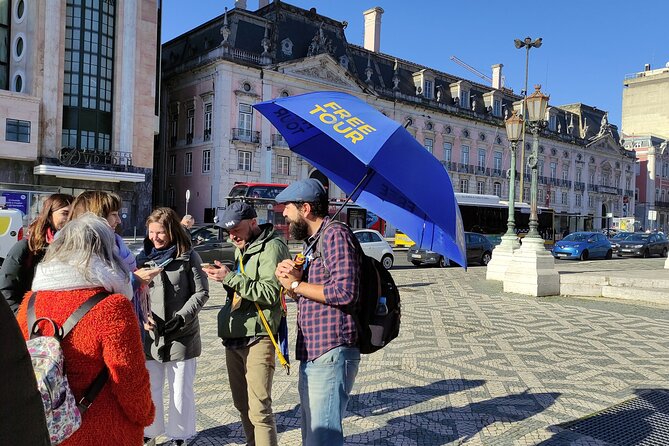
Reviewed · CITY TOURS
Lisbon City Center Tour – The Unmissable Lisbon
Lisbon’s best introduction may be on foot, moving from the grand Restauradores square through old churches, literary cafés, revolutionary landmarks, and steep lanes to the Tagus. This 2.5-hour walk gives you the city’s central neighborhoods in one steady sweep, with guides such as Miriam, Claudia, Hugo, and Ricardo adding stories and practical advice.
I like the pay-what-you-think-it-is-worth model, especially at the listed price of $3.62 per person. I also like the route’s useful finish at Praça do Comércio, since you leave with a mental map of Rossio, Chiado, Bairro Alto, and Baixa. The main caution is the amount of talking: one guide may offer lively stories and local context, while another may give more facts than some people want.
In This Review
- Key points to know
- Why this walk works as your Lisbon orientation
- Restauradores and the first look at Lisbon’s past
- Rossio and the memory of intolerance
- Rossio Station and the route into Chiado
- Santa Justa and the Carmo revolution
- São Roque and Bairro Alto after dark
- A Brasileira, Pessoa, and Lisbon’s literary side
- São Carlos Theatre, Rua Augusta, and the river
- How the guides shape the experience
- Walking effort, weather, and group size
- Is $3.62 a good value?
- Who should book The Unmissable Lisbon?
- Should you book it?
- FAQ
- Where does the tour start?
- Where does the tour end?
- How long does the tour last?
- What language is the tour offered in?
- How much does the tour cost?
- How large can the group be?
- Is the tour suitable for most people?
- Are service animals allowed?
- Is the tour near public transportation?
- What happens if the weather is poor?
- Can I cancel for a full refund?
- What if the minimum number of participants is not reached?
Key points to know
- A strong first-day orientation: See central Lisbon’s main squares and three important neighborhoods before deciding where to spend the rest of your visit.
- A car-free route: Walk through lanes, stairways, squares, and streets that taxis and buses cannot reach.
- History with a human edge: The route includes the 1506 Jewish massacre memorial, Igreja de São Domingos, and the site of the 1974 revolution.
- Practical local advice: Guides share food, cultural, and sightseeing suggestions, and some provide follow-up information through WhatsApp.
- A manageable but active walk: The route lasts about two and a half hours and includes uneven streets, so good shoes matter.
- Small enough for conversation: Groups can reach 25 people, though some departures are much smaller.
Why this walk works as your Lisbon orientation
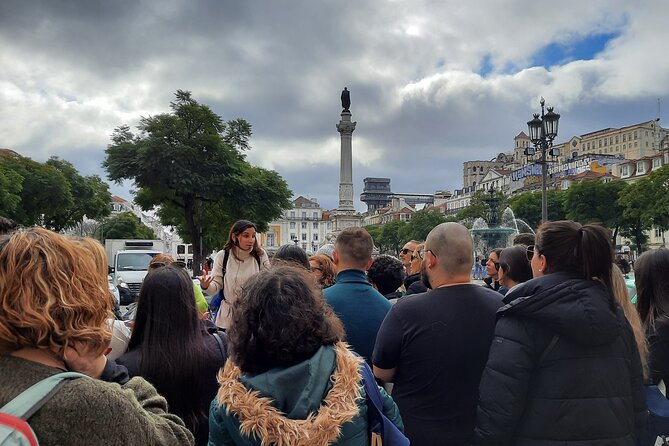
The route is designed to help you get your bearings fast. It begins at Praça dos Restauradores, follows the historic center uphill and downhill through Rossio, Chiado, and Bairro Alto, then descends toward Rua Augusta and the riverfront.
You are not simply being driven past Lisbon’s sights. You walk between them, which lets you notice the city’s changing texture: formal squares, scorched church walls, tiled façades, café terraces, narrow streets, and broad river views.
The tour is particularly useful after arriving in Lisbon. One participant described the steady walking as a good way to stay awake after a long international flight, and that makes sense. You cover ground without spending the day inside a museum or on public transport.
I would book it near the start of a Lisbon stay, not at the end. The guide’s food and sightseeing suggestions can shape the rest of your visit. Some guides, including Fernanda, have sent a WhatsApp document with local tips after the walk, which adds value beyond the official two-and-a-half-hour schedule.
More City Tours in Lisbon
- Lisbon: Daytime/Sunset/Night City Sailboat Tour with Drink
★ 4.9 · 3,114 reviews - Lisbon: City Highlights and Viewpoints E-Bike Tour
★ 4.9 · 1,556 reviews - Lisbon: Private City Tour by Eco Tuk Tuk
★ 4.9 · 1,215 reviews
Restauradores and the first look at Lisbon’s past
The meeting point is the Monumento dos Restauradores in Praça dos Restauradores, where Avenida da Liberdade reaches the historic center. The square commemorates Portugal’s restoration of independence, and it is an easy place to begin because it is large, central, and near public transport.
The stop itself is brief, about five minutes, but it gives the guide a chance to place Lisbon on a timeline. From here, the group heads toward Igreja de São Domingos.
This church is not one of Lisbon’s most decorated interiors, and that is part of its power. It serves as a reminder that grand religious buildings are not the only way to understand a city. The guide connects it with themes of peace, tolerance, and unity, giving the tour an early human focus rather than launching straight into dates and rulers.
You spend about ten minutes here. If you prefer stories about ordinary lives, conflict, and memory, this is a worthwhile stop. If you want long interior visits, keep expectations in check. This is a walking tour, not a church tour, and the stops are short.
Rossio and the memory of intolerance
The nearby memorial to the victims of the 1506 Jewish massacre is one of the route’s most serious moments. It recalls the killing of Lisbon’s Jewish population during a period of religious fanaticism and intolerance.
This stop gives the city center a needed layer of honesty. Lisbon’s old streets can look charming, but their history is not all pretty viewpoints and coffeehouses. A good guide can use this memorial to explain how prejudice and public violence shaped the city.
The tour then reaches Praça Dom Pedro IV, better known as Rossio Square. For more than six centuries, this has been one of Lisbon’s main public stages. Its patterned pavement, broad open space, and busy edges make it a good place to pause and understand the layout of downtown.
You spend around ten minutes here. The square is also useful for orientation: it links the Baixa district with the routes toward Chiado and the castle area. The tour does not take you into every nearby attraction, but it helps you see how the center fits together.
Rossio Station and the route into Chiado
Rossio Station is one of Lisbon’s most memorable buildings, even if you are not catching a train. Its ornate exterior looks older than it is, and the guide points out the date of its construction, which is intended to surprise you.
The station opened in 1846 and has looked over major events in the city’s past. You get about ten minutes here, enough to appreciate the façade and hear the station’s place in Lisbon’s story.
From Rossio, the walk moves toward Chiado, one of the city’s most cosmopolitan districts. The stop at Chiado is short, about five minutes, but it marks a clear change in mood. You leave the monumental center and enter an area associated with shops, cafés, theater, writers, and city life.
The route’s appeal here is not one single sight. It is the transition between districts. You begin to understand why Lisbon is best explored by neighborhoods rather than by isolated monuments.
More Lisbon city days:
- Lisbon: Tagus River Sailboat City Cruise
★ 4.9 · 1,212 reviews - Lisbon: City Sightseeing Hop-On Hop-Off Bus Tour
★ 3.7 · 794 reviews - Lisbon: Private City Tour by Tuk-Tuk
★ 5.0 · 789 reviews - Lisbon: City Tour by Tuk Tuk
★ 4.7 · 617 reviews
Santa Justa and the Carmo revolution
The Santa Justa Lift is one of Lisbon’s most photographed structures. It was built as public transport, yet its ironwork and vertical form have made it feel like a monument.
The tour includes access to the lift’s free area. That is an important detail because the paid parts of the attraction can involve separate arrangements, while this walk focuses on the public section. You spend about ten minutes here, likely hearing how the lift connects the lower streets with the higher part of the city.
Next comes Largo do Carmo, one of the route’s strongest stops. The square was a stage for passionate revolutions, most notably the 1974 Carnation Revolution, which ended decades of dictatorship in Portugal.
The setting is unusually effective. The square is not just a place where history happened in a distant past. Its buildings and open space help you picture a public turning point. Allow around fifteen minutes here, the longest stop on the route.
The nearby Carmo church ruins are also part of what makes this area memorable, though the supplied tour details emphasize the square and its revolutionary role rather than a long church visit. If your guide spends time on the political background, listen closely. This is one of the moments when a short walk can give you a useful understanding of modern Portugal.
São Roque and Bairro Alto after dark
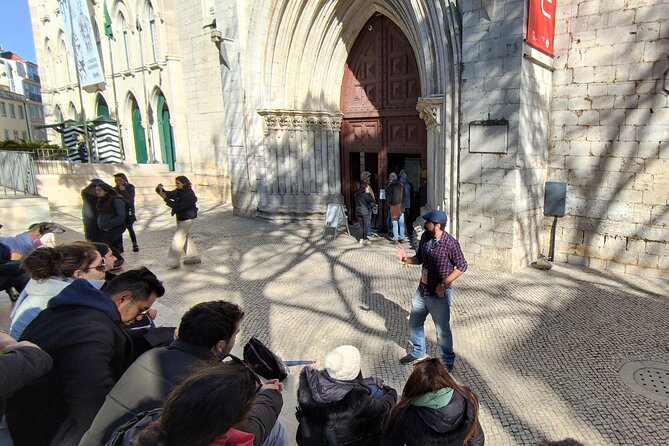
Igreja de São Roque brings the tour back to an older chapter. Built in the sixteenth century, it was Portugal’s first Jesuit church and served as the Jesuits’ home church in the country for more than two centuries, until their expulsion.
Inside is one of the world’s most valuable chapels. The scheduled stop lasts about ten minutes, so do not expect a slow, detailed art-history visit. Still, it is an important contrast with São Domingos. One church is remembered for its plainness and scars; São Roque is associated with ornate religious art and wealth.
The group then enters Bairro Alto, Lisbon’s nightlife district. Its history reaches back more than 500 years, and the guide presents it as Lisbon’s bohemian quarter.
A daytime walk is useful here because you can study the district before the nighttime crowds and music arrive. The tour does not promise an evening pub crawl. Instead, it gives you a sense of the streets and suggests how Bairro Alto fits into Lisbon’s social life.
At Largo do Chiado, the route pauses at the small square that links Chiado with Bairro Alto. This is a brief five-minute stop, but it helps you keep the districts straight. Lisbon’s central neighborhoods can blur together on a first visit. Having a guide name the boundaries makes later exploring easier.
A Brasileira, Pessoa, and Lisbon’s literary side
A Brasileira is one of the route’s most characterful stops. The café is linked with the arrival of coffee culture and with Fernando Pessoa, one of Portugal’s best-known writers. Other intellectuals and artists connected with the modernist magazine Orpheu here as well.
You spend about ten minutes in the area. The tour is not a literary seminar, but this stop gives context to Chiado’s café culture. It also helps explain why the neighborhood has long attracted writers, artists, and people who come to watch city life from a table.
This is the sort of detail that makes a walking tour more useful than a checklist. You learn not only what a building is, but how people used the district. If your guide is in a storytelling mood, A Brasileira can become one of the liveliest moments of the walk.
São Carlos Theatre, Rua Augusta, and the river
The São Carlos National Theatre is Portugal’s only theater devoted to producing and presenting opera, choral music, and symphonic music. The stop lasts about ten minutes and rounds out the cultural side of the tour.
From there, the route reaches Rua Augusta, the lively central street leading toward the river. It is described as one of downtown Lisbon’s most active and charming streets, and it is a good place to notice the shift from neighborhood streets to the formal Baixa grid.
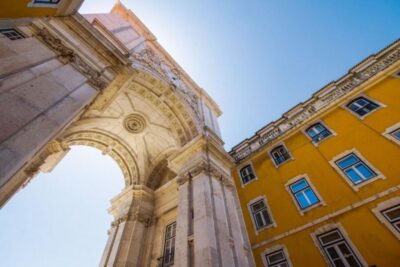
The itinerary also points out the triumphal arch associated with Lisbon travel photographs. This is the Arco da Rua Augusta, the grand gateway toward Praça do Comércio. The arch frames the final approach and makes a clear visual transition from the city center to the waterfront.
The tour ends in Praça do Comércio, between the arch and the equestrian statue of King José I. This is one of Europe’s great urban squares, with the Tagus opening beyond it. The square is where Lisbon meets the river, and it gives the walk a satisfying finish.
Ending here is practical. You can continue along the waterfront, return toward Baixa, or use your new bearings to head into another part of the city. The guide does not leave you in a random side street.
How the guides shape the experience
The strongest praise goes to the guides’ personality, storytelling, and ability to make history approachable. Miriam is described as funny, personable, and engaging, with useful suggestions for food and cultural activities. Claudia is praised for being warm, clear, and organized, with a break built into the walk and concise takeaways at the end.
Hugo has handled difficult weather well, keeping the stories moving when rain and fog reduced the chance for good photographs. Ricardo is described as especially charismatic, with strong storytelling and obvious enthusiasm for Lisbon. Other named guides include Cecília, Mariana, Odelia, Fernanda, Silvestro, Sandra, Marti, and Sérgio.
That range matters because a pay-what-you-want walk can vary with the individual guide. Most of the feedback is highly positive, with a 5 out of 5 rating from 22,236 reviews and recommendation from 99 percent of participants. Still, one person found the opening history talk too long and fact-heavy, leaving the group for a self-guided version of the route.
That criticism is useful. If you want a compact tour with only brief explanations, tell yourself that this may be more like a series of mini talks at important stops. If you enjoy history and ask questions, the extra detail may be exactly what you want.
Walking effort, weather, and group size
The route lasts roughly two hours and thirty minutes, with frequent stops of five to fifteen minutes. You are walking continuously between them, and the streets are uneven. Wear shoes with a firm sole and expect a steady pace.
Rain can change the experience. One guide kept a group engaged through heavy rain and fog, but poor weather will limit photos and make the stone streets less pleasant. The activity requires good weather, and if it is canceled for that reason, you are offered another date or a full refund.
Groups can include up to 25 people. That is not a private tour, but the cap keeps it from becoming enormous. Some departures are small enough for real conversation with the guide and other people in the group.
Most people can participate, and service animals are allowed. The start and end points are near public transport. The tour is offered in English and includes a mobile ticket.
Is $3.62 a good value?
At the listed price of $3.62 per person, this is an unusually inexpensive way to spend a first morning or afternoon in Lisbon. The pay-what-you-think-it-is-worth structure also makes the financial risk low, although you should understand that the experience depends heavily on the guide you receive and on the contribution you choose to make.
Past participants have booked for about $5 Australian dollars and praised the value. The real benefit is not admission to major attractions, since the listed stops are free. You are paying for a local person to connect the places, explain the history, answer questions, and point you toward useful choices for the rest of your stay.
I would not choose this if you want entry tickets, long museum visits, or a private pace. I would choose it if you want a broad central-Lisbon overview without paying for a full sightseeing package.
Free cancellation is available up to 24 hours before the start time for a full refund. Inside 24 hours, you cannot change the booking or receive a refund. The minimum number of participants must also be met.
Who should book The Unmissable Lisbon?
This is best for a first visit to Lisbon, particularly if you want to understand how Rossio, Chiado, Bairro Alto, and Baixa connect. Solo visitors should find the small-group format easy for conversation, while couples and families can use the walk to decide which areas deserve more time.
It also suits history fans who enjoy political, religious, and literary stories. The route covers Portugal’s restored independence, religious persecution, Jesuit influence, the Carnation Revolution, Pessoa, and Lisbon’s café culture in a single outing.
You may want something else if you dislike steady walking, uneven streets, or detailed commentary. People who prefer photographs at every stop may also find the schedule brisk, especially in rain.
Should you book it?
Book this tour if you want a low-cost, English-language introduction that gives you both a map and a story of central Lisbon. The best reasons are the thoughtful route, the finish at Praça do Comércio, and the chance to receive practical advice from guides such as Miriam, Claudia, Hugo, Ricardo, or Fernanda.
Skip it if your ideal tour is quiet, highly polished, and tightly limited to short facts. The guide’s style can range from entertaining storytelling to a heavier history lecture. For most first-time visitors, though, the route offers a smart start: walk the center, learn the connections, then return to the neighborhoods that catch your interest.
FAQ
Where does the tour start?
It starts at the Monumento dos Restauradores in Praça dos Restauradores, Lisbon.
Where does the tour end?
It ends at Praça do Comércio, between the Arco da Rua Augusta and the equestrian statue of King José I.
How long does the tour last?
The tour lasts approximately two hours and thirty minutes.
What language is the tour offered in?
The tour is offered in English.
How much does the tour cost?
The listed price is $3.62 per person. The experience also uses a pay-what-you-think-it-is-worth model.
How large can the group be?
The maximum group size is 25 people.
Is the tour suitable for most people?
Most people can participate. The route involves a substantial amount of walking on uneven streets.
Are service animals allowed?
Yes, service animals are allowed.
Is the tour near public transportation?
Yes, the meeting area is near public transportation.
What happens if the weather is poor?
The experience requires good weather. If it is canceled because of poor weather, you are offered another date or a full refund.
Can I cancel for a full refund?
Yes. You must cancel at least 24 hours before the experience start time for a full refund. Cancellations within 24 hours are not refunded.
What if the minimum number of participants is not reached?
You are offered another date or experience, or you receive a full refund.
Recently reviewed around Lisbon
- Portinho da Arrábida: Coasteering Boat Tour★ 4.9 · 78 reviews
- Setúbal: Dolphin-Watching Boat Tour★ 4.8 · 213 reviews
- From Lisbon: Private Óbidos and Nazaré Tour★ 5.0 · 152 reviews
- No Diet Club – Unique food tour in Lisbon with many Tastings★ 4.8 · 44 reviews
- Queluz National Palace & Gardens Ticket★ 4.6 · 447 reviews
- Melides: Horse Riding on the Beach with Wine Tasting★ 4.3 · 117 reviews
- Melides: Horseback Riding on Melides Beach★ 4.7 · 111 reviews
- Lisbon: Street Art Tuk Tuk Tour★ 4.9 · 372 reviews
City Tours, compared.
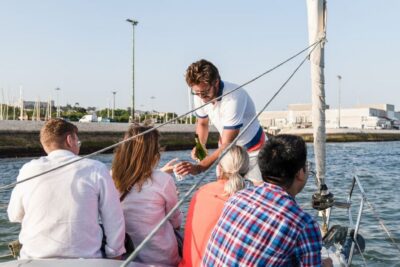
Daytime/Sunset/Night City Sailboat Tour with Drink
Read our review →
City Highlights 3-Hour Guided Electric Bike Tour
Read our review →


Browse the lists this tour appears in