Reviewed · FULL-DAY
Full Day Lisbon Tour Baixa Chiado with Alfama and Belem
Lisbon packs much of its story into one long day on this nine-hour walking tour, moving from the riverfront launch point of the Portuguese Discoveries to the steep lanes and grand squares of the old city. You get Belém in the morning, a long lunch pause, and the central districts in the afternoon.
I like the clear sweep of the route, which gives you both the great monuments and smaller places such as Alfama’s lanes, the old Manueline church of Nossa Senhora da Conceição Velha, and Casa dos Bicos. I also like that a pastel de Belém and several monument admissions are included, while lunch remains your choice.
The trade-off is simple: this is a full day on foot, with hills, cobbles, and a lot of standing. Private transport is not included, and the 90-minute lunch break at Time Out Market is not covered in the price. If you want a slow visit inside every church and museum, this tour moves too quickly.
In This Review
- Key points to know before booking
- Why this route gives you a useful first day in Lisbon
- Belém Tower and the riverfront story
- Inside Jerónimos Monastery
- Pastéis de Belém and the best use of your sweet stop
- Lunch at Time Out Market
- Praça do Comércio and Lisbon after the earthquake
- Alfama, the Cathedral, and St. Anthony
- Manueline details and Casa dos Bicos
- Rua Augusta, Rossio, and the Carmo ruins
- São Roque and the final viewpoint
- Guides, group size, and the pace of the day
- Is $110.06 a fair price?
- Who should book this Lisbon walking tour?
- Final verdict: a strong one-day introduction
- FAQ
- How long does the Lisbon tour last?
- Where does the tour begin and end?
- Is lunch included?
- What admissions are included?
- How large is the group?
- How physically demanding is the experience?
- Can I cancel for a refund?
Key points to know before booking
- Belém comes first: Begin beside the Tagus with Belém Tower, the Discoveries Monument, the Wind Rose, and Jerónimos Monastery.
- One tour links three sides of Lisbon: The route covers Belém, the historic center, and Alfama without making you arrange separate outings.
- The group is limited to 20 adults: That is small enough for a guide to keep the walking group together, though it is not a private tour.
- History is a major part of the day: Guides such as João, Fernanda, Teresa, Diego, and Roselyn are praised for making Portuguese history clear, lively, and personal.
- Lunch is flexible but not included: You get 90 minutes at Time Out Market or another spot of your choice.
- Finish above the center: The day ends near São Pedro de Alcântara viewpoint, a useful place to continue exploring Bairro Alto or Chiado.
Why this route gives you a useful first day in Lisbon
Lisbon can be awkward to organize on your own. Belém lies west of the central districts, while Alfama and Baixa sit across hills and ridges closer to the river. This tour joins those pieces in a single day, giving you a broad first look before you return to the places that deserve more time.
The route also has a good historical shape. In Belém, your guide explains how Portugal’s sea voyages shaped the nation and paid for grand Manueline buildings. After lunch, the focus shifts to earthquakes, royal power, religious life, and the daily character of Lisbon’s oldest neighborhoods.
That story is more valuable than simply ticking off monuments. At Jerónimos, for example, you learn why the monastery was built after Vasco da Gama’s return from India and how overseas trade funded its ornate design. In Baixa, the 1755 earthquake explains the orderly streets and monumental Praça do Comércio.
The experience is operated by Take Lisboa. Start time is 9:00 am at Avenida Brasília in Belém, and you finish near the São Pedro de Alcântara viewpoint at Rua de São Pedro de Alcântara 85. Since the tour ends far from the morning meeting point, plan your evening from the central Lisbon side rather than expecting to return to Belém.
More Lisbon trips worth a second look
- Sintra Full-Day Private Tour – A Journey through Wonderland
★ 5.0 · 1,665 reviews - From Lisbon: Fátima, Batalha, Nazaré & Óbidos Full-Day Tour
★ 4.7 · 881 reviews - Évora and Megaliths Full-Day Tour from Lisbon
★ 4.7 · 456 reviews
Belém Tower and the riverfront story
The morning opens at Torre de Belém, Lisbon’s best-known riverside landmark. You have about 30 minutes here, enough to see the tower, hear why it matters, and take photographs from the outside. Admission is listed as included.
The tower feels most meaningful when paired with the riverfront walk that follows. Along the Tagus, the guide connects the scenery to Portugal’s Discoveries, the period when ships left this waterfront for Africa, India, and other parts of the world.
Next comes Padrão dos Descobrimentos, the large monument shaped like a ship with Henry the Navigator leading a line of Portuguese figures. You do not enter it, and admission is not included, so treat this as an outdoor explanation and photo stop rather than a museum visit.
The nearby Rosa dos Ventos gives the history a visual anchor. Its broad map and compass rose mark the routes of Portuguese seafarers. You get about 15 minutes here, followed by time in Praça do Império Garden, built for the 1940 Portuguese World Exhibition. The garden includes mosaic patterns, a sundial, a fountain, two lakes, and sculptural groups with horses whose tails become sea creatures.
These stops are short, but they help you read Belém as a planned district rather than a string of unrelated sights. The pace also keeps the morning moving toward the day’s major interior visit.
Inside Jerónimos Monastery
Jerónimos Monastery is the morning centerpiece, with about an hour allotted and admission included. Its Manueline design is full of maritime references, carved details, and stonework funded by Portugal’s trade with Africa and the Orient.
The cloisters are the part I would pay close attention to. Their layered arches and elaborate decoration show why this monastery is often treated as the finest example of Portuguese Gothic, also called Manueline. The building began in 1501 after King Manuel I sought permission to create a major monastery beside the Tagus.
Your guide may explain the site’s connection to the Ermida do Restelo, a place where sailors sought refuge before voyages. That setting gives the building emotional weight: this was not an inland palace disconnected from the sea, but part of a working port district tied to departure and return.
The practical limit is the one common to many guided monument visits. Guides may not be allowed to explain everything inside certain buildings, so some of the interpretation happens outdoors before or after entry. One hour is enough for a strong introduction, but not enough for every chapel, carved figure, and architectural detail.
Pastéis de Belém and the best use of your sweet stop
A 15-minute stop at Pastéis de Belém follows the monastery. The original custard pastry is included, which is a small but welcome touch in a day where lunch is extra.
The pastry’s story is tied to the closure of Portugal’s convents in 1834. A former monastery worker began selling sweet pastries beside the sugar refinery, and production at the Belém shop began in 1837 using a secret recipe passed down among its master confectioners.
You should think of this as a taste and history stop, not a long café break. Fifteen minutes will not leave room for a leisurely sit-down meal, but it does give you a chance to try the signature pastry in the neighborhood where its story began.
A different kind of day out, same corner of Portugal:
- Lisbon City Center Tour – The Unmissable Lisbon
★ 5.0 · 22,234 reviews - Lisbon: Sintra, Pena, Regaleira, Cabo da Roca & Cascais
★ 4.7 · 19,656 reviews - Sintra: Pena Palace and Park Entrance Ticket
★ 4.2 · 17,410 reviews - Lisbon: Jerónimos Monastery Entrance Ticket
★ 4.1 · 14,164 reviews
Lunch at Time Out Market
The tour allows 90 minutes for lunch at Time Out Market Lisboa. The meal is not included, and you are free to eat there or choose another place.
The market makes logistical sense for a mixed group. It offers many food choices, including seafood and other dishes suited to different tastes and ages. You can spend the break making your own choice instead of being tied to a fixed group menu.
Still, a market lunch has a clear compromise. It is convenient, but it may feel less personal than sitting in a small family-run restaurant. If you want to use the break for a specific Lisbon meal, ask your guide for a local suggestion. Several guides are praised for practical advice about food and places to visit, so this is a good moment to ask.
The break also matters physically. By this point, you will have spent the morning walking and standing. Use the 90 minutes to eat, rest, and refill your water before the central-city portion begins.
Praça do Comércio and Lisbon after the earthquake
The afternoon begins at Praça do Comércio, also called Terreiro do Paço. Its broad open space faces the Tagus and occupies about 36,000 square meters, framed by 79 arches.
Before the 1755 earthquake, this was the site of the royal palace and the residence of Portuguese kings for roughly 250 years. After the disaster, the Marquis of Pombal used the area as a key part of the rebuilt city. The square’s scale makes more sense once you understand it as both a former palace front and a symbol of Lisbon’s planned reconstruction.
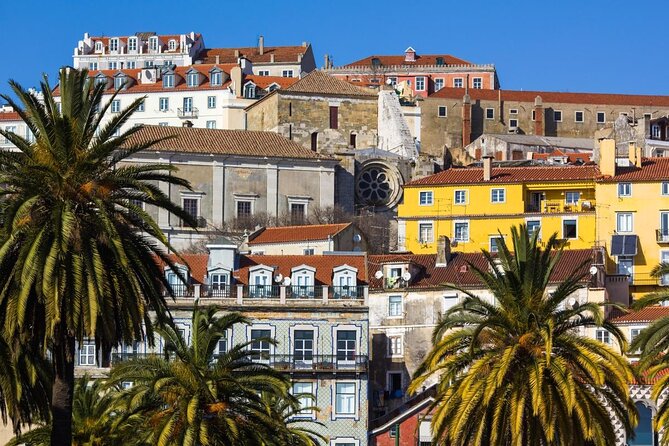
From here, the route moves toward older layers of the city. At Miradouro de Santa Luzia, you look across the tiled roofs of Alfama toward the Tagus. Vines, tile panels, and the small church create one of Lisbon’s most attractive viewpoints.
The two tile panels attached to the church walls are worth a close look. They show how Lisbon uses azulejos not merely as decoration, but as a way to tell and frame its own story.
Alfama, the Cathedral, and St. Anthony
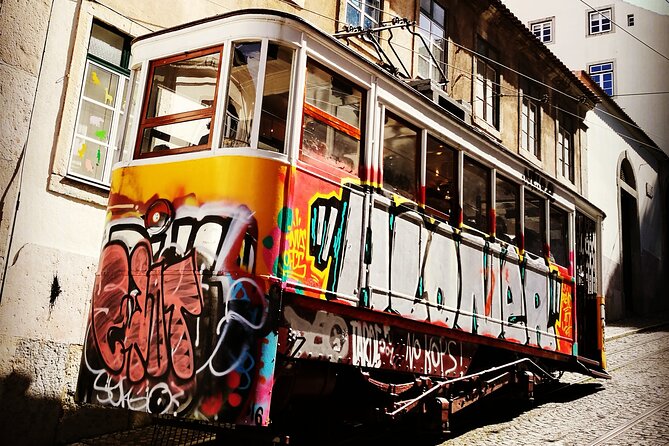
Alfama receives about 40 minutes, enough for a guided walk through its narrow streets, small shops, and taverns. This is one of the strongest parts of the tour because the neighborhood feels different from the broad, rebuilt streets below.
Many Alfama buildings survived the 1755 earthquake. As you walk between the castle and the river, you get a sense of the older street pattern, with steep lanes and tight turns that are hard to understand from a map.
The route includes Lisbon Cathedral, or Sé, with about 30 minutes. Built in the early second half of the 12th century after Lisbon was retaken from the Moors, it occupies a site associated with earlier religious buildings, including a mosque and an earlier Christian temple.
The cathedral has changed over the centuries, especially after the earthquake. Admission is not included, so check what you want to see before deciding if you will enter. The guide may not be able to provide a full explanation inside, another reason to listen carefully during the outdoor introduction.
Nearby, the Church of Saint Anthony marks the place where the saint was born. The present building was rebuilt after the earthquake, but the crypt preserves the association with his birthplace. You have 15 minutes here, including time to see the saint’s image and hear about the church’s connection to Lisbon.
Manueline details and Casa dos Bicos
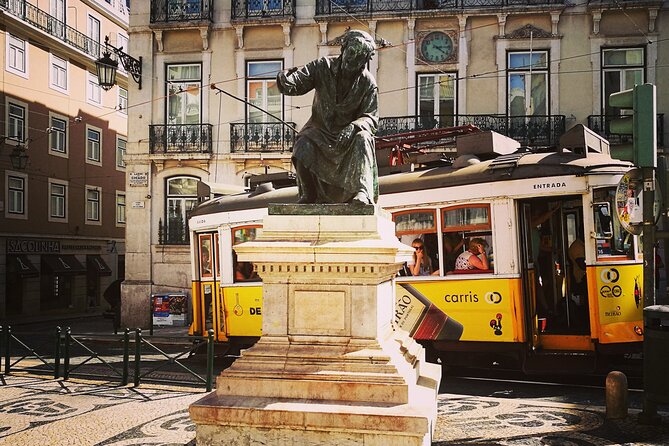
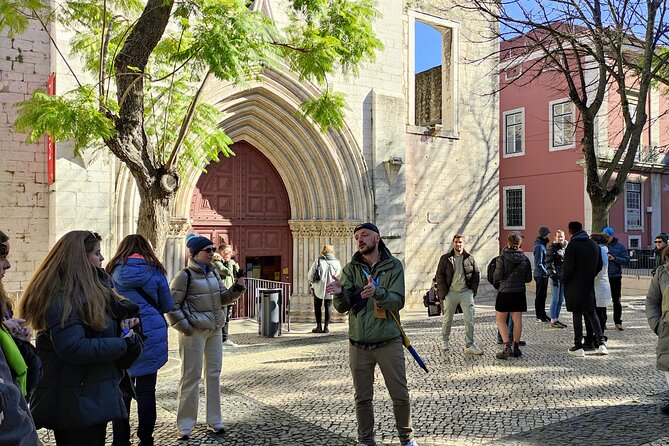
The Igreja de Nossa Senhora da Conceição Velha is a quick 10-minute stop, but its façade deserves attention. Angels, flowers, and religious symbols combine in the Manueline style, making this one of the notable structures to survive the earthquake.
Casa dos Bicos provides a different architectural surprise. Its façade is covered with diamond-shaped stones, inspired by the Diamond Palace in Bologna after its owner saw that building on a trip. The earthquake destroyed the upper floors, which were restored in 1983.
Today, Casa dos Bicos houses the José Saramago Foundation. Admission is not included, and the stop lasts only about 10 minutes, so you will mainly see the exterior and hear the building’s story.
These brief stops show why a guide helps on a fast Lisbon tour. Without context, a carved façade or unusual stone pattern can become just another photograph. With a few minutes of explanation, you can spot the Manueline style and understand how earthquake damage shaped the city.
Rua Augusta, Rossio, and the Carmo ruins
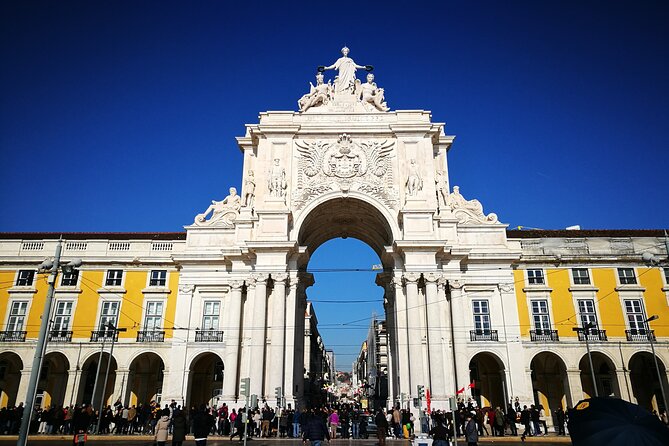
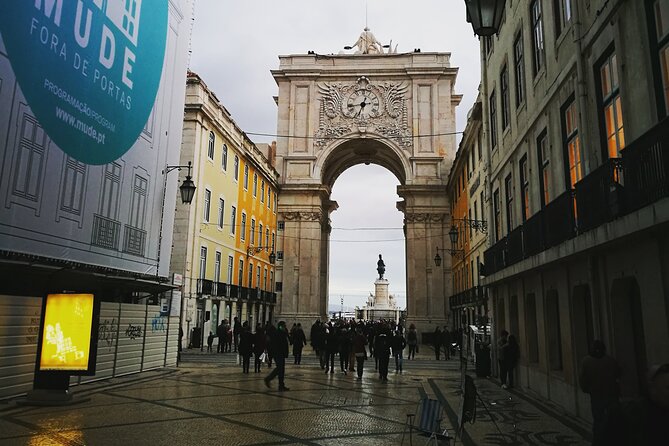
At Arco da Rua Augusta, you enter the Baixa Pombalina, the rebuilt central district. Admission to the arch is included, and about 20 minutes are allotted.
The arch was completed in 1873 and carries statues representing Glory crowning Genius and Valor. Below are figures linked to Portuguese history, including Viriato, Vasco da Gama, the Marquis of Pombal, and Nuno Álvares Pereira. The arch faces the Tagus, linking the rebuilt center to the sea voyages explained in Belém.
Rua Augusta then leads you through Lisbon’s main pedestrian shopping street. Its calçada pavement, shops, street artists, craftsmen, and vendors give you a more everyday view of the center. The street connects Praça do Comércio with Rossio and has been closed to traffic since the late 1980s.
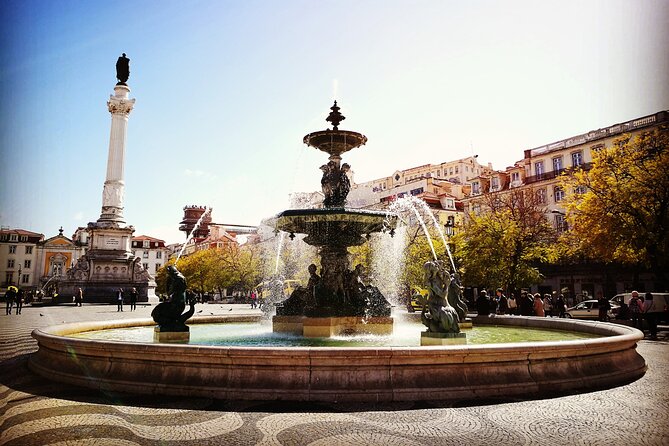
At Praça Dom Pedro IV, known as Rossio, you get 20 minutes to look at the square, the statue of Dom Pedro IV, and the National Theatre of D. Maria II. The square has served as a place for fairs, festivals, public burnings, and, during World War II, a major meeting point for refugees and spies waiting for visas.
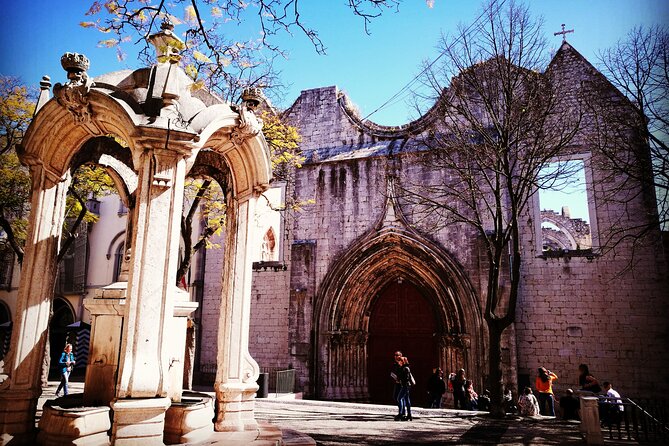
The route continues to Carmo Convent and Church, where about 20 minutes are planned. The open Gothic ruins are among Lisbon’s clearest reminders of the 1755 earthquake. The roof collapsed on November 1, 1755, while much of the convent survived.
Admission is not included, and the short stop may favor an exterior explanation over a museum visit. If you have a strong interest in medieval architecture or the earthquake, return later with more time.
São Roque and the final viewpoint
The Church of São Roque receives another 20 minutes. Its plain exterior gives little warning of the art inside, including ornate chapels built by major artists and craftsmen.
The church survived the earthquake with relatively little damage. Its story reaches back to 1506, when Manuel I requested a relic of Saint Roch from Venice during an outbreak of plague. The contrast between the simple façade and the lavish interior is the main reason to pay attention here.
The final stop is Miradouro de São Pedro de Alcântara, where the tour ends. The viewpoint looks across Lisbon and includes a tile panel identifying landmarks such as São Jorge Castle, Graça Church, and the Cathedral.
This is a practical ending. You finish with a city view and can continue into Bairro Alto or nearby Chiado on your own. You may also find yourself ready for a quieter evening after nine hours of walking.
Guides, group size, and the pace of the day
The tour uses a maximum group size of 20 adults. That is a reasonable middle ground: more personal than a large coach outing, but not as flexible as a private guide.
The guide makes a major difference on a route this packed. João is praised for clear history lessons about Belém and the Portuguese kings. Fernanda is described as both informative and entertaining, while Teresa is known for energy, humor, and an easy way with historical facts.
Other named guides include Carlos, Natalia, Diego, Roselyn, Elvira, Ricardo, Helena, Laura, and Andreas. The guide languages vary by tour or guide, so confirm your language when booking rather than assuming every departure is identical.
The route requires moderate physical fitness. You will deal with Lisbon’s hills, uneven pavement, and long periods on your feet. The tour does not include private transport, so anyone who needs frequent seated breaks should think carefully before booking.
Is $110.06 a fair price?
At $110.06 per person, this is not the cheapest way to see Lisbon. You could visit many of these outdoor sites independently for less, especially if you are happy to research the history yourself.
The value comes from the amount of ground covered and the included extras. You receive a guide for roughly nine hours, entry to Torre de Belém, Jerónimos Monastery, and the Rua Augusta Arch, plus an original pastel de Belém. You also avoid building a complicated plan that connects Belém with Alfama and the central districts.
The price makes the most sense for a first visit, a short stay, or anyone who wants historical context instead of a simple photo route. It is less compelling if you already know Lisbon, prefer slow museum visits, or want to choose every meal and stop yourself.
Free cancellation is available up to 24 hours before the 9:00 am start. The tour requires good weather and a minimum number of participants, with another date or a full refund offered if the operator cancels for those reasons.
Who should book this Lisbon walking tour?
I would choose this tour if you have one full day in Lisbon and want a strong orientation to the city. It suits people who enjoy history, viewpoints, old neighborhoods, and a guide who can connect separate buildings into one story.
It also fits solo visitors and couples who want company without joining a huge group. The maximum of 20 keeps the outing manageable, and the lunch break gives you a little freedom in an otherwise structured day.
I would hesitate if your priority is comfort. There is no private vehicle, lunch costs extra, and the itinerary includes many short stops. Families with young children, people with limited mobility, or anyone seeking a leisurely pace may prefer to split Belém and the historic center over two days.
Final verdict: a strong one-day introduction
Book it if you want Lisbon’s major sights explained in a single sweep, and if you are ready to walk. The best parts are the Belém sequence, the Jerónimos cloisters, Alfama’s old lanes, and the guide-led links between Portugal’s sea power, the 1755 earthquake, and the rebuilt city.
Skip it if you want long interior visits or complete independence. For everyone else, this is a well-filled first day, with enough local detail to help you choose where to return on your own.
FAQ
How long does the Lisbon tour last?
The experience lasts approximately nine hours. It begins at 9:00 am and ends near the São Pedro de Alcântara viewpoint.
Where does the tour begin and end?
The meeting point is Avenida Brasília, Av. Brasília, 1400-038 Lisbon, in the Belém area. The tour ends at R. de São Pedro de Alcântara 85, near the São Pedro de Alcântara viewpoint.
Is lunch included?
No. The tour provides a 90-minute lunch break, usually at Time Out Market Lisboa, but the cost of the meal is not included. You may eat at the market or choose another location.
What admissions are included?
Admission is included for Torre de Belém, Jerónimos Monastery, and Arco da Rua Augusta. Entry to the Discoveries Monument, Lisbon Cathedral, Casa dos Bicos, and Carmo Convent is not included.
How large is the group?
The tour has a maximum of 20 adults.
How physically demanding is the experience?
A moderate level of physical fitness is recommended. The day is spent walking through Lisbon’s streets and historic districts, including areas with hills and uneven pavement.
Can I cancel for a refund?
You can cancel up to 24 hours before the experience begins for a full refund. Cancellations or changes made less than 24 hours before the start time are not accepted for a refund.
Recently reviewed around Lisbon
- Lisbon: Catamaran Luxury Sunset and Wine Tour★ 5.0 · 119 reviews
- Lisbon’s authentic Food and Wine tour with a Winemaker★ 5.0 · 67 reviews
- Morning Sailing Tour in Tagus River from Lisbon★ 5.0 · 68 reviews
- Lisbon: Belem Walking Tour with Jeronimos Monastery Tks Included★ 5.0 · 115 reviews
- PRIVATE Unforgettable Full Day Tour to Sintra from Lisbon★ 5.0 · 236 reviews
- Sesimbra Wild Beach Tour from Lisbon★ 5.0 · 57 reviews
- Private Jeep Tour from Lisbon – Arrábida, Sesimbra & Beach Picnic★ 5.0 · 48 reviews
- Discover Lisbon’s Alfama: Secrets of the Old Town★ 5.0 · 104 reviews
Full-Day, compared.
São Miguel West: Full-Day Van Tour with Lunch
Read our review →
Sintra Full-Day Private Tour – A Journey through Wonderland
Read our review →
Eastern Madeira: Full-Day Tour with Rum Tasting
Read our review →
São Miguel West Full Day Tour with Setes Cidades Including Lunch
Read our review →
São Miguel East: Full-Day Van Tour with Lunch
Read our review →