Reviewed · LISBON TOURS
Alfama Tour in Lisbon Old Town
Alfama is best understood on foot, and this tip-based walking tour takes you through its steep lanes, old walls, churches, fountains, murals, and postcard viewpoints. Guides such as Hugo, Cecilia, Claudia, Belen, and Nina bring different personalities to the route, but the common thread is lively storytelling about Moorish Lisbon, fado, religion, migration, and daily life.
I like the way the walk combines famous stops such as Portas do Sol and Santa Luzia with quieter squares where the guide can explain old customs. I also like the practical local advice at the end, including suggestions for food, music, and the rest of your Lisbon visit. The main drawback is the terrain: steep hills and many stairs can make the 2.5-hour route tiring.
In This Review
- Key points to know before you book
- Why Alfama makes such a good walking tour
- Starting at Casa dos Bicos and the first fountains
- Largo de São Rafael and Salvador’s local stories
- São Miguel, the mural, and Alfama’s changing identity
- Climbing toward Santo Estêvão
- Portas do Sol and Santa Luzia viewpoints
- Sé Cathedral and the Church of St. Anthony
- Fado, saudade, and the human side of the route
- Price, tipping, and what you actually receive
- Timing, meeting details, and practical preparation
- Who should book the Alfama walk
- Should you book it?
- FAQ
- How long does the Alfama tour last?
- Where does the tour begin?
- Where does the tour end?
- What time does the tour start?
- Is the tour conducted in English?
- Are cathedral admission, food, and drinks included?
- How difficult is the walking?
Key points to know before you book
- Start at Casa dos Bicos: Meet near the blue umbrellas at R. dos Bacalhoeiros 12A.
- Hear Alfama’s layered story: The route covers Moorish influences, Roman traces, the old Jewish quarter, dictatorship, empire, migration, and fado.
- Enjoy several major viewpoints: Portas do Sol, Santa Luzia, and Santo Estêvão offer very different views over Alfama and the Tagus area.
- Expect a tip-based price: The listed booking price is about $3.62 per person, but a tip at the end is expected and should reflect the experience.
- Plan for hills and stairs: You need a moderate level of fitness and good walking shoes.
- Finish near Lisbon’s oldest cathedral: The tour ends around Sé de Lisboa and the Church of St. Anthony, in a different place from the start.
Why Alfama makes such a good walking tour
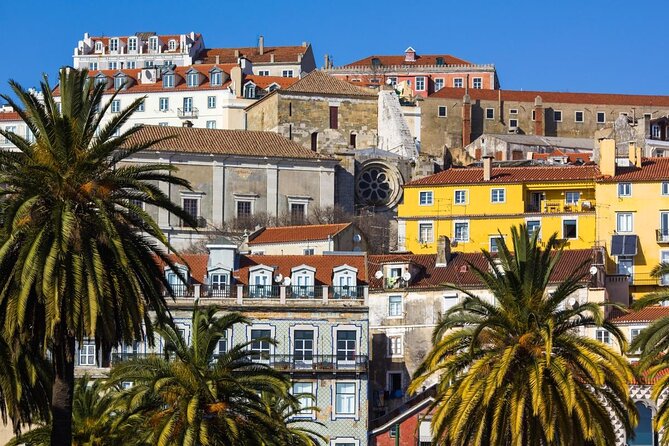
Alfama is not a district you understand by checking off monuments. Its appeal is in the way narrow lanes bend around old walls, small squares open suddenly, and everyday life still occupies spaces shaped centuries ago.
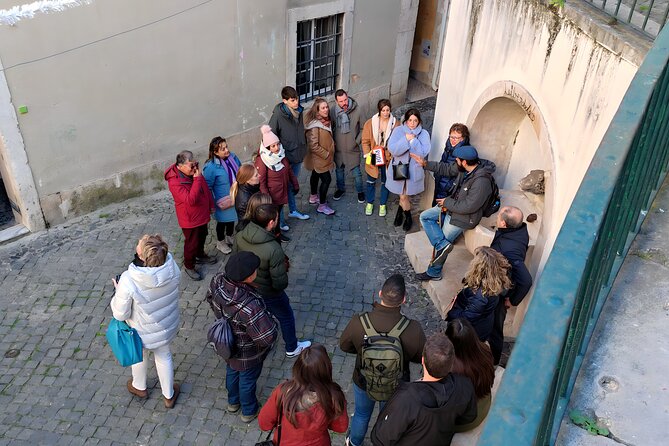
A guide gives those details a place in the story. At one fountain, you learn about public water and the people who once depended on it. At another square, you hear how local celebrations, music, religion, and neighborhood customs still shape Alfama.
The route also helps explain why the district feels different from much of central Lisbon. Alfama survived the 1755 earthquake better than many other parts of the city, and its irregular streets reflect older layers of settlement. A walk through the lanes can bring up Roman, Moorish, Jewish, imperial, and modern Portuguese history without turning the afternoon into a dry lecture.
That balance is one of the strongest reasons to book this experience early in your Lisbon stay. You get a basic map of the city’s past, then plenty of suggestions for what to do afterward. Guides have also been praised for answering questions, slowing down for the group, and adding humor, singing, or a small ginjinha tasting when suitable.
Other Lisbon days travellers weigh against this one:
- Lisbon City Center Tour – The Unmissable Lisbon
★ 5.0 · 22,234 reviews - Lisbon: Sintra, Pena, Regaleira, Cabo da Roca & Cascais
★ 4.7 · 19,656 reviews - Sintra: Pena Palace and Park Entrance Ticket
★ 4.2 · 17,410 reviews
Starting at Casa dos Bicos and the first fountains
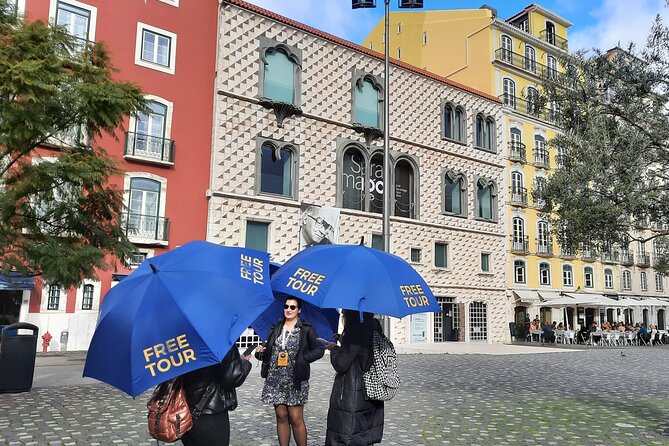
The meeting point is at R. dos Bacalhoeiros 12A, near Casa dos Bicos. Look for the blue umbrellas, which serve as the visual marker for the beginning of the walk.
Casa dos Bicos has an unusual diamond-pointed facade and makes a fitting starting place. You do not go inside as part of this walk, and museum admission is not included. The value here is orientation: you begin near the lower edge of Alfama before gradually moving uphill into the older maze.
The first stop is Chafariz D’El Rei, described as possibly Lisbon’s first public fountain. Its location matters. Alfama rises sharply, so access to water was once a major part of neighborhood life. A short explanation here turns a simple stone fountain into a window on how the district worked before modern plumbing.
Next comes Largo do Chafariz de Dentro, Alfama’s central plaza. It was once known as Chafariz dos Cavalos, or Horse Fountain. The name also points to the old Fernandina wall, whose boundaries help explain why this square feels like a doorway into the district.
You should expect short stops of roughly 10 to 15 minutes, with time for photographs and questions. This is not a museum tour with long indoor visits. It is a moving lesson, given outdoors and tied to the streets around you.
Largo de São Rafael and Salvador’s local stories
The walk continues through Largo de São Rafael, beside an ancient section of wall. The appeal is less about a single grand monument and more about the sense of older Alfama still present in the built setting.
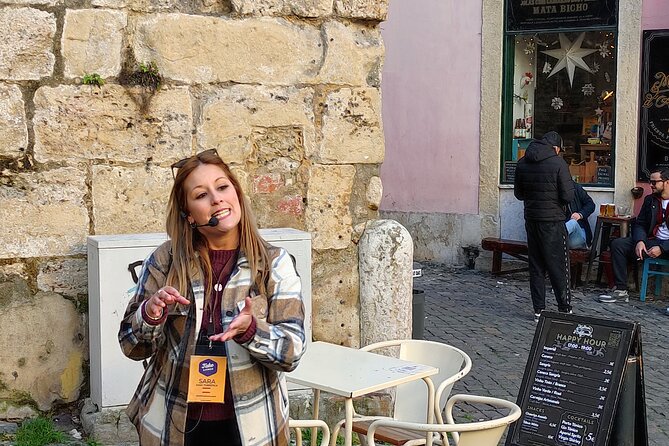
At Largo do Salvador, the guide uses the square for stories about culture and long-standing habits. This is where a good guide can make the difference. Guides including Laura, Jessica, Joao, Fernanda, and Mariam have been praised for explaining architecture, local life, and history with energy and humor.
The group size can reach 25 people, though some departures are much smaller. A smaller group makes it easier to hear in tight lanes and ask questions. With a larger group, stay near the guide, especially when the route turns through narrow streets.
One of the pleasures of this part of the walk is its ordinary scale. You are not only looking at monuments. You are seeing doorways, walls, squares, and corners that help make Alfama a living neighborhood rather than an open-air museum.
São Miguel, the mural, and Alfama’s changing identity
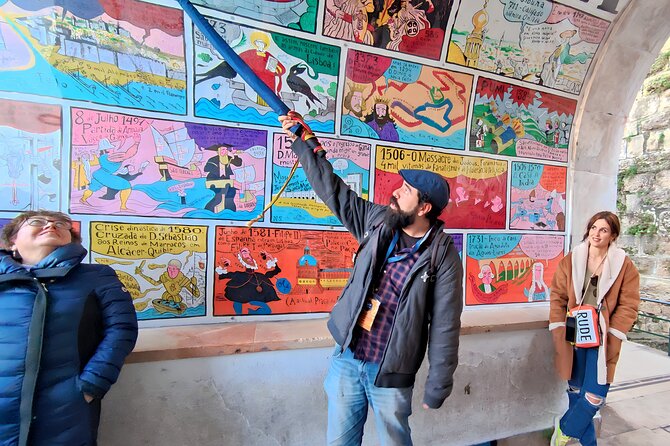
Igreja de São Miguel and its square are among the route’s more memorable cultural stops. The church is linked with Lisbon’s Popular Saints festivities, especially the neighborhood celebrations that fill streets and squares with music, food, and decorations.
The stop offers a useful reminder that Alfama’s identity is not only medieval. Religious life, public festivals, family customs, and neighborhood gatherings remain part of how the district is understood today.
The History of Lisbon mural by Nuno Saraiva adds a more modern visual break. It is one of Lisbon’s noted murals and gives the guide a chance to connect the city’s past with a contemporary public artwork.
This is also where the tour’s wider historical range becomes especially useful. The route can include discussion of Roman remains, Moorish alleys, the former Jewish quarter, colonization, empire, dictatorship, and migration. The best explanations do not treat these as isolated facts. They show how different periods left marks on the same streets.
One particularly striking detail is the story of a fountain whose tiles were defaced, connected with the way enslaved and free residents once used the site. Details like this make the past more human and less polished. You may leave with a more honest sense of Lisbon’s story, including the difficult parts.
A different kind of day out, same corner of Portugal:
- Lisbon: Jerónimos Monastery Entrance Ticket
★ 4.1 · 14,164 reviews - Lisbon: History, Stories and Lifestyle Walking Tour
★ 4.8 · 10,902 reviews - Lisbon: Sunset Boat Party Cruise with DJ and Open Bar
★ 4.5 · 10,378 reviews - Lisbon: Pena Palace, Sintra, Cabo da Roca, & Cascais Daytrip
★ 4.7 · 9,981 reviews
Climbing toward Santo Estêvão
Depending on the pace of the group, the route enters the more tangled section of Alfama and reaches the Miradouro de Santo Estêvão. The climb is part of the experience, but it is also the point where you will feel the physical demands most clearly.
Several people who have taken this walk describe the hills and stairs as challenging, while others note that guides adjusted the pace so older participants could keep up. That is useful information if you are unsure about your fitness. You do not need to move quickly, but you do need to be comfortable walking uphill for a sustained period.
Wear shoes with a firm sole. Lisbon’s stone paving can be uneven, and the route includes slopes, steps, and tight passages. Bring water, since food and drinks are not included.
Santo Estêvão is worth the climb for the change in atmosphere. The viewpoint is quieter than the most famous terraces and gives you a chance to pause while the guide fills in more of Alfama’s story. The stop is also a good example of the tour’s rhythm: walk, listen, pause, take photographs, then continue.
Portas do Sol and Santa Luzia viewpoints
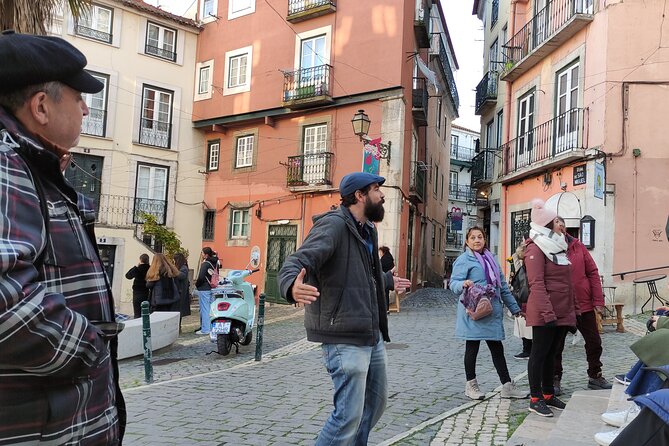
Miradouro das Portas do Sol is one of Lisbon’s great viewing terraces. From here, Alfama spreads below and the city opens toward the water. It is a classic postcard scene, so expect a popular photo stop rather than a secret corner.
The guide adds value by helping you read the view. Instead of simply taking a picture, you can connect the slopes, rooftops, churches, and old lanes with the places you have just walked through.
A short distance away, Miradouro de Santa Luzia offers another famous terrace. Its atmosphere is more romantic, with decorative details and a view that invites you to linger. The two viewpoints are close, but they do not feel identical. Portas do Sol gives a broader balcony-like outlook, while Santa Luzia feels more intimate.
These stops are among the strongest photographic moments of the afternoon. They are also practical orientation points. After seeing Alfama from above, you understand why the district’s streets are so steep and why its lanes developed in such an irregular pattern.
Sé Cathedral and the Church of St. Anthony
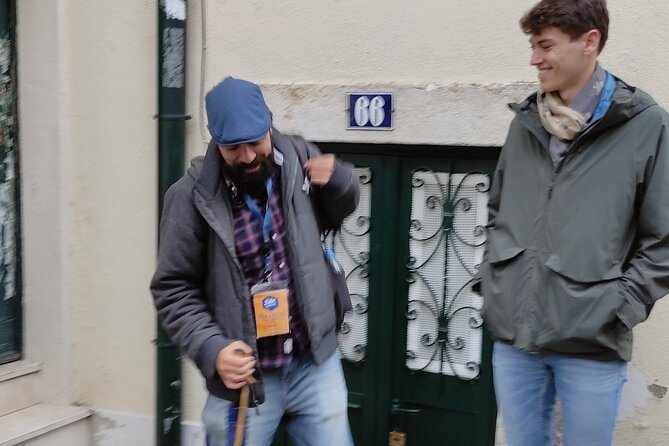
The route then descends toward Lisbon Cathedral, or Sé de Lisboa. Built in the 12th century, it is the oldest and most important church in the city.
The tour does not include entry. Admission is listed at €5, so you can decide afterward if you want to go inside. That keeps the walking tour affordable, but you should budget separately if the cathedral interior is a priority.
Even from outside, the cathedral is an important closing point because it ties together several themes from the walk: conquest, religion, defense, rebuilding, and the growth of Lisbon. Your guide can explain the building in context before sending you on to the final stop.
The walk ends at the Church of St. Anthony, dedicated to Lisbon’s much-loved saint. It is a fitting place to finish because Santo António is closely tied to the city’s identity and popular traditions.
The endpoint is different from the starting point, which is useful for planning your next move. You are not returned to Casa dos Bicos, so do not leave anything there or arrange transportation from the original meeting spot.
Fado, saudade, and the human side of the route
The tour’s strongest guides do more than list dates. They explain how fado developed as an emotional tradition shaped by longing, resilience, and movement between places.
The Portuguese idea of saudade often gets reduced to a simple translation such as sadness or longing. A good explanation shows why the word matters in Lisbon and how it connects to music, migration, family separation, and memory.
Some guides are also singers, and Cecilia has been praised for adding song to the experience. That kind of personal touch can make the discussion of fado feel less like a cultural footnote and more like something connected to real life.
You may also have the chance to taste ginjinha, the cherry liqueur associated with Lisbon, sometimes served in a small chocolate cup. This is not listed as a formal included food or drink, so treat it as an occasional extra and carry a little cash if you want to participate.
The tour does not include meals or beverages. That is no problem if you plan ahead, but the 2.5-hour length means you may want water before starting and a meal afterward.
Price, tipping, and what you actually receive
The advertised booking price is about $3.62 per person, which makes the initial cost unusually low for a guided two-and-a-half-hour walk. But this is a fully tip-based experience, and a tip at the end is welcomed and expected.
Think of the listed amount as a reservation charge, not the complete cost of the guide’s work. If your guide gives you a strong afternoon of history, local context, practical advice, and patient pacing, plan to tip accordingly.
That model can offer good value because there is no large fixed tour fee. It also places more responsibility on you to judge the experience fairly. A guide who handles a steep route, answers questions, keeps a group together, and makes Alfama understandable has provided more than a short stroll.
The tour has a 4.9 rating from 4,936 reviews and is recommended by 99 percent of customers. Those figures point to a consistently strong experience, though they do not remove the need to check the meeting details and prepare for the hills.
Timing, meeting details, and practical preparation
The listed start time is 3:30 pm, although the experience is described as having morning or afternoon options. Check the time shown for your selected booking because schedules can vary.
Finding the meeting point may require care. The location is near Casa dos Bicos, and a small group or nearby churches can make the exact guide harder to spot. Use the blue umbrellas as your main landmark and arrive early enough to identify the meeting area.
The tour is offered in English and uses a mobile ticket. It is near public transportation, and service animals are allowed. A moderate fitness level is advised, not because the route is a race, but because of the prolonged walking, slopes, stairs, and uneven paving.
Rain does not necessarily end the walk. One guide completed the full route during heavy rain, but weather can make stone streets slippery and viewpoints less pleasant. Bring suitable clothing and do not count on every stop offering shelter.
Free cancellation is available up to 24 hours before the start time for a full refund. Cancellations or changes within 24 hours are not refunded, and the tour requires a minimum number of participants. If that minimum is not met, you are offered another date or experience, or a full refund.
Who should book the Alfama walk
I would choose this tour if you want your first look at Alfama to include context, not just photographs. It suits anyone interested in architecture, local customs, Lisbon’s complicated past, fado, and the way a neighborhood changes over time.
It is also a good choice for visitors who want restaurant, music, and sightseeing suggestions from an English-speaking local guide. Guides such as Claudia and Belen have been praised for adjusting the pace, while Hugo, Cecilia, Nina, and others bring strong personality and clear storytelling.
You may want a different plan if you have trouble with hills and stairs, need frequent indoor breaks, or prefer a fixed-price tour with no expected tip. The route also does not include cathedral entry, food, or drinks.
Should you book it?
Yes, if you can manage the terrain and are willing to treat the low booking price as the start of the cost rather than the end. The combination of viewpoints, old fountains, churches, public art, fado, and neighborhood stories gives you a useful introduction to Lisbon’s oldest quarter.
Book it near the beginning of your stay so the guide’s suggestions can shape the rest of your visit. Wear serious walking shoes, bring water, arrive early near the blue umbrellas, and leave room in your budget for a fair tip. If the hills are a concern, ask for a slower pace at the start and stay close enough to hear the guide in the narrow streets.
FAQ
How long does the Alfama tour last?
The walk lasts approximately 2 hours and 30 minutes.
Where does the tour begin?
It begins at R. dos Bacalhoeiros 12A, 1100-070 Lisboa, near Casa dos Bicos. Look for the blue umbrellas.
Where does the tour end?
The tour ends in a different location from the starting point, near the final stops around Lisbon Cathedral and the Church of St. Anthony.
What time does the tour start?
The listed start time is 3:30 pm. The experience is also described as offering morning or afternoon options, so check the selected booking time.
Is the tour conducted in English?
Yes. English is the offered language.
Are cathedral admission, food, and drinks included?
No. Cathedral entry is not included and is listed at €5. Food and beverages are also not included.
How difficult is the walking?
You should have a moderate level of physical fitness. The route includes steep grades, stairs, and substantial walking through Alfama. Good walking shoes are advised.
Recently reviewed around Lisbon
- Portinho da Arrábida: Coasteering Boat Tour★ 4.9 · 78 reviews
- Setúbal: Dolphin-Watching Boat Tour★ 4.8 · 213 reviews
- From Lisbon: Private Óbidos and Nazaré Tour★ 5.0 · 152 reviews
- No Diet Club – Unique food tour in Lisbon with many Tastings★ 4.8 · 44 reviews
- Queluz National Palace & Gardens Ticket★ 4.6 · 447 reviews
- Melides: Horse Riding on the Beach with Wine Tasting★ 4.3 · 117 reviews
- Melides: Horseback Riding on Melides Beach★ 4.7 · 111 reviews
- Lisbon: Street Art Tuk Tuk Tour★ 4.9 · 372 reviews
Lisbon Tours, compared.
Lisbon City Center Tour – The Unmissable Lisbon
Read our review →
Sintra, Pena, Regaleira, Cabo da Roca & Cascais
Read our review →

Sunset Boat Party Cruise with DJ and Open Bar
Read our review →
Pena Palace, Sintra, Cabo da Roca, & Cascais Daytrip
Read our review →