Reviewed · LISBON TOURS
Alfama and Mouraria Tour – The oldest neighbourhoods in Lisbon
Lisbon’s oldest quarters are best understood on foot, and this 2.5-hour walk takes you from the grand riverfront at Praça do Comércio into the steep lanes of Alfama and Mouraria. You’ll see tiled façades, old churches, viewpoints over the rooftops, and streets tied to fado and Lisbon’s Moorish past. I like the route’s strong sense of place, and I like that guides such as Walter, Tiago, José, Kate, and Hugo are praised for making the history lively rather than dry.
The main consideration is the walking. You’ll climb hills and stairs, with few places to sit while the guide talks. The meeting point also deserves care: start at the Statue of Dom José I, not at the tour’s ending point in Rossio. The very low listed price makes this remarkable value, but you still need to budget for any paid admission if you decide to enter the cathedral or castle.
In This Review
- Key points at a glance
- Starting at Praça do Comércio
- St. Anthony and the Casa dos Bicos
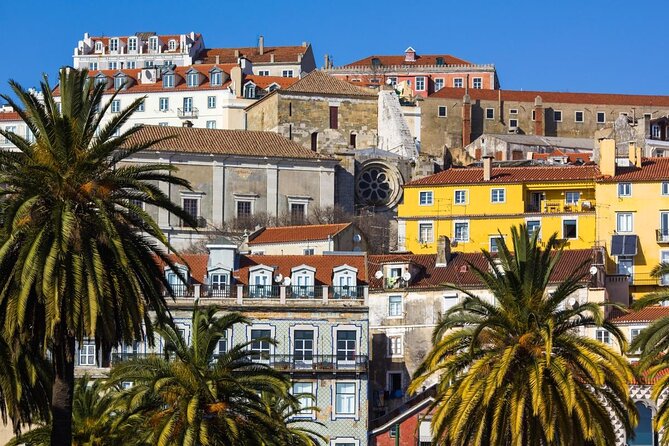
- Walking into Alfama’s steep lanes
- Lisbon Cathedral and the old city’s religious center
- The National Pantheon and two fine viewpoints
- Santa Luzia and the character of Alfama
- Mouraria, fado, and the route toward Rossio
- How much value do you get for $1.25?
- What the strongest guide experiences have in common
- Who should book this Lisbon walk?
- Should you book it?
- FAQ
- Where does the tour start?
- Where does the tour end?
- How long does the tour last?
- What language is offered?
- How much does the tour cost?
- Does the tour include entry to Lisbon Cathedral?
- Does the tour include entry to São Jorge Castle?
- How large is the group?
- Is the route suitable for most people?
- Can I cancel for a refund?
Key points at a glance
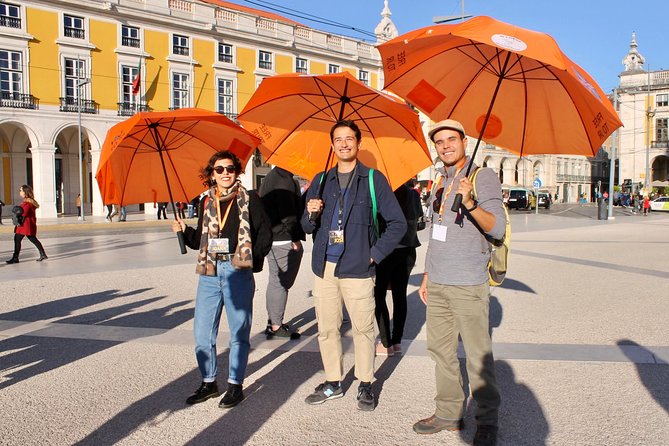
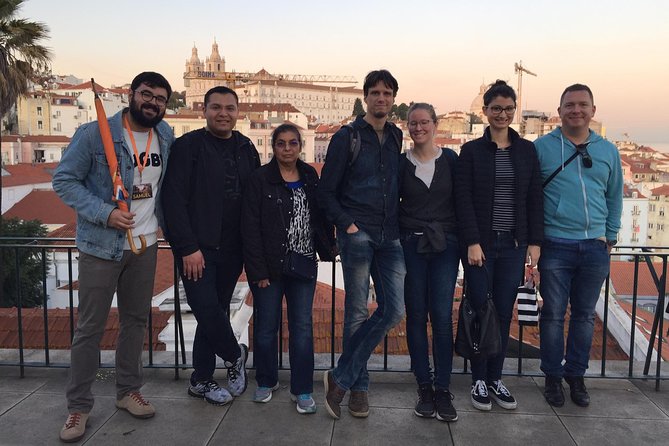
- Begin beneath the Arch of Rua Augusta: Meet by the Statue of Dom José I in Praça do Comércio, looking for the orange umbrella.
- Climb through Alfama in stages: The route includes hills and stairs, but guides generally pause often and set a manageable pace.
- See Lisbon’s best old-city views: Portas do Sol and Santa Luzia provide two memorable overlooks across Alfama.
- Connect the city to fado: Mouraria offers a closer look at the neighborhood associated with Lisbon’s fado culture.
- Expect history with local advice: Guides have suggested restaurants, viewpoints, and useful ideas for exploring Lisbon after the walk.
- Know what is and is not included: The listed stops are free to visit from the outside, but entry to places such as Lisbon Cathedral and São Jorge Castle may cost extra.
Starting at Praça do Comércio
The tour opens at the Statue of Dom José I, in the middle of Praça do Comércio. This is one of the easiest places in Lisbon to recognize: a huge yellow arc frames the inland side of the square, while the statue sits prominently in the center.
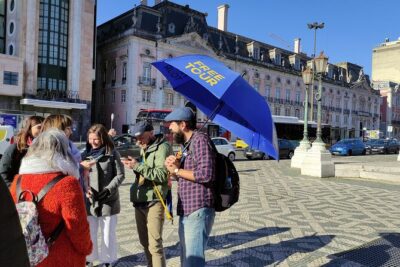
Look for the guide with an orange umbrella between the arch and the statue. That detail matters. One person arrived at the finishing point instead of the starting point, and another had difficulty keeping up after losing sight of the group. I suggest arriving early, confirming the orange umbrella, and staying close once the walk begins.
Praça do Comércio is more than a convenient meeting place. It is Lisbon’s grand ceremonial square, opening toward the Tagus River. The guide uses it to set the scene for the city, its rulers, and the great rebuilding that followed the 1755 earthquake.
The group can contain up to 20 people. That is large enough to give the walk some energy, yet small enough for a guide to speak to the group without a microphone. The quality depends partly on the guide assigned that day, but the strongest reports repeatedly single out Walter, Tiago, José, Kate, Ann-Elisa, Rita, Hugo, and others for clear explanations, humor, and practical help.
Other Lisbon days travellers weigh against this one:
- Lisbon City Center Tour – The Unmissable Lisbon
★ 5.0 · 22,234 reviews - Lisbon: Sintra, Pena, Regaleira, Cabo da Roca & Cascais
★ 4.7 · 19,656 reviews - Sintra: Pena Palace and Park Entrance Ticket
★ 4.2 · 17,410 reviews
St. Anthony and the Casa dos Bicos
From the square, the route heads toward the Church of St. Anthony. The church occupies the place traditionally associated with the birth of St. Anthony of Padua, one of Lisbon’s best-known saints.
This is a short stop, around ten minutes, so expect an explanation and an opportunity to look around rather than a long guided visit. The stop works well early in the tour because it introduces the close link between religion, neighborhood life, and Lisbon’s identity.
Next comes Casa dos Bicos, one of Lisbon’s oldest houses. Its pointed diamond-shaped stone façade makes it easy to recognize, and its Manueline design gives you a quick introduction to the decorative style associated with Portugal’s maritime age.
I like this pairing because it moves beyond the city’s big postcard sights. You see a place of worship and an unusual private building, then hear how they fit into the older quarters around them. The guide’s job here is not simply to name the buildings, but to help you notice details you might otherwise walk past.
Walking into Alfama’s steep lanes
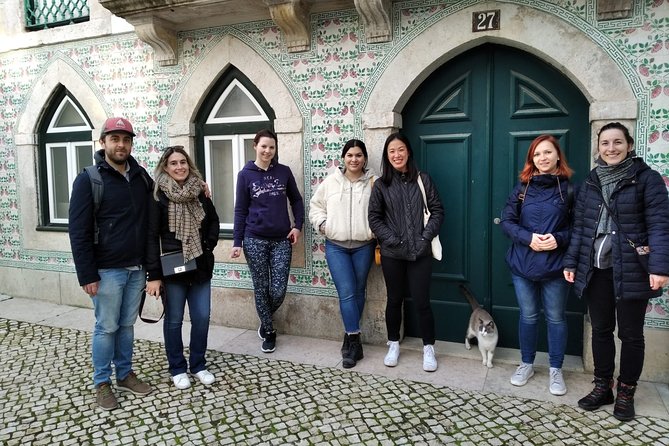
The Alfama portion lasts about 20 minutes, though the full route continues through the district for much longer. This is where the tour becomes less about individual monuments and more about how Lisbon feels at street level.
Alfama is a maze of narrow lanes, stairways, small squares, and sudden openings between buildings. The footing can change quickly, and the hills are real. Several guides have been praised for breaking the climb into sections, stopping for photos, and adjusting the pace to the group.
You should wear comfortable shoes and bring water, especially in warm weather. On a hot day, Tiago was praised for finding shade and allowing time for breaks and photographs. That kind of practical pacing can make the difference between enjoying the neighborhood and simply trying to keep up.
There are not always seats at the stopping points. One person noted that much of the explanation takes place while standing. If you need frequent seating, this may not be the right format. For most reasonably active walkers, the frequent pauses make the climb manageable, but this is not a flat stroll along the waterfront.
Lisbon Cathedral and the old city’s religious center
The route pauses at Lisbon Cathedral, described as the oldest church in Lisbon. Its heavy stone appearance contrasts with Alfama’s more delicate residential streets, and its position helps show how the lower and upper parts of the old city connect.
The stop is listed as about ten minutes. Pay attention to the distinction between stopping at the cathedral and entering it. The tour price does not cover every admission charge, and one unhappy participant assumed that the word free meant entry inside the cathedral and São Jorge Castle was included.
The safest approach is to treat the walk as an outdoor sightseeing tour. If you want to go inside a paid site, ask the guide about timing and the current admission cost. You may need to return later on your own, since the group’s schedule is built around moving through several neighborhoods.
A different kind of day out, same corner of Portugal:
- Lisbon: Jerónimos Monastery Entrance Ticket
★ 4.1 · 14,164 reviews - Lisbon: History, Stories and Lifestyle Walking Tour
★ 4.8 · 10,902 reviews - Lisbon: Sunset Boat Party Cruise with DJ and Open Bar
★ 4.5 · 10,378 reviews - Lisbon: Pena Palace, Sintra, Cabo da Roca, & Cascais Daytrip
★ 4.7 · 9,981 reviews
The National Pantheon and two fine viewpoints
The National Pantheon is listed as a one-minute stop, so do not expect a detailed interior visit. It is mainly a quick point of orientation as the route continues uphill through Alfama.
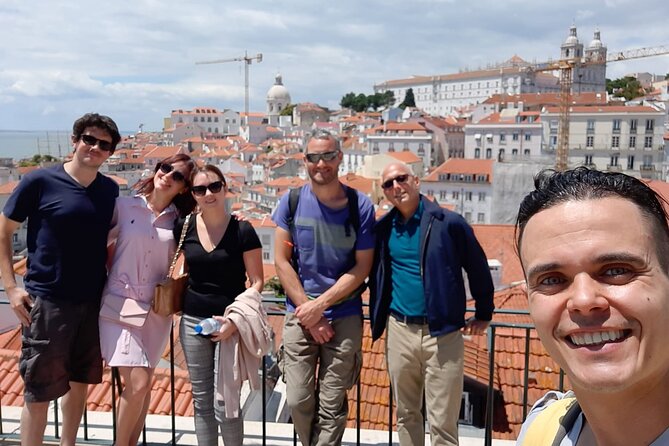
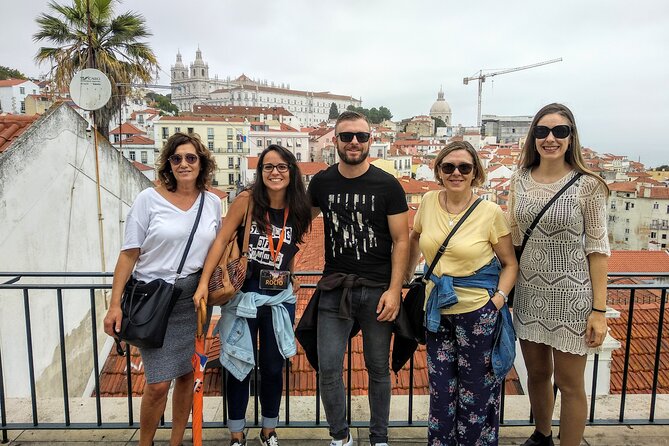
The reward comes at Miradouro das Portas do Sol. This viewpoint is one of the tour’s strongest moments, with broad views across Alfama and toward the Tagus. It is a useful place to pause, take photographs, and understand the district’s steep shape from above.
The guide may point out features across the rooftops, but the amount of detail can vary. One poor account described a quiet viewpoint stop with little explanation. That appears to be an exception among the supplied feedback, yet it is a fair reminder that a viewpoint is more useful when the guide actively identifies what you are seeing.
The stop at São Jorge Castle follows. The castle was built by the Moors in the eighth century, and its position explains why this hill has mattered for centuries. The scheduled stop is only about five minutes, which suggests a brief exterior explanation rather than a full castle visit.
Entry is not included. If the castle is high on your list, plan a separate visit and allow much more time. The walking tour gives you the setting and the story, but it is not a substitute for exploring the castle grounds.
Santa Luzia and the character of Alfama
Miradouro de Santa Luzia is another ten-minute stop. It is often considered one of Lisbon’s most charming viewpoints, and the setting gives you a different angle from Portas do Sol.
The value of seeing both viewpoints is that they are close but not identical in feel. You get repeated chances to understand the city’s rooftops, church towers, river, and hillside streets without spending the entire tour inside museums or monuments.
This is also a good part of the walk for photos. Still, keep your attention on the guide. The route has a lot of visual appeal, but the best value comes from combining the views with an explanation of how Alfama developed and how ordinary life continues in the old quarter.
The walk is not polished into a rigid show. That can be a strength when the guide is lively and responsive. Tiago, Walter, José, Kate, and Ann-Elisa have all been praised for answering questions and offering personal suggestions. It can be less satisfying if you expect every stop to receive the same amount of commentary.
Mouraria, fado, and the route toward Rossio
The tour then moves toward Mouraria, with about 20 minutes set aside for its streets and the Monumento Mouraria Berço do Fado. Mouraria is strongly linked with fado, Lisbon’s distinctive song tradition, and this section gives the tour a cultural focus beyond architecture.
The neighborhood feels different from the grand squares and formal monuments at the beginning. Here, the interest comes from the streets themselves, the layers of local life, and the connection between place and music. The tour does not appear to include a fado performance, so think of this as an introduction to the neighborhood and its cultural meaning.
The route also lists Igreja de São Vicente de Fora, a church honoring St. Vincent. It receives only about one minute in the schedule, so this is likely a passing reference or quick exterior stop rather than a full visit.
The walk ends around Rossio Square. That makes the tour useful on your first day in Lisbon: you finish near a central square and can continue exploring, eat nearby, or use public transport. It also means you should not wait at Rossio for the start. Praça do Comércio is the departure point.
How much value do you get for $1.25?
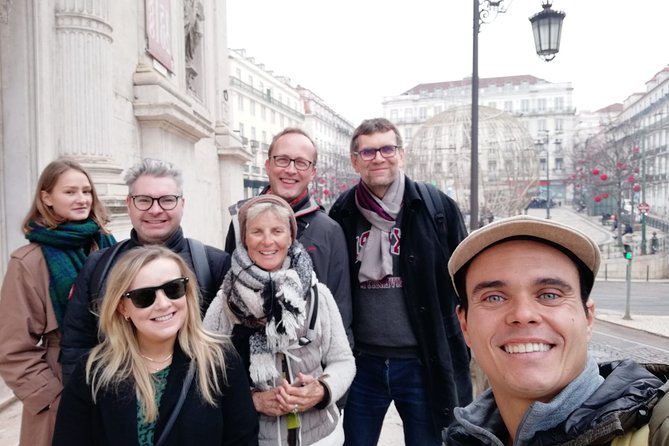
At the listed price of $1.25 per person, the value is exceptional if the price shown at booking is accurate. You receive roughly two and a half hours of guided orientation through some of Lisbon’s most interesting older districts, with no separate charge listed for the walking tour itself.
The price should not lead you to expect a private guide, long interior visits, or a highly customized itinerary. The group may include up to 20 people, and the route covers many stops in a limited time. The best value is the guide’s local explanation, the route planning, and the chance to connect sites that can seem scattered when you explore alone.
The price also makes this a sensible first activity for a solo visitor or anyone arriving without a plan. Rita was praised for being especially welcoming to solo visitors, while several guides offered restaurant and viewpoint suggestions. Those small tips can save time later.
The walk is offered in English and uses a mobile ticket. Confirmation arrives when you book. Service animals are allowed, and the meeting point is near public transportation.
What the strongest guide experiences have in common
The most consistent praise goes to the guides’ ability to explain Lisbon in an engaging way. Walter is described as animated, humorous, and passionate about architecture and history. Tiago is praised for his friendly manner, patience, shade breaks, and staged approach to the climb.
José receives credit for pacing the walk well and offering useful perspectives on both the past and present city. Kate is praised for cultural explanations, restaurant suggestions, and help with finding good views in Alfama. Hugo is described as funny and professional.
These details matter because a walking tour is only as good as the person leading it. The company uses several guides, so you cannot assume you will receive one particular person unless your booking specifically confirms that. The overall rating is 4.9 from 466 reviews, with 97 percent recommending the experience, but the few poor accounts show why expectations should stay realistic.
One person lost the group after falling half a block behind. Another found a tour late, quiet, and too fast, and left after about 70 minutes. I would treat those accounts as practical warnings: arrive at the right point, introduce yourself if possible, keep the guide in sight, and speak up quickly if the pace is a problem.
Who should book this Lisbon walk?
I would choose this tour if you want a broad introduction to Alfama and Mouraria before exploring them on your own. It suits first-time visitors, solo visitors, history fans, and anyone who prefers streets and viewpoints to a bus or a list of isolated attractions.
You should be comfortable walking uphill and on stairs for much of the route. The guides generally pause often, but there are few opportunities to sit. On a hot day, water, sun protection, and a slower personal pace will help.
This is less suitable if you want extended time inside Lisbon Cathedral, São Jorge Castle, the National Pantheon, or São Vicente de Fora. The route visits or points out these places, but several stops are very brief. Plan separate admissions if those interiors matter to you.
Free cancellation is available up to 24 hours before the start time. Changes made inside that window are not accepted, and poor weather or failure to reach the minimum group size can lead to a new date or refund.
Should you book it?
Book this walk if you want good-value orientation, lively local explanation, and a workout through Lisbon’s oldest neighborhoods. The views at Portas do Sol and Santa Luzia, the fado connection in Mouraria, and the steady climb through Alfama give you a useful feel for the city that a simple monument checklist cannot provide.
Before booking, accept three limits: the route is hilly, some stops are brief, and paid entry is not included simply because the itinerary labels the stops free. Arrive at Praça do Comércio, find the orange umbrella, stay with the group, and ask questions. If you do that, this is an inexpensive and practical way to get your bearings in Lisbon.
FAQ
Where does the tour start?
The tour starts at Praça do Comércio, by the Statue of Dom José I in Lisbon. Look for the guide with an orange umbrella between the large arch and the statue.
Where does the tour end?
The walk ends around Rossio Square, also called Praça do Rossio.
How long does the tour last?
The tour lasts approximately two hours and 30 minutes.
What language is offered?
The tour is offered in English.
How much does the tour cost?
The listed price is $1.25 per person.
Does the tour include entry to Lisbon Cathedral?
The tour stops at Lisbon Cathedral, but the listed price does not guarantee free admission inside. Entry may require a separate payment.
Does the tour include entry to São Jorge Castle?
The route includes a brief stop at São Jorge Castle, but admission to the castle may cost extra.
How large is the group?
The maximum group size is 20 people.
Is the route suitable for most people?
Most people can participate, but the route includes uphill walking, stairs, and extended periods of standing. Comfortable walking ability is important.
Can I cancel for a refund?
You can cancel at least 24 hours before the start time for a full refund. Cancellations or changes made less than 24 hours before the start are not accepted for a refund.
Recently reviewed around Lisbon
- Lisbon: Catamaran Luxury Sunset and Wine Tour★ 5.0 · 119 reviews
- Lisbon’s authentic Food and Wine tour with a Winemaker★ 5.0 · 67 reviews
- Morning Sailing Tour in Tagus River from Lisbon★ 5.0 · 68 reviews
- Lisbon: Belem Walking Tour with Jeronimos Monastery Tks Included★ 5.0 · 115 reviews
- PRIVATE Unforgettable Full Day Tour to Sintra from Lisbon★ 5.0 · 236 reviews
- Discover Lisbon’s Alfama: Secrets of the Old Town★ 5.0 · 104 reviews
- Sesimbra Wild Beach Tour from Lisbon★ 5.0 · 57 reviews
- Private Jeep Tour from Lisbon – Arrábida, Sesimbra & Beach Picnic★ 5.0 · 48 reviews
Lisbon Tours, compared.
Lisbon City Center Tour – The Unmissable Lisbon
Read our review →
Sintra, Pena, Regaleira, Cabo da Roca & Cascais
Read our review →

Sunset Boat Party Cruise with DJ and Open Bar
Read our review →
Pena Palace, Sintra, Cabo da Roca, & Cascais Daytrip
Read our review →