
Reviewed · HISTORICAL TOURS
Lisbon: Jewish History Tour of Lisbon
Lisbon’s Jewish story is largely a story of places that disappeared. This private walk follows the old judiarias, or Jewish quarters, through Praça do Comércio, Alfama, Baixa, Mouraria, and Rossio, while your guide explains how Jewish life shaped Portugal before persecution, forced conversion, and expulsion changed the city forever. I like that the tour treats Lisbon as both a physical city and an historical puzzle, using streets, squares, churches, and surviving traces to rebuild a community that left few visible monuments. I also like the wider reach, from the 1506 Pessah massacre to the diaspora that spread from Portugal across the Atlantic, Mediterranean, Asia, and northern Europe.
The main consideration is simple: you will see few Jewish artifacts or intact medieval buildings. This is an oral and interpretive history walk, not a museum visit. You should also expect substantial walking over Lisbon’s uneven streets, although guides have adjusted the pace for older participants and, according to several accounts, the route requires only limited hill climbing.
In This Review
- Key points to know before booking
- Why this Lisbon Jewish history walk matters
- Starting beneath Praça do Comércio’s triumph arch
- Alfama and the old medieval judiarias
- Baixa and the story of forced conversions
- Rossio and the 1506 Pessah massacre
- Mouraria, memory, and the city’s layers
- From medieval Lisbon to WWII refugees
- The worldwide Portuguese Jewish diaspora
- What the guides do best
- Walking effort, group format, and value
- Who should book this experience
- Should you book the Lisbon Jewish History Tour?
- FAQ
- How long is the Lisbon Jewish History Tour?
- What language is the tour offered in?
- Is this a private tour?
- Where does the tour meet?
- What places are covered?
- Will I see preserved Jewish buildings or many artifacts?
- What should I bring?
- Is hotel pickup included?
Key points to know before booking
- Praça do Comércio begins the story: Meet under the great triumph arch and connect Lisbon’s waterfront to the Exodus and the city’s later Jewish history.
- Alfama reveals medieval segregation: The route explores the old Jewish quarter and explains how religious communities were separated in medieval Lisbon.
- Rossio carries the darkest memory: You’ll learn about the 1506 Pessah massacre and the violence directed at converted and practicing Jews.
- Baixa explains forced conversion: Streets around the lower city help place the forced conversions within Portugal’s changing religious and political life.
- The walk goes beyond medieval history: WWII refugees, modern Lisbon, Portuguese culture, science, gastronomy, and the global Sephardic diaspora are part of the discussion.
- Private guiding is the real value: At $106 per person, the price makes most sense for a small private party that wants time for questions and a tailored pace.
Why this Lisbon Jewish history walk matters
I find this tour most useful for travelers who want to understand Lisbon through the experience of its Jewish and New Christian communities. You are not simply ticking off a synagogue, cemetery, or preserved quarter. Instead, you are tracing how a community lived, adapted, suffered persecution, and helped carry Portuguese culture beyond Portugal.
The route also puts Jewish history inside the larger story of Lisbon. The guide connects religious policy to trade, exploration, science, food, migration, and political power. That wider view matters because Jewish life in Portugal was never isolated from the rest of the city.
The experience lasts about three hours and costs $106 per person. That is not a budget walking tour, but it is a reasonable price if you are booking a private group and want a guide who can respond to your questions. Several guides, including José Antunes, Filipa or Fellipe, Rita, Jorge, Sofia, and others, have been praised for clear explanations and strong storytelling. The exact guide is not guaranteed, so I would book this for the subject and private format rather than for one particular person.
More Historical Tours in Lisbon
- Lisbon: History, Stories and Lifestyle Walking Tour
★ 4.8 · 10,902 reviews - Lisbon: Live Fado Show with Port Wine in Historic Center
★ 4.7 · 4,166 reviews - Lisbon: Fado Show with Wine in a Historic Venue
★ 4.8 · 1,294 reviews
Starting beneath Praça do Comércio’s triumph arch
The meeting point is under the large triumph arch at Praça do Comércio. Look for an orange backpack or tote bag marked with the Lisbon Walker logo. This is a sensible place to begin because the square links Lisbon’s waterfront, trade, royal power, and the city’s long connection to the wider world.
The guide uses the square as an opening point for the story of the Exodus and the movement of Jewish communities across regions. From here, you start thinking about Lisbon not only as a port, but as a place shaped by arrivals, departures, exile, and overseas connections.
The nearby Praça do Município and Rua do Comércio continue that introduction. These streets are not presented as preserved Jewish monuments. Their value is in the historical setting, where the guide can explain how commerce, government, and religious life overlapped in the lower city.
You will also pass Casa dos Bicos and the Ribeira area. The route may include discussion of Lisbon’s trading world and the place of Jewish merchants, professionals, and converted families within Portuguese society. The guide may also point out other historical remains along the way, including Roman traces or churches, as several participants found useful. These additions help you understand the city beyond a narrow list of Jewish sites.
Alfama and the old medieval judiarias
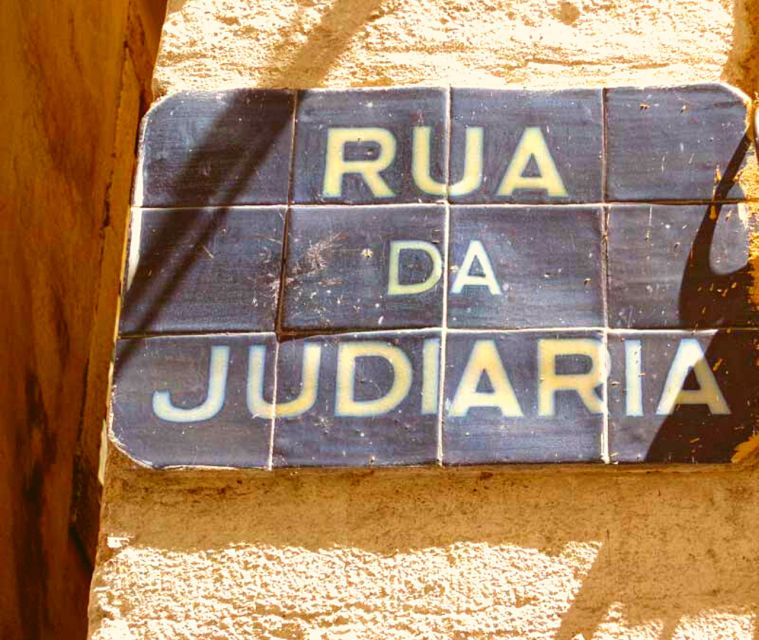
Alfama is one of the central sections of the walk. Its steep lanes and old street pattern provide the setting for a discussion of medieval segregation. The Jewish quarter was known as a judiaria, and the guide explains how Jewish residents lived in designated areas rather than moving through the city on equal terms with Christian communities.
Do not expect a perfectly preserved quarter with original signs on every corner. The significance comes from the urban shape and the explanation of what once happened here. The route turns ordinary-looking lanes into evidence of a social system that divided people by religion.
This is where a private guide helps. You can stop to ask how Jewish residents worked, traded, worshipped, or interacted with their neighbors. You can also ask how the community fitted into the larger Portuguese kingdom. A fixed group tour may have to keep moving, but a private walk can spend more time on the subjects that matter most to you.
Alfama also requires practical attention. The streets are uneven, and Lisbon’s hills can be tiring. Several people have described the walking as manageable, with limited hill climbing, but your experience will depend on the exact route and your pace. Wear comfortable shoes, bring water, and avoid treating this as a polished museum circuit.
Baixa and the story of forced conversions
The route then moves through Baixa, where the guide turns to one of the most painful changes in Portuguese Jewish history: forced conversion. In the late medieval and early modern period, Jews faced pressure and coercion to become Christians. Those who converted were often known as New Christians, and their identity could remain under suspicion for generations.
Baixa is important because it lets the guide connect religious persecution to the public life of Lisbon. A street or square may not carry an obvious Jewish marker, but it can still be the setting for a careful explanation of what happened to families who were compelled to convert.
I appreciate this part of the tour because it avoids reducing the story to a simple division between Jews and Christians. The experience explores the complicated position of New Christians, including the lasting effects of suspicion, social pressure, and the Inquisition. It also shows how persecution changed Portuguese society as a whole.
The physical lack of evidence can be frustrating. If you expect a building where a Jewish school, synagogue, or home remains intact, this section may feel thin. The guide’s job is to make the historical setting meaningful without pretending that modern Lisbon preserves more than it does.
More history-led days around Lisbon:
- Explore Lisbon by Tuk Tuk: History and Viewpoints
★ 5.0 · 840 reviews - Lisbon: Daytime or Sunset Boat Cruise with History and Wine
★ 4.9 · 819 reviews - Private Tuk Tuk Tour Through Lisbon’s Historical Streets
★ 5.0 · 734 reviews - Lisbon Sunset Sailing with Portuguese Wine and History
★ 5.0 · 668 reviews
Rossio and the 1506 Pessah massacre
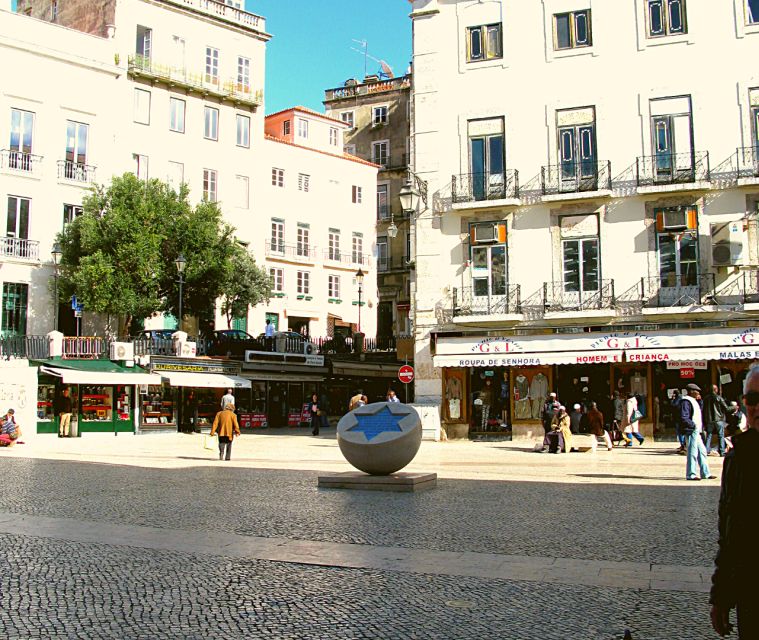
Rossio brings the walk to one of its most difficult subjects, the 1506 Pessah massacre. Here, the guide explains the violence directed at Lisbon’s Jewish and New Christian population and places the event within the wider climate of religious intolerance.
This is not a light sightseeing stop. The square is a busy public space today, so the contrast between modern Lisbon and the memory of violence is sharp. You may stand in an ordinary city center while hearing about a devastating episode that is easy to miss if you only follow Lisbon’s major landmarks.
The guide’s storytelling matters especially here. The tour is built around explanation rather than surviving objects, so a clear account can make the difference between a list of dates and a human story. José has been singled out for his ability to bring Portuguese history to life, while Filipa has been praised for speaking clearly and keeping people engaged. Other guides, including Rita, Jorge, and Sofia, have also been described as warm and well prepared.
The massacre section also helps explain why so little visible Jewish heritage remains. Destruction, conversion, later building, and changing city streets all contributed to the loss of physical traces. That absence is not a minor footnote. It is one of the central facts of the Lisbon Jewish experience.
Mouraria, memory, and the city’s layers
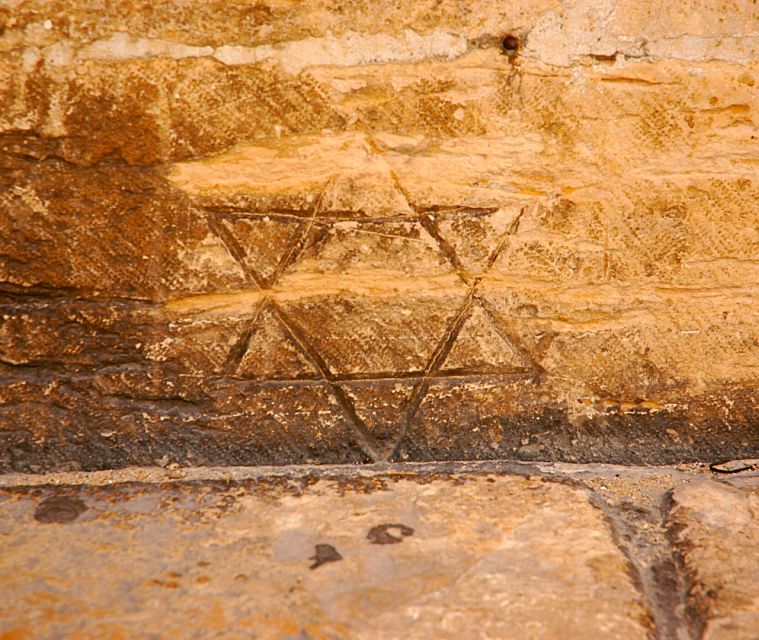
Mouraria is included among the districts covered by the walk. Like Alfama, it provides a historic setting where different communities and periods overlap. The guide uses the area to continue the discussion of medieval Jewish life and the changing shape of Lisbon.
You may also see historical locations that are not exclusively Jewish. This is a strength if you want a broader Lisbon history lesson. One participant valued being shown Roman remains and churches alongside the Jewish story. Those stops can explain how the city was built over earlier layers and how religious history intersects with architecture and public space.
The trade-off is focus. If you want every minute devoted only to Jewish institutions, ask your guide at the beginning to keep the route tightly centered on the Jewish quarter and its legacy. If you enjoy connections to Roman, Christian, and civic history, the added context should make the walk more useful.
The tour can be adapted to different time frames and starting points. That flexibility is especially helpful for a private party, though you should confirm the preferred arrangement when booking. The advertised walk begins at Praça do Comércio, but the experience is not locked to one rigid route.
From medieval Lisbon to WWII refugees
The tour does not stop with the medieval community or the era of forced conversion. It also covers Lisbon’s contemporary Jewish presence and the passage of WWII refugees through Portugal in the 1940s.
This section gives the experience a modern purpose. Lisbon was not only a place where Jewish communities lived in earlier centuries. It was also part of the movement of people escaping war and persecution. The guide connects those events to Lisbon’s role as a port and crossroads.
The Resistance Museum is included in the route. Its presence adds a political and modern layer to the walk, linking the history of refugees and resistance with Portugal’s twentieth-century story. The information provided does not promise an extended museum visit or admission inside, so think of it as a stop within the walking route rather than a separate museum tour.
I like that the experience reaches from medieval segregation to twentieth-century refuge. It gives you a longer view of Jewish life in Portugal and avoids treating the community as something that vanished after the Inquisition.
The worldwide Portuguese Jewish diaspora
One of the most interesting themes is the diaspora that spread from Lisbon across the Atlantic, the Mediterranean, Asia, and northern Europe. The guide uses Lisbon as a starting point for a much larger story of movement, adaptation, and cultural exchange.
This can be especially valuable if your interest extends beyond local landmarks. You learn how the history of one city connects to communities and families far beyond Portugal. The guide also discusses the Jewish legacy in Portuguese culture, science, and gastronomy.
The gastronomic connection is a useful reminder that history is not only about persecution and loss. Communities leave influences in language, work, family traditions, scientific learning, and food. The exact examples may depend on your guide and questions, so I would ask for the cultural subjects that interest you most.
Because this is a private group, you can shape the conversation. You might ask about migration routes, New Christian identity, the Portuguese Jewish diaspora, or the modern community. The guide can spend more time on those issues than a standard sightseeing walk normally allows.
What the guides do best
The strongest part of this experience is the guiding. José Antunes is repeatedly described as articulate, engaging, and exceptionally well prepared on Portuguese and Jewish history. Filipa or Fellipe has been praised for clear English, strong storytelling, and a patient pace, including on a hot day with older participants.
Rita is described as friendly and full of information. Jorge’s command of history helped turn the walk into an educational experience, while Sofia has been noted for explaining the lack of surviving landmarks clearly. These details suggest a consistent strength in the provider’s guiding team, though your guide may be someone else.
The best guides do not hide the gaps in the evidence. They explain that Lisbon retains few physical remains from its earlier Jewish communities, then use the surviving street plan and historical setting to build a picture of the past.
That honesty is important. A guide who points out what has vanished gives you a more accurate experience than one who labels every old street as an intact Jewish site.
Walking effort, group format, and value
You should plan for a real city walk, not a short talk beside one monument. The route covers Praça do Comércio, Praça do Município, Rua do Comércio, Casa dos Bicos, Ribeira, the Resistance Museum, Mouraria, Praça da Figueira, Rossio, Alfama, and the castle hill area.
The precise order may change, and the route can be adapted. Comfortable shoes are essential. Lisbon’s paving and slopes can be tiring, even when the hill climbing is described as limited.
The private format is a major advantage for families, couples, and groups with a shared interest in Jewish history. It gives you space to ask questions and request a slower pace. At $106 per person, the value improves as your group is small and committed to the topic. If you are traveling alone and mainly want a quick orientation to Lisbon, the price may feel high for three hours.
There is no hotel pickup or drop-off, and food and drinks are not included. You meet at Praça do Comércio, so allow time to reach the arch and find the orange backpack or Lisbon Walker tote bag.
You can reserve now and pay later, and cancellation is free up to 24 hours before the tour for a full refund. Those terms help if your Lisbon schedule is still changing.
Who should book this experience
I would choose this tour if you want history explained in context, especially if you are interested in Jewish heritage, Sephardic migration, the Inquisition, New Christian identity, or WWII refugee routes.
It is also a good choice if you want to understand Lisbon’s neighborhoods before exploring them on your own. The route gives Alfama, Baixa, Mouraria, and Rossio more meaning than they have when seen only as scenic streets and squares.
You may want another option if your main goal is to see preserved Jewish buildings, artifacts, or a substantial museum collection. This tour cannot provide what Lisbon no longer has. Its strength is interpretation, not a large collection of physical remains.
Older participants and anyone concerned about hills should contact the provider about the route and desired pace. Several guides have shown patience with people who needed rests, but the walk still covers a fair distance.
Should you book the Lisbon Jewish History Tour?
Book it if you value an informed private guide more than a long list of intact monuments. The tour makes the most of Lisbon’s missing evidence, connecting old quarters, public squares, forced conversions, the 1506 massacre, WWII refugees, and the global Portuguese Jewish diaspora.
At $106 per person, I see good value for a private group that wants a serious three-hour conversation while walking through central Lisbon. I would not book it expecting a museum-style heritage tour. I would book it to understand why the evidence disappeared, how Jewish life shaped Portugal, and how the city’s streets still carry that story.
FAQ
How long is the Lisbon Jewish History Tour?
The guided walking tour lasts three hours.
What language is the tour offered in?
The tour is offered in English or Portuguese.
Is this a private tour?
Yes. The group type is listed as private.
Where does the tour meet?
Meet under the big triumph arch at Praça do Comércio. The guide will carry an orange backpack or a tote bag with the large Lisbon Walker logo.
What places are covered?
The route includes Praça do Comércio, Praça do Município, Rua do Comércio, Casa dos Bicos, Ribeira, the Resistance Museum, Mouraria, Praça da Figueira, Rossio, Alfama, and the castle hill area.
Will I see preserved Jewish buildings or many artifacts?
The tour covers historical sites of Jewish presence, but few physical remains or artifacts survive. Much of the experience is based on the guide’s explanation of the neighborhoods and their history.
What should I bring?
Bring comfortable shoes because the experience involves substantial walking through Lisbon’s streets and historic districts.
Is hotel pickup included?
No. Hotel pickup and drop-off are not included. Food and drinks are also not included.
Recently reviewed around Lisbon
- Portinho da Arrábida: Coasteering Boat Tour★ 4.9 · 78 reviews
- Setúbal: Dolphin-Watching Boat Tour★ 4.8 · 213 reviews
- From Lisbon: Private Óbidos and Nazaré Tour★ 5.0 · 152 reviews
- No Diet Club – Unique food tour in Lisbon with many Tastings★ 4.8 · 44 reviews
- Queluz National Palace & Gardens Ticket★ 4.6 · 447 reviews
- Melides: Horse Riding on the Beach with Wine Tasting★ 4.3 · 117 reviews
- Melides: Horseback Riding on Melides Beach★ 4.7 · 111 reviews
- Lisbon: Street Art Tuk Tuk Tour★ 4.9 · 372 reviews
Historical Tours, compared.

Historical Sites, Wine Experience, Lunch & Cruise
Read our review →
Live Fado Show with Port Wine in Historic Center
Read our review →

Browse the lists this tour appears in