
Reviewed · WALKING TOURS
Lisbon: Belem Walking Tour with Jeronimos Monastery Entry
Jerónimos Monastery is the star here, and the separate entrance can save you from a long wait outside one of Lisbon’s busiest sights. Inside, your guide connects carved stone, royal tombs, monks, and Portugal’s seafaring age in a way that makes the building much easier to read.
I like the early start and the stop for an original Pastel de Belém, made from the monastery’s old recipe. I also like the small-group feel reported by several guests and the guides’ practical approach, with names such as Luis, Leonardo, and Federico receiving especially warm praise.
The main drawback is clear: Belém Tower is closed for restoration, so you see it from outside only. You’ll also walk in the open for several hours, with little shade, and the tour is not suitable for wheelchair users or people with mobility impairments.
In This Review
- Key points to know before booking
- Why Jerónimos Monastery deserves a guided visit
- The lower cloister, Chapter Room, and Fernando Pessoa
- Santa Maria de Belém Church and Portugal’s famous tombs
- Pastéis de Belém and the original custard tart
- Empire Square and the walk toward the river
- Monument to the Discoveries and the Age of Exploration
- Belém Tower from the outside
- Is $70 a fair price?
- Timing, meeting point, and group pace
- Who should book this Belém tour?
- Should you book it?
- FAQ
- Is entry to Jerónimos Monastery included?
- Does the tour skip the line?
- What time does the tour begin?
- How long does the experience last?
- Is the Pastel de Belém included?
- Can I enter Belém Tower?
- Where does the tour end?
- Is transportation included?
- What language is the tour offered in?
- Is the tour suitable for wheelchair users?
Key points to know before booking
- Early access to Jerónimos Monastery: Tickets are purchased in advance, and you enter through a separate access point rather than joining the main ticket-buying queue.
- A guide gives the monastery meaning: Expect the upper and lower cloisters, Chapter Room, old Refectory, church, royal tombs, and navigation-era figures to be explained in English.
- The Pastel de Belém is part of the price: You stop at the famous bakery for the original custard tart linked to the monastery’s monks.
- Belém’s main monuments fit into one morning: The route continues through Empire Square, the Monument to the Discoveries, and Belém Tower.
- The tower is currently an exterior stop: Restoration work prevents entry, so this tour does not include a visit inside Belém Tower.
- The guides are the strongest part: Luis, Leonardo, Leo, and Federico are repeatedly praised for clear English, humor, historical detail, and helpful answers.
Why Jerónimos Monastery deserves a guided visit
If you visit Jerónimos Monastery on your own, you can admire the stonework, arches, columns, and tombs. The harder task is understanding what you are looking at. The building has limited explanatory signage, so a guide adds real value here rather than simply leading you from room to room.
The visit begins around 9:30 in the morning, after your guide meets you near the south entrance to the church and the access queues. With tickets already arranged, you avoid the usual first chore of figuring out where to buy admission and how the lines work. This does not mean you should arrive late. The guide asks you to be on time because the group enters together.
The first major stop is the upper cloister, where the monastery’s Manueline decoration is easiest to appreciate as a whole. Manueline architecture developed in Portugal in the early 16th century, combining late Gothic forms with Renaissance details. It also uses maritime images and elaborate carved ornament, making the building feel closely tied to Portugal’s Age of Discovery.
Your guide explains why the monastery was built, what it represented to Portuguese society, and how it connects with the voyages of the 15th and 16th centuries. That context matters. Without it, the cloister can seem like an impressive collection of decorative stone. With it, you begin to see the monastery as a royal, religious, and national statement.
The upper level also gives you strong views across the cloister’s architecture. This is a good place to slow down and look closely at the repeated arches, carved details, and balance of the design. The guide may use pictures to explain historical context, as Luis did for one group, which can help you picture features or events that are not immediately obvious from the stonework.
More Walking Tours in Lisbon
- Lisbon: History, Stories and Lifestyle Walking Tour
★ 4.8 · 10,902 reviews - Best of Lisbon Small-Group Guided Walking Tour
★ 5.0 · 4,869 reviews - Lisbon: Food and Wine Small Group Walking Tour
★ 4.9 · 4,082 reviews
The lower cloister, Chapter Room, and Fernando Pessoa
The route continues into the lower section of the cloister. Here, the experience becomes less about the grand first impression and more about the working life of the monastery.
You see the Chapter Room and the old Refectory, spaces that help show how the religious community functioned. Your guide explains the purpose of each room and points out details you might otherwise pass without notice.
The tour also includes the tomb of Fernando Pessoa. He was moved to this space only in the 20th century, so the tomb is not part of the original monastic story in the same way as the medieval and royal features. That later connection adds another layer to the building’s role in Portuguese culture.
This is one reason I would choose a guided visit over a quick solo walk-through. The architecture is worth seeing on its own, but the explanations give you a sequence of ideas to follow. Several guides are praised for answering questions and adjusting the amount of detail to the group. One guest found the information almost too much to follow at times, so if you prefer a fast, mostly visual visit, this may feel talk-heavy.
Santa Maria de Belém Church and Portugal’s famous tombs
The monastery visit includes Santa Maria de Belém Church, a majestic Manueline building connected to the monastery complex. The church brings together religious purpose, royal power, and national memory in one space.
Inside, you see the tombs of King Manuel I and his son, João III, both from the Avis dynasty. You also see the tomb of Vasco da Gama, the navigator associated with the sea route to India, and Luiz Vaz de Camões, Portugal’s celebrated poet.
A guide helps explain why these people are here and how the church fits into the larger story of Portuguese expansion. This is especially useful if you know the names but not the connections between them. The tour does not treat the church as a quick photo stop. It gives you time to understand the people, symbols, and architecture together.
The church is also a welcome change from the open-air walking portion that follows. You should still dress comfortably and wear shoes suited to several hours on foot, but the morning begins mostly indoors before moving into Belém’s broad public spaces.
Pastéis de Belém and the original custard tart
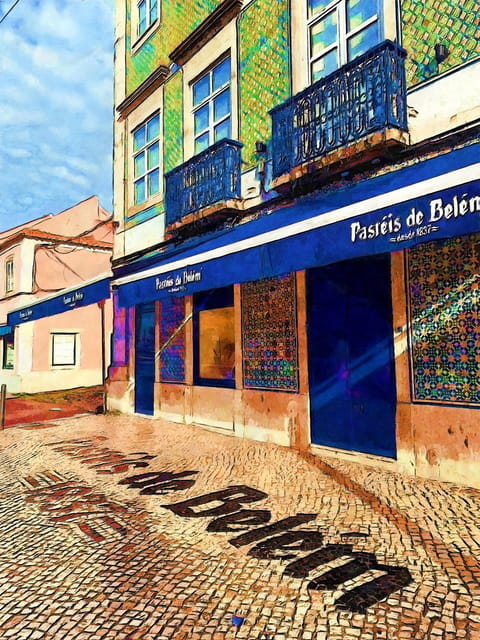
Before continuing to the riverside monuments, you stop at Pastéis de Belém for the original custard tart associated with Lisbon. The recipe was created by monks from Jerónimos Monastery and has been sold at the same establishment since the middle of the 19th century.
The included pastry is a small but important part of the tour. It links the monastery you have just explored with a living food tradition in the neighborhood. You are not simply eating a generic Portuguese tart at a random café. You are trying the pastry at the historic shop tied to the recipe’s story.
The visit lasts about 30 minutes. That gives you a little breathing room after the monastery and church, though this is not a full meal. Lunch is not included, so plan to eat separately if you need something more substantial.
Several people specifically praised the tart, with one describing it as the best Portuguese custard tart they had during their time in Portugal. That is a matter of taste, of course, but the stop is useful even if you are not a pastry enthusiast. It breaks up the sightseeing and gives the morning a distinctly local flavor.
More Lisbon walks with a guide:
- Best of Lisbon Walking Tour: Rossio, Chiado & Alfama
★ 4.9 · 2,700 reviews - Age of Discoveries Walking Tour in Belém
★ 5.0 · 1,513 reviews - Sintra & Cascais Day Tour with Pena Palace Entry and Gardens Walk
★ 5.0 · 962 reviews - Lisbon Roots – Small group Food & Culture Walking Tour w/tastings
★ 5.0 · 910 reviews
Empire Square and the walk toward the river
From the pastry shop, the group walks through Empire Square Garden, a broad public space in front of the monastery. The route between stops is part of the experience, since it lets your guide explain how the monuments relate to one another rather than treating each one as an isolated attraction.
The walk to the Monument to the Discoveries takes about 15 minutes. You should expect sun, wind, and hard walking surfaces, depending on the day. The tour runs rain or shine, so bring sunscreen and an umbrella. A sun hat and comfortable clothes are sensible as well.
This open section can feel demanding on a hot day. One guest enjoyed the tour despite high temperatures, while another still found the walking worthwhile in the heat. The practical lesson is simple: do not treat this as an indoor museum visit. Wear shoes you can walk in for three to three and a half hours, and carry water even though it is not listed as an included item.
Monument to the Discoveries and the Age of Exploration
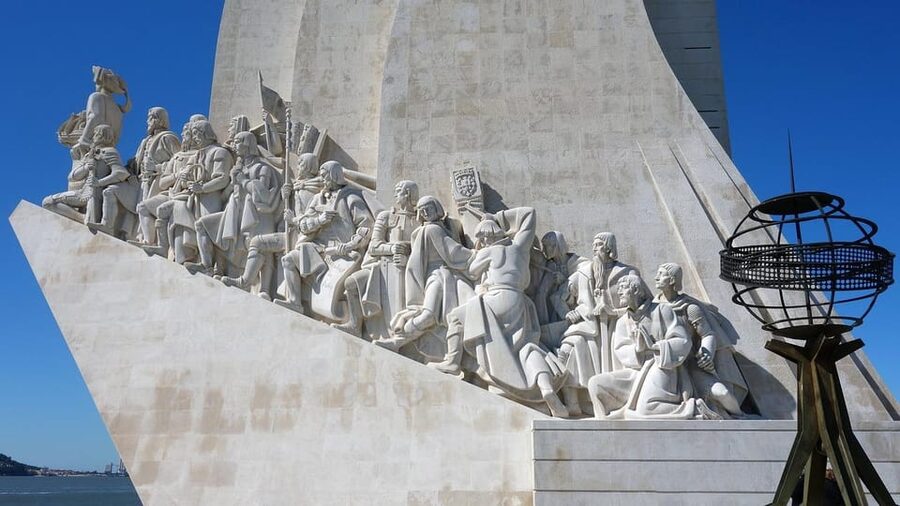
The Monument to the Discoveries was erected in 1960 to mark the 500th anniversary of the death of Infante D. Henrique, known as the main figure behind the Portuguese navigations. The monument also represents other important figures connected with the voyages and Portugal’s expansion overseas.
Your guide gives you a short guided visit and sightseeing stop of about 20 minutes. That is enough to explain the monument’s purpose and identify the figures represented there, but it is not a long museum visit. The value lies in seeing it within the same morning as Jerónimos Monastery and Belém Tower.
The sequence also gives you a chance to consider the Age of Discovery from more than one angle. At the monastery, you see how religion and royal power shaped the era. At the monument, you see how later Portugal chose to commemorate its navigators. A strong guide can make those connections clear without turning the walk into a lecture.
The guides praised most often are Luis, Leonardo, Leo, and Federico. Their strengths vary in style, but the pattern is consistent: clear English, enthusiasm for Portuguese history, humor, and a willingness to answer questions. Renan Stein and Ricardo are also praised for passion and detail. Guide assignment can vary, so you should not book on the assumption that a particular person will lead your group unless the provider confirms it.
Belém Tower from the outside
After roughly another 15-minute walk, you reach Belém Tower. Together with Jerónimos Monastery, it is part of the UNESCO World Heritage designation in Belém.
The tower was built as a defensive point against invaders approaching Lisbon. It is another major example of Manueline architecture, and its position beside the river makes it one of the area’s most recognizable sights.
At present, restoration work means you cannot enter Belém Tower. Your guide takes you to the exterior and explains its role and design, but you should not pay for this tour expecting access inside. This limitation is mentioned by several people who still felt the rest of the morning was worthwhile, but it remains the tour’s most important disappointment.
The exterior stop is brief, listed at about 15 minutes. If entering the tower is a top priority, check its restoration status before booking and consider whether you want to visit later if access resumes. If your main goal is to understand Belém’s major sights and see the tower from the riverfront, the stop still completes the route well.
The tour ends at Belém Tower rather than returning you to the monastery. That makes sense geographically, but it means you should plan your next move from there. Transportation is not included, and the activity itself does not provide lunch.
Is $70 a fair price?
At $70 per person, this is not the cheapest way to see Belém. The value comes from the combination of a prearranged Jerónimos Monastery ticket, a live English-speaking guide, the pastry stop, and a structured walk through several major sights.
The ticket matters most on crowded days. Several people specifically valued entering through a separate queue, and one guest said the tour saved a great deal of time. If you arrive when the monastery line is long, the saved time may be worth a large part of the price by itself.
The guide is the other major value. Jerónimos Monastery is visually impressive but not always easy to interpret without help. The strongest guides use pictures, explain architectural symbols, connect the monastery to the monarchy and voyages, and answer questions without making the morning feel like a school lesson.
The price is harder to justify if you already have monastery admission, prefer exploring alone, or mainly want to enter Belém Tower. Since the tower is closed, you are paying for an exterior explanation rather than full access. You also pay for a pastry, which is enjoyable but not a major financial saving.
For me, the tour makes the most sense for a first visit to Lisbon, especially if you want structure and context. It is less compelling for repeat visitors who already know the monastery and can manage the area independently.
Timing, meeting point, and group pace
Meet your guide in front of Jerónimos Monastery, near the south entrance to the church and where the access lines form. Pay close attention to the supplied meeting-point photo. One person found the meeting instructions needed clearer planning, so do not rely on a vague assumption that everyone will gather at the most obvious gate.
Allow extra time to reach Belém. One guest nearly missed the start after traffic delayed a Bolt ride. The tour begins early, and late arrival affects the whole group, so leave your hotel earlier than you think you need to.
The total duration is about three to three and a half hours. The monastery and church portion lasts around 90 minutes, followed by the square, pastry shop, monument, and tower. The pace is active but not rushed according to the available feedback, with enough time to walk, listen, ask questions, and take photographs.
Private groups are available. That option may suit you if your party wants a particular pace or has strong interests in architecture, art, or Portuguese history. Standard group size can vary, but one small group had only four people, and another person specifically appreciated having a small group.
Who should book this Belém tour?
I would recommend it to you if you want the following:
- A guided introduction to Jerónimos Monastery rather than a silent walk through beautiful rooms.
- A better grasp of Portugal’s monarchy and seafaring era.
- Help avoiding the main monastery ticket queue.
- A morning that combines architecture, monuments, a pastry, and outdoor walking.
- An English-speaking guide who can answer questions and explain small details.
- A planned route that ends at Belém Tower.
It suits couples, families with older children, solo visitors, and anyone visiting Lisbon for the first time. It is also a good choice if you enjoy history and architecture but do not want to spend hours reading signs or researching each carved symbol yourself.
I would hesitate if you have limited mobility, use a wheelchair, dislike walking in sun or rain, or want a slow café morning. The tour is not suitable for wheelchair users or people with mobility impairments, and it continues in all weather. You should also think twice if Belém Tower’s interior is the main reason you are booking, since restoration prevents entry.
Should you book it?
Book this tour if Jerónimos Monastery is high on your Lisbon list and you want the building to make sense, not just look beautiful in photographs. The combination of early access, a strong English-speaking guide, the original Pastel de Belém, and a walk through Belém’s key monuments gives you a useful first look at the district.
The best reason to choose it is the monastery explanation. The best reason to pause is the closed tower and the $70 price. If those limits do not bother you, this is a well-paced and practical way to spend a Lisbon morning, especially with guides such as Luis, Leonardo, Leo, or Federico leading the group.
Free cancellation is available up to 24 hours before the start, and you can reserve now and pay later. The tour can be canceled if the minimum number of participants is not reached, so check the final booking details before you set your day around it.
FAQ
Is entry to Jerónimos Monastery included?
Yes. Your entrance ticket to Jerónimos Monastery is included, and the guide has the tickets purchased before the group enters.
Does the tour skip the line?
The tour uses a separate entrance for the monastery, which can help you avoid the main ticket-buying queue. You should still arrive on time at the stated meeting point.
What time does the tour begin?
The monastery visit begins at around 9:30 in the morning. Starting times can vary, so check availability when booking.
How long does the experience last?
The tour lasts about three to three and a half hours.
Is the Pastel de Belém included?
Yes. One original custard tart at Pastéis de Belém is included.
Can I enter Belém Tower?
No. Belém Tower is currently undergoing restoration, so the tour visits and explains the tower from outside.
Where does the tour end?
The tour ends at Torre de Belém.
Is transportation included?
No. Transportation to and from the tour is not included.
What language is the tour offered in?
The live tour is offered in English.
Is the tour suitable for wheelchair users?
No. The activity is not suitable for wheelchair users or people with mobility impairments.
Recently reviewed around Lisbon
- Portinho da Arrábida: Coasteering Boat Tour★ 4.9 · 78 reviews
- Setúbal: Dolphin-Watching Boat Tour★ 4.8 · 213 reviews
- From Lisbon: Private Óbidos and Nazaré Tour★ 5.0 · 152 reviews
- No Diet Club – Unique food tour in Lisbon with many Tastings★ 4.8 · 44 reviews
- Queluz National Palace & Gardens Ticket★ 4.6 · 447 reviews
- Melides: Horse Riding on the Beach with Wine Tasting★ 4.3 · 117 reviews
- Melides: Horseback Riding on Melides Beach★ 4.7 · 111 reviews
- Lisbon: Street Art Tuk Tuk Tour★ 4.9 · 372 reviews
Walking Tours, compared.
Best of Lisbon Small-Group Guided Walking Tour
Read our review →

Porto Walking Tour, Lello Bookshop, River Cruise and Cable Car
Read our review →
Best of Lisbon Walking Tour: Rossio, Chiado & Alfama
Read our review →
Experience Porto’s Charm: 3-Hour Guided Walking Tour
Read our review →
Enjoy a Guided Levada Walk in the Rabaçal Valley
Read our review →Browse the lists this tour appears in