
Reviewed · TUK TUK TOURS
Tuk Tuk Lisbon: Exploring Urban Art
Lisbon’s urban art is spread across steep hills, side streets, vacant buildings, and busy avenues. This private tuk-tuk tour links the best-known works without asking you to walk between them, from Pichi&Avo’s painted figure at Santa Apolónia to Bordalo II’s giant waste-made bee at Lx Factory. I like the mix of major artists and less obvious walls, and I like that guides such as Nuno, Filipe, and Pifas add city and art background rather than simply pointing at murals.
I also appreciate the flexible rhythm. If traffic allows, Filipe can stop for photographs or roll slowly past a work, and some tours add a miradouro or pastelaria stop. The main caution is physical: children under seven are not permitted, and the ride is not recommended for pregnant people or those with reduced mobility. At about $93.73 per person, the value depends on how much you want a private ride and expert commentary rather than a simple street-art walk.
In This Review
- Key points at a glance
- Why a tuk-tuk is a smart way to see Lisbon’s street art
- Santa Apolónia and Pichi&Avo’s classical rebel
- Campo de Santa Clara and 53,000 tiles
- Vhils and the art of carving a face into Lisbon
- Graça’s literary portraits and two viewpoints
- Avenida Fontes Pereira de Melo’s giant building project
- Lx Factory and Bordalo II’s recycled bee
- What the private format adds
- Price, timing, and who gets the best value
- Should you book Tuk Tuk Lisbon: Exploring Urban Art?
- FAQ
- Where does the urban-art tour take place?
- How long does the tour last?
- Is the tour private?
- Is pickup available?
- Where can I meet the tuk-tuk?
- Is the tour offered in English?
- How many people can ride in the tuk-tuk?
- Are children allowed?
- Is the tour suitable for people with reduced mobility or pregnant people?
- Are food, drinks, or monument tickets included?
- Can I cancel for a refund?
Key points at a glance
- Pichi&Avo at Santa Apolónia: See a large classical figure laid over layers of graffiti tags, a useful introduction to Lisbon’s mix of fine art and street culture.
- André Saraiva’s enormous tile wall: At Campo de Santa Clara, about 53,000 tiles cover a 170-meter wall near Feira da Ladra.
- Vhils in a tucked-away passage: Alexandre Farto’s carved face shows how Lisbon urban art can be cut into a wall instead of painted on it.
- Graça portraits and viewpoints: Find literary figures Sophia de Mello Breyner, Natália Correia, and Florbela Espanca near two of Lisbon’s best-known viewpoints.
- A famous Avenida Fontes Pereira de Melo work: Os Gêmeos, Blu, Eric Il Cane, and Sam3 transformed three vacant buildings in a project recognized by The Guardian.
- Bordalo II at Lx Factory: Finish among changing works at Lisbon’s creative complex, including a huge bee assembled from discarded material.
Why a tuk-tuk is a smart way to see Lisbon’s street art
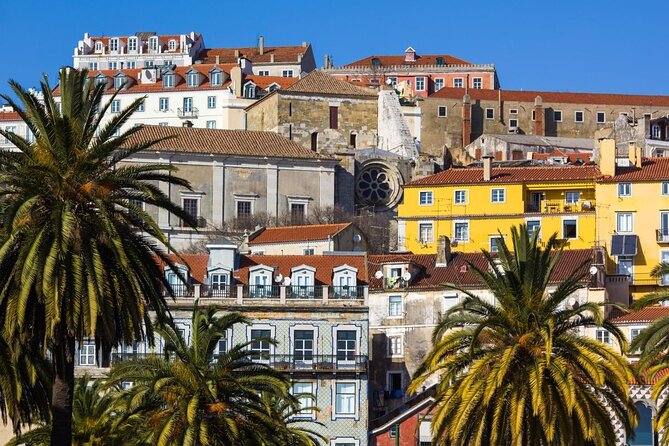
Lisbon’s urban art is not confined to one walkable district. The stops range from Santa Apolónia and Campo de Santa Clara to Graça, Avenida Fontes Pereira de Melo, and Lx Factory. That spread matters because Lisbon’s hills and uneven pavements can turn a self-guided mural hunt into a tiring half-day.
A tuk-tuk gives you a practical shortcut. You ride between neighborhoods, then pause where the art deserves a closer look. You also get a private guide, private transportation, and a tour designed only for your group. That makes this more personal than a large sightseeing vehicle, though it also means the price is higher than a standard group walk.
The outing lasts about two to three hours. That is enough time to sample several parts of Lisbon without giving up a full day, but you should not expect to inspect every work in detail or visit every street-art district in the city. The guide’s explanations are a key part of the value.
The experience is offered in English and has a 4.9 rating from 90 reviews, with 98 percent of customers recommending it. The strongest praise centers on the guides. Nuno is singled out for bringing the art and city to life, while Filipe is praised for sharing his enthusiasm and allowing photo stops when traffic permits. Pifas is noted for discussing both art and other aspects of Lisbon. Those details suggest that the guide can shape the experience as much as the murals do.
More Tuk Tuk Tours in Lisbon
- True 4Hour Private Tuk Tuk Tour: Discover Lisbon with a Local!
★ 5.0 · 8,008 reviews - Lisbon Highlights: Private Tuk Tuk Tour Adventure Sightseeing
★ 5.0 · 3,284 reviews - Welcome Lisbon Tour with Local Guide in Private Eco Tuk Tuk
★ 5.0 · 1,691 reviews
Santa Apolónia and Pichi&Avo’s classical rebel
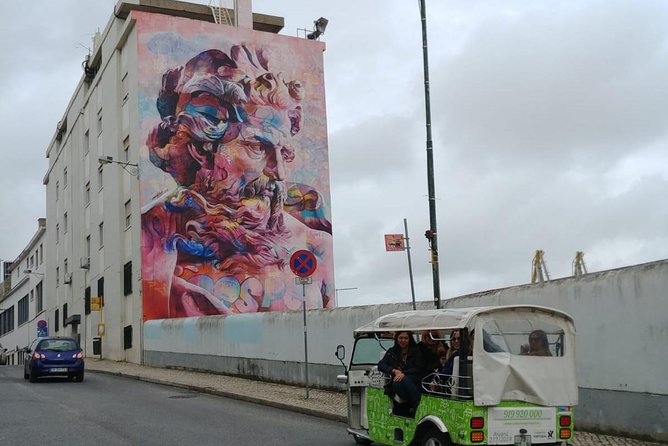
The first listed stop is the sidewalk along Calçada de Santa Apolónia. Here, Pichi&Avo combine classical art with graffiti in a large composition that places a sculptural human figure over a field of tags.
This is a strong opening because it gives you a quick visual lesson in the difference between street art and simple wall decoration. The Spanish duo use rough, broad brushwork alongside more careful drawing. The contrast makes the figure seem to rise from the wall while the surrounding marks keep the work tied to graffiti culture.
The mural was created for the Versus exhibition at Underdogs Gallery, a Lisbon venue associated with contemporary urban art. Your guide can help explain that link and point out how the work brings gallery ideas into public space.
The stop is on a sidewalk, so your viewing position may depend on traffic, parked vehicles, and pedestrians. This is where the tuk-tuk’s slower pass and photo flexibility become useful. You can take in the full scale first, then focus on color, brush marks, and the layers of tags beneath the figure.
Campo de Santa Clara and 53,000 tiles
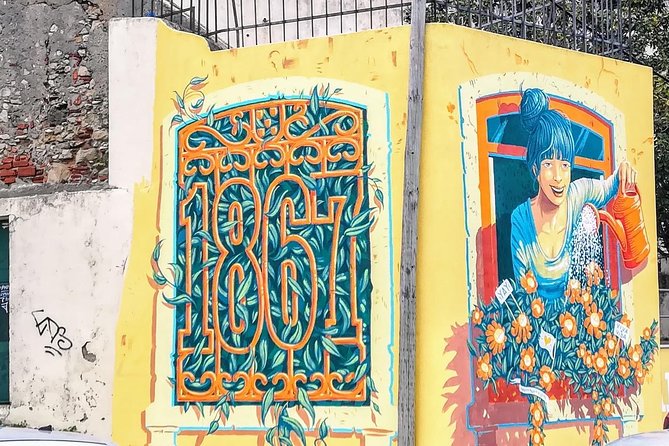
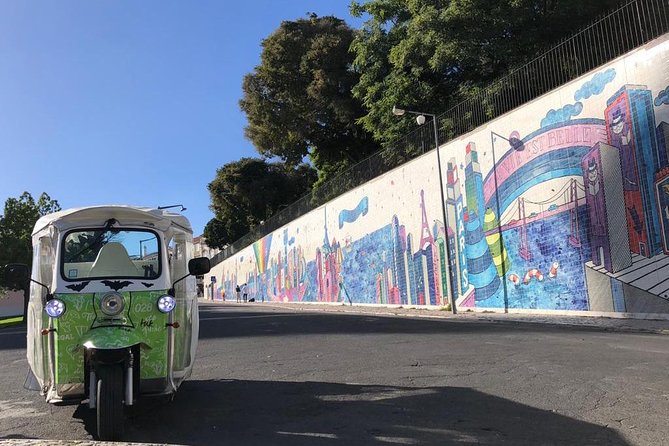
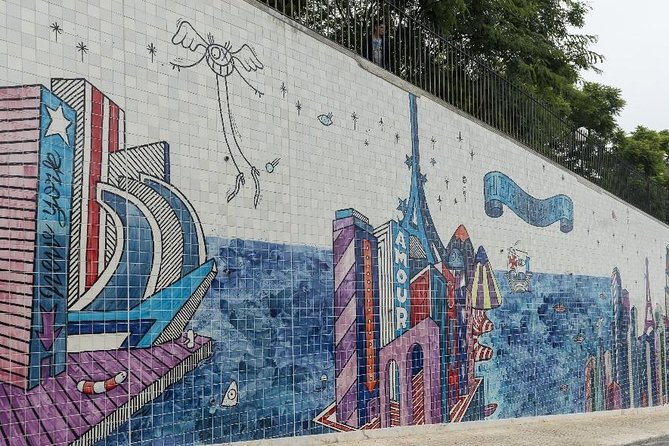
At Santa Clara Field, near Feira da Ladra, André Saraiva’s wall changes the mood completely. The old wall of Jardim Botto Machado is covered by a colorful tile mural measuring about 170 meters long and 1,000 square meters in area. It uses roughly 53,000 tiles.
Those numbers are worth remembering because the work is easy to underestimate in a photograph. You need the full length of the wall to understand its size. Rather than one isolated image, it operates as a long public-art surface beside an active part of Lisbon.
The location also gives the guide a chance to connect art with daily city life. Campo de Santa Clara is associated with Feira da Ladra, Lisbon’s well-known flea market, so the mural is not sitting in a sealed museum setting. You see it in the middle of an ordinary neighborhood, with the city continuing around it.
I would pay attention here to the scale and the change in material. The Pichi&Avo piece uses paint and tags to create tension. Saraiva’s work turns thousands of tiles into a single wall-length statement. If you enjoy photography, this is one of the stops where a wider view matters more than a close-up.
Vhils and the art of carving a face into Lisbon
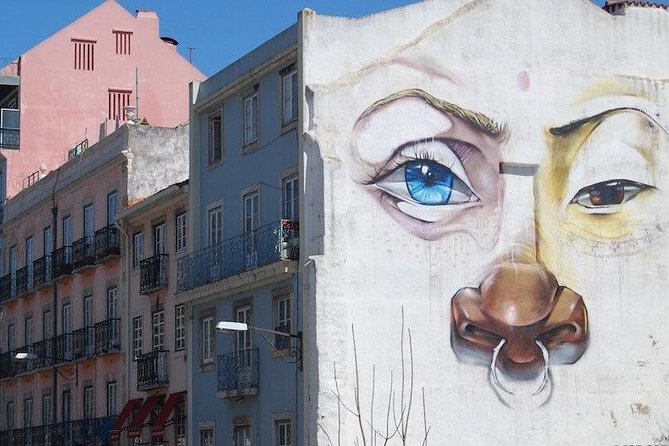
The Vhils stop takes you to Travessa das Merceeiras, where one of Alexandre Farto’s early Lisbon faces is tucked away. Vhils is known for carving into walls, removing parts of the surface to form portraits rather than adding paint on top.
That method gives the work a different physical quality from most murals. The wall itself becomes the material. You are not just looking at color spread across brick or plaster; you are looking at a face created through subtraction.
The location is described as hidden in the passage, so your guide’s knowledge helps you find it and understand why it matters. This is a good example of the value of a private art tour. Without directions or context, you could pass nearby and never know what was there.
Because the work is tucked into a narrow passage, viewing space may be limited. That is not a flaw so much as part of the experience. The piece feels tied to the old street fabric rather than presented like a billboard.
More Lisbon trips worth a second look
- Lisbon: Private Guided Tuk-Tuk Tour with Hotel Pickup
★ 4.9 · 4,552 reviews - Private Lisbon Sightseeing Tuk-Tuk Tour: Alfama, Belém & More
★ 5.0 · 4,277 reviews - Lisbon: Private City Tour by Eco Tuk Tuk
★ 4.9 · 1,215 reviews - Lisbon: Private Sightseeing Tour in a Vintage Tuk Tuk
★ 4.9 · 1,057 reviews
Graça’s literary portraits and two viewpoints
The Graça section brings together urban art, Portuguese literature, and hilltop views. In 2014, artists created works honoring national literary figures connected with the district.
On Rua Josefa de Óbidos, Eime created the face of Sophia de Mello Breyner. Nearby, on Travessa do Monte, Mariana Dias Coutinho portrayed Natália Correia and Florbela Espanca. These portraits give you a more local subject than the large international murals on the route.
You do not need to arrive with a detailed knowledge of Portuguese poetry to appreciate the idea. The portraits show how street art can preserve public memory and connect a neighborhood with its writers. Your guide is especially useful here, since the names and connections may not be familiar to you.
The tour also passes near the viewpoints of Graça and Senhora do Monte. A brief viewpoint stop may be included, depending on the guide and timing, and this is one of the most welcome changes of pace. After several walls and portraits, you get a wider look at Lisbon from above.
The practical point is that viewpoints are reached on steep terrain. The tuk-tuk saves you from making the full climb on foot, but the experience is still not recommended for people with reduced mobility. Ask about the exact stop arrangement if mobility is a concern before booking.
Avenida Fontes Pereira de Melo’s giant building project
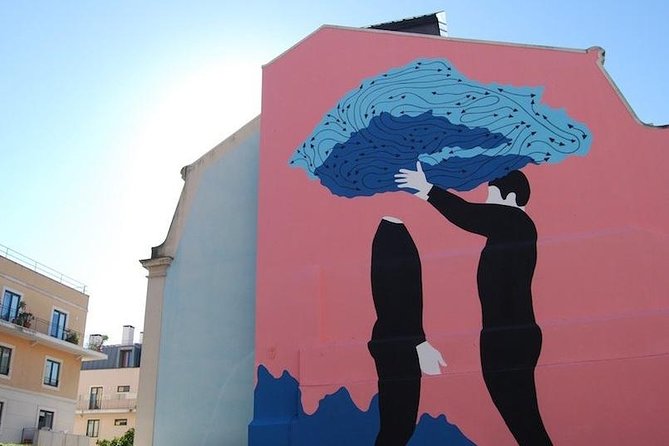
One of the most dramatic parts of the route is along Avenida Fontes Pereira de Melo. Three vacant buildings were transformed by an international group of artists: the Brazilian duo Os Gêmeos, Italians Blu and Eric Il Cane, and Spanish artist Sam3.
The scale here is the attraction. Instead of a single wall, you see entire building facades treated as public canvases. The project was recognized as one of the world’s ten best works by the British newspaper The Guardian, which helps explain why this is one of Lisbon’s most noted urban-art sights.
The vacant buildings also add an unusual layer. Their worn condition is part of what makes the work powerful, but it means the setting may look rough rather than polished. You are seeing art in conversation with neglected architecture, not in a tidy gallery district.
This is a place where a moving view may be more useful than a long stop. The road is busy, and the guide needs to work with traffic conditions. Filipe’s approach, allowing you to choose between a photo stop and a slow pass when possible, is exactly the sort of flexibility that helps here.
Lx Factory and Bordalo II’s recycled bee
Lx Factory is the final listed stop and one of the best places to finish an urban-art tour. This former industrial complex is described as a creative factory, with more than a dozen works often on view by well-known artists.
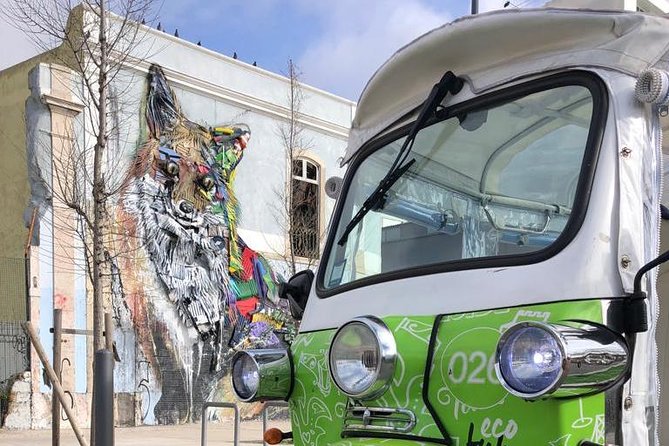
The art can change over time, so the exact selection may not remain fixed. One named highlight is Bordalo II’s huge bee made from garbage. His work often turns discarded objects into animals, making the material part of the message. The bee is not simply a painted insect. Its construction from waste asks you to look twice at what has been thrown away.
Lx Factory adds variety after the route’s large outdoor walls. You get a cluster of works in one place, along with the feel of an active creative site. Since food and drinks are not included, this may also be a useful place to make your own refreshment plans before or after the ride, though the tour price covers neither.
The drawback is that a two to three-hour outing cannot guarantee a full tour of every work at Lx Factory. Think of it as a strong sample, guided by someone who can point out the important pieces, rather than a complete art inventory.
What the private format adds
A private tour can be worth paying for when your interests are specific. You can ask why one artist uses tiles, why another removes wall material, or how Lisbon’s public art relates to its neighborhoods. You are not limited to the pace of a large group.
The guide names associated with this experience include Nuno, Filipe, and Pifas. The exact guide for your booking is not specified, so I would not reserve it expecting one particular person unless the operator confirms that in advance. Still, the feedback gives useful clues about the guiding style to look for: city context, art background, enthusiasm, and attention to photographs.
Pickup is offered at Lisbon hotels and Airbnb properties near the historic center, at the city’s three cruise terminals, and at nearby restaurants or other central locations. Time Out Market and Alto do Parque Eduardo VII are suggested meeting points because they are practical for many visitors.
The tuk-tuk holds up to six seats and has a maximum capacity of 400 kilograms. That limit matters for larger groups, luggage, or equipment. Confirm your group’s needs before booking, especially if you are arriving from a cruise ship with bags.
Price, timing, and who gets the best value
At $93.73 per person, this is not the cheapest way to see street art. You are paying for a private guide, private transportation, pickup options, and the ability to cover several scattered parts of Lisbon in a short time.
For a group of friends or family, the price may make more sense than it does for a solo visitor. Group discounts are offered, and only your party participates. You also avoid spending time figuring out routes between distant murals, which has real value during a short Lisbon stay.
I would choose this tour if you care about urban art but do not want to build your own route, if steep hills are a concern but you can comfortably ride in a tuk-tuk, or if you want a guide who can explain the city beyond the artwork. I would skip it if you prefer a slow walk with long time at each mural, need guaranteed wheelchair access, or want admission to monuments included. Monument tickets are not part of the price, though the listed stops are primarily public outdoor works.
The tour is booked an average of 45 days ahead, so advance planning is sensible. Confirmation is normally sent at booking, although reservations made within two hours of departure are confirmed as soon as possible and remain subject to availability.
Children under seven cannot join. Service animals are allowed. Most people can participate, but the operator does not recommend the ride for pregnant people or those with reduced mobility.
Should you book Tuk Tuk Lisbon: Exploring Urban Art?
I would book this experience if you want an efficient, personal introduction to Lisbon’s public art, especially if you are visiting for only a few days. The route has real range: painted figures, tile work, carved portraits, literary tributes, full-building murals, and art made from discarded objects.
The strongest reason to go is the guide. Nuno, Filipe, and Pifas are associated with the sort of commentary that adds meaning to the walls, and Filipe’s flexible approach to photographs is a useful touch. Before booking, confirm pickup, group size, and physical comfort in the tuk-tuk.
For an art-focused visitor who values context and convenience, the price can be fair. For someone who simply wants to spot a few colorful walls, a self-guided walk will cost less. This tour earns its place when you want Lisbon’s street art explained, connected, and reached without wrestling with the hills.
FAQ
Where does the urban-art tour take place?
The tour takes place in Lisbon, with stops at Santa Apolónia, Campo de Santa Clara, Travessa das Merceeiras, the Graça district, Avenida Fontes Pereira de Melo, and Lx Factory.
How long does the tour last?
The experience lasts approximately two to three hours.
Is the tour private?
Yes. It is a private activity, so only your group participates.
Is pickup available?
Yes. Pickup is offered at Lisbon hotels and Airbnb properties near the historic center, the city’s three cruise terminals, and nearby restaurants or other central locations.
Where can I meet the tuk-tuk?
Suggested meeting points include Time Out Market and Alto do Parque Eduardo VII. Pickup can also be arranged at eligible central locations.
Is the tour offered in English?
Yes. English is the listed tour language.
How many people can ride in the tuk-tuk?
The tuk-tuk has six seats and a maximum capacity of 400 kilograms.
Are children allowed?
Children under seven are not allowed on this experience.
Is the tour suitable for people with reduced mobility or pregnant people?
The tour is not recommended for pregnant people or people with reduced mobility.
Are food, drinks, or monument tickets included?
No. Food, drinks, and monument tickets are not included.
Can I cancel for a refund?
You can cancel at least 24 hours before the start time for a full refund. Cancellations or changes made less than 24 hours before the experience are not accepted for a refund.
Recently reviewed around Lisbon
- Lisbon: Catamaran Luxury Sunset and Wine Tour★ 5.0 · 119 reviews
- Lisbon’s authentic Food and Wine tour with a Winemaker★ 5.0 · 67 reviews
- Morning Sailing Tour in Tagus River from Lisbon★ 5.0 · 68 reviews
- Lisbon: Belem Walking Tour with Jeronimos Monastery Tks Included★ 5.0 · 115 reviews
- PRIVATE Unforgettable Full Day Tour to Sintra from Lisbon★ 5.0 · 236 reviews
- Discover Lisbon’s Alfama: Secrets of the Old Town★ 5.0 · 104 reviews
- Sesimbra Wild Beach Tour from Lisbon★ 5.0 · 57 reviews
- Private Jeep Tour from Lisbon – Arrábida, Sesimbra & Beach Picnic★ 5.0 · 48 reviews
Tuk Tuk Tours, compared.

True 4Hour Private Tuk Tuk Tour: Discover Lisbon with a Local!
Read our review →
Lisbon Highlights: Private Tuk Tuk Tour Adventure Sightseeing
Read our review →
Discover Porto’s Highlights on a 2-Hour Private Electric Tuk Tuk
Read our review →
Welcome Lisbon Tour with Local Guide in Private Eco Tuk Tuk
Read our review →


Explore Lisbon by Tuk Tuk: History and Viewpoints
Read our review →
Historic Porto by Private Electric Tuk Tuk to Top Landmarks
Read our review →Browse the lists this tour appears in