
Reviewed · SAILING
Sight Sailing in Lisbon
Lisbon’s best waterfront views come from the water, where the city’s hills, domes, bridges, and monuments line up in one grand sweep. This private Tagus River sailing trip gives you that view with a welcome drink, Portuguese wine, food, and a crew that can add local stories as you pass the sights.
I especially like the private format, which lets your own group settle into the boat without sharing the experience with strangers. I also like the mix of sightseeing and hospitality: you are not simply pointed at monuments, you can enjoy a drink, taste Portuguese food, and watch the city change in the afternoon or at sunset. The main consideration is price: at $226.41 per person, it makes the most sense for a celebration or group willing to pay for privacy.
In This Review
- Key points to know before you sail
- Why Lisbon looks different from the Tagus
- Belém Tower and the monuments of the Age of Discoveries
- Crossing the city’s waterfront from Praça do Comércio to Cais do Sodré
- The 25 de Abril Bridge and Christ-King across the river
- Alfama, São Jorge Castle, and Lisbon’s old skyline
- The modern and industrial side of the river
- Food, wine, and the feel of a private boat
- Is $226.41 per person good value?
- Who should book this Lisbon sailing trip?
- Should you book Sight Sailing in Lisbon?
- FAQ
- How long does the sailing experience last?
- Where does the tour begin?
- Where does the tour finish?
- Is this a private tour?
- What is included in the price?
- Is hotel pickup and drop-off included?
- Can I cancel or change the booking?
Key points to know before you sail
- Private sightseeing on the Tagus: Only your group takes part, making this a good choice for birthdays, honeymoons, family outings, and small celebrations.
- A broad Lisbon view: The route brings Belém Tower, the Discoveries Monument, the 25 de Abril Bridge, Christ-King, Praça do Comércio, Alfama, and many waterfront buildings into view.
- Food and drinks are part of the outing: Wine tasting, Portuguese food, bottled water, a welcome drink, and alcoholic beverages are included.
- Local hosts add context: Past crew members have included Luis, Luiz, Bruno, Fernando, and Tomas, with Luis especially noted for his Lisbon stories.
- About two and a half hours afloat: That is enough time for a relaxed city overview, but the experience is primarily a cruise, not a series of long monument visits.
- Sunset can add extra atmosphere: The timing varies, but an evening departure can put Lisbon’s waterfront in warm light.
Why Lisbon looks different from the Tagus
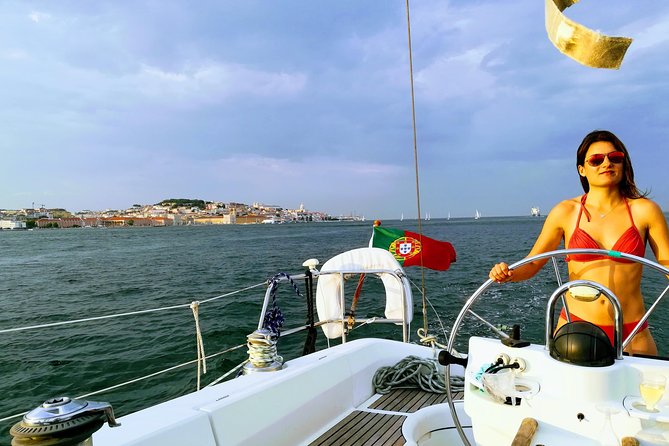
From Lisbon’s streets, the Tagus often appears as a strip of blue beyond a quay or down a steep lane. From a sailing boat, the city opens up. You see the long waterfront, the pale hills behind it, and the way Lisbon’s old quarters rise above the river.
That change in viewpoint is the real reason to book. You are not racing from one address to another. You are sitting with time to look, photograph, and listen while the boat carries you past the city’s major riverfront sights.
The route covers a generous stretch of Lisbon. Belém is to the west, with its grand monuments tied to Portugal’s maritime past. Central Lisbon brings Praça do Comércio, Cais do Sodré, and the older districts into view. Across the river, Almada and Christ-King provide a strong counterpoint to the city’s historic center.
The boat also gives you a useful sense of Lisbon’s geography. You can see how the river shaped the city’s trade, defenses, transport, and public spaces. That is harder to grasp when you are standing below a monument with your neck tilted upward.
More Boat Tours in Lisbon
- Lisbon: Sunset Boat Party Cruise with DJ and Open Bar
★ 4.5 · 10,378 reviews - Lisbon: Daytime/Sunset/Night City Sailboat Tour with Drink
★ 4.9 · 3,114 reviews - Lisbon: Sunset Cruise with Welcome Drink and Snacks
★ 4.4 · 3,021 reviews
Belém Tower and the monuments of the Age of Discoveries
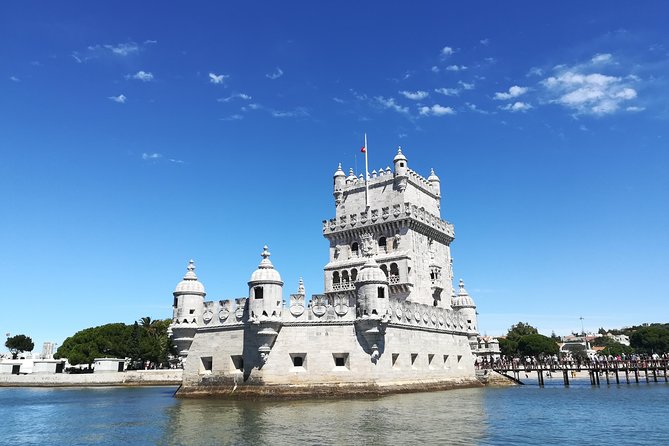
Belém Tower is one of the cruise’s signature sights. Built at the narrowest point of the Tagus estuary, it was designed to help defend Lisbon. Its original setting was surrounded by water, although a pedestrian bridge now links it symbolically to the riverbank.
From the boat, you get the context that a land visit can miss. The tower was not simply placed beside the river for decoration. Its position made sense as part of Lisbon’s defenses and maritime gateway. It is also a UNESCO World Heritage Site, classified in 1983.
Nearby, the Discoveries Monument takes the shape of a ship pointing toward the river. Henry the Navigator appears at the prow, followed by 32 carved figures connected to Portugal’s Age of Discoveries. Vasco da Gama, Luís de Camões, Fernão de Magalhães, and Pedro Álvares Cabral are among them.
The monument you see today has an unusual story. The first version was built for the 1940 Portuguese World Exhibition from materials that were not meant to last. It was dismantled in 1943, and the current structure replaced it later.
This is a good place to listen carefully to your guide. The monuments are visually impressive, but they also reflect Portugal’s complicated maritime story. A short explanation can turn a row of famous façades into a more useful picture of exploration, empire, national pride, and public memory.
Jerónimos Monastery adds another major landmark to the Belém section. This 16th-century masterpiece of Portuguese architecture sits in a monumental setting beside the river. The navigators departed from this area, and the monastery is linked with Vasco da Gama and Luís de Camões.
You will likely view these sights from the water rather than tour their interiors. That is both the strength and limit of the sailing trip. You gain a wide, uncluttered view, but you do not get time to examine the tower rooms, monastery cloisters, or museum collections.
Crossing the city’s waterfront from Praça do Comércio to Cais do Sodré
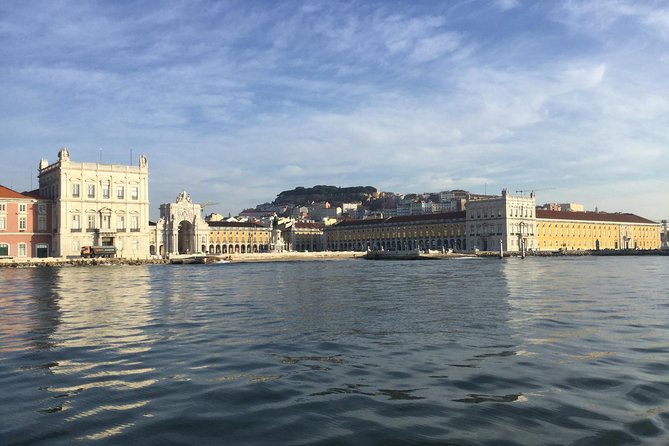
Praça do Comércio is one of Lisbon’s finest public spaces, especially from the river. The great square opens directly onto the Tagus, giving the city a ceremonial front door.
Its present form grew from disaster. The earthquake of November 1, 1755 destroyed much of central Lisbon, including the royal palace, opera house, convents, palaces, schools, and hospitals. The rebuilding plan created the broad square once known as Terreiro do Paço, now Praça do Comércio.
From the boat, the open space is easy to appreciate. You see why it works so well for major events and why the river remains central to Lisbon’s identity. The square’s scale is much clearer from offshore than from the middle of its arcaded buildings.
Cais do Sodré lies farther along the central waterfront. It has long been tied to river and ocean travel. In the 17th century, ships left from here for Portuguese colonies. By the 19th century, bars and entertainment venues had made it a known stopping place for sailors and adventurers.
Today, Cais do Sodré is still a practical transport and nightlife hub, but the boat lets you see its older role as a working waterfront. The South and Southeast River Station at Praça do Comércio serves boats crossing to the south bank. Inaugurated in 1932, it has undergone several renovations, with the latest completed in May 2021.
Santa Apolónia Station gives you another glimpse of Lisbon’s transport story. Opened in 1865 in a former convent site, it was planned as both a railway and river station. It remains close to the cruise port and has been the final stop on one of the city’s metro lines since 2007.
Part of the station now houses The Editory Riverside Santa Apolónia hotel, with 126 rooms linked to Portuguese railway heritage. From the water, you may not catch every detail, but the station helps explain how Lisbon’s riverfront connects rail, metro, cruise ships, ferries, and city streets.
The 25 de Abril Bridge and Christ-King across the river
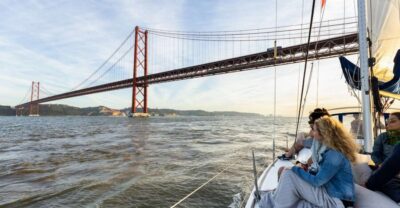
The 25 de Abril Bridge is one of Lisbon’s unmistakable sights. Its suspension design invites comparison with San Francisco’s Golden Gate Bridge, and the construction was assigned to the same American company.
The bridge was first known as Ponte Salazar. Its construction became notable for costing less than expected and being completed in record time. Today, it links Lisbon with Almada and is essential to movement between the two riverbanks.
A boat gives you a particularly good angle on the bridge. You can see its length, height, and relationship to the city rather than viewing only one section from a roadway or lookout. Bring a camera, but also look upward and behind you as the boat passes beneath or near its span, depending on the exact route and river conditions.
Across the water, Christ-King faces Lisbon with open arms. The monument consists of an 82-meter structure including its portico and an upper statue of the Redeemer measuring 28 meters. It is Almada’s biggest attraction and one of the most recognizable features on the south bank.
The monument was built after a vow by Portugal’s bishops in 1940, asking for Portugal to be spared participation in the Second World War. Portugal remained neutral under António de Oliveira Salazar.
Seeing Christ-King from the Tagus makes the scale easier to understand. It also gives you a cross-river view of Lisbon’s historic center, with the city’s hills rising behind Praça do Comércio and Alfama.
More Lisbon trips worth a second look
- Lisbon: Sunset Catamaran Boat Tour with Music and Drinks
★ 4.7 · 2,834 reviews - 2 Hour Lisbon Sunset and Wine Sailing Tour
★ 5.0 · 2,680 reviews - Lisbon: Sailing Tour on the Tagus River
★ 4.8 · 2,632 reviews - Lisbon: Champagne Sailing Tours
★ 4.9 · 1,366 reviews
Alfama, São Jorge Castle, and Lisbon’s old skyline
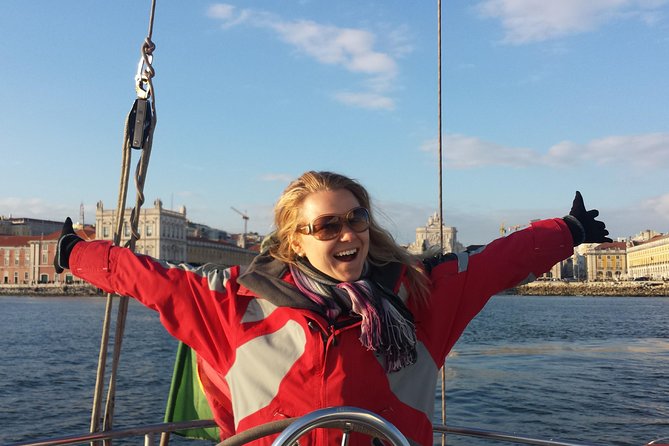
Alfama is Lisbon’s oldest district and one of the oldest urban quarters in Europe. It climbs the slope below São Jorge Castle, with the Tagus forming one of its edges.
From the water, you will not enter the narrow cobbled lanes or hear Fado in one of the district’s restaurants. Instead, you see the stacked houses, church towers, and steep hillside that give Alfama its character. The view is especially useful before a walking visit because it helps you understand the district’s steep shape.
São Jorge Castle sits high above the historic center. Its origins reach back to the 10th and 11th centuries, when Lisbon was an important Muslim port. In 1147, Portugal’s first king, Afonso Henriques, took the castle and city from the Moors.
The castle’s high position explains its importance. From the river, you can see why it controlled views over Lisbon and the estuary. If you plan to visit the castle on foot, the boat tour provides a preview without spending your sailing time climbing Lisbon’s hills.
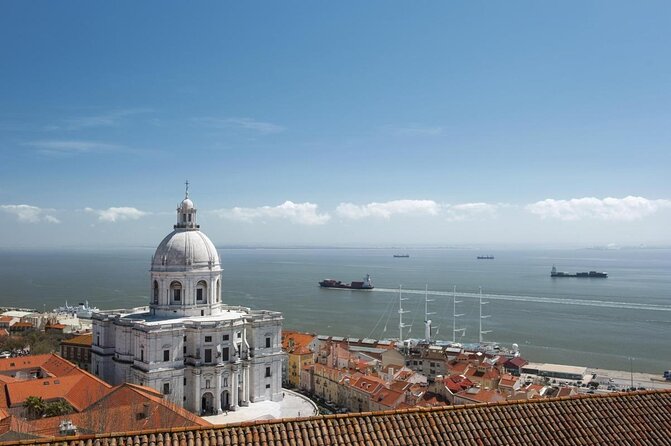
The National Pantheon, also called the Church of Santa Engrácia, is another strong Alfama landmark. Its imposing form houses the remains of notable Portuguese figures and is classified as a National Monument.
The Lisbon Cathedral is also in Alfama. Construction began in the second half of the 12th century after the city was taken from the Moors. It is Lisbon’s oldest church and holds a treasury with relics, jewelry, and sacred art across four rooms.
Again, these are primarily exterior views during the cruise. If you want interiors, you will need a separate visit. That is not a flaw, but you should understand the experience as a moving panorama rather than a guided museum tour.
The modern and industrial side of the river
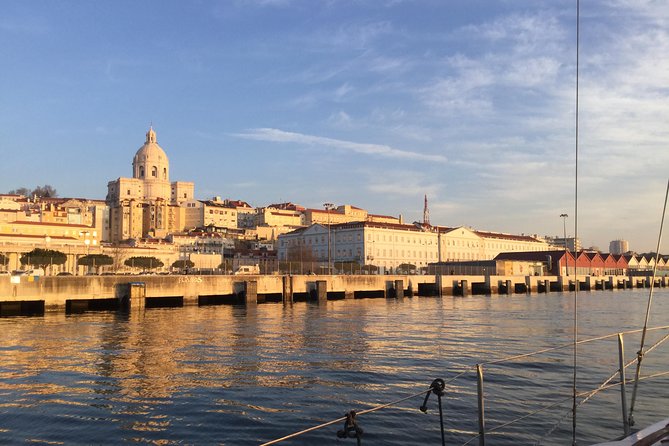
Lisbon’s riverfront is not all royal squares and medieval churches. The cruise also passes places that show the city’s industrial and contemporary sides.
Central Tejo began as a thermoelectric plant supplying power to the Lisbon region. Built in 1908, it operated from 1909 until 1972. It opened to the public as the Electricity Museum in 1990 and reopened permanently after restoration work in 2006.
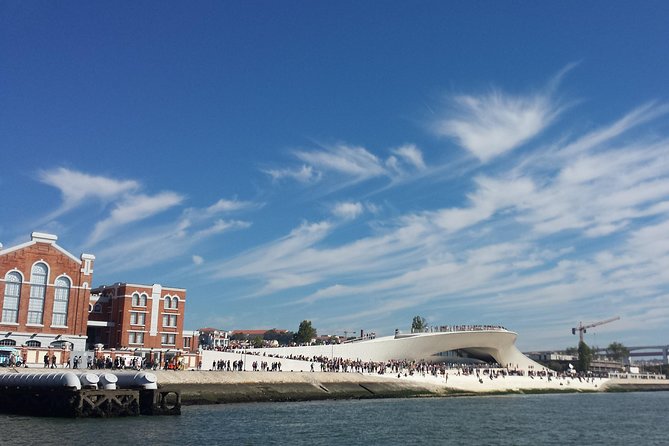
MAAT, the Museum of Art, Architecture and Technology, opened in 2016. British architect Amanda Levete designed its unusual modern building, which now presents exhibitions by artists, architects, and thinkers, along with educational programs and events.
These two places make a useful visual pair. Central Tejo represents Lisbon’s industrial past, while MAAT looks toward contemporary art and design. From the river, their buildings become part of the city’s changing waterfront rather than isolated attractions.
The National Museum of Ancient Art occupies the former Palácio dos Condes de Alvor. Founded in 1884, it holds more than 500 years of art, including painting, sculpture, goldwork, and decorative pieces from Europe, Africa, and the Orient.
The Folk Art Museum has a different origin. Its building began as a pavilion for the Popular Life Section of the 1940 Portuguese World Exhibition. It became a museum in 1948 and is now linked with the Ethnology Museum.
You may not see every collection clearly from the boat, but the guide can help connect the buildings to Lisbon’s wider cultural story. That is one reason a private trip can be more useful than a basic harbor cruise. You can ask about a building as it comes into view instead of waiting for a recorded announcement.
The Maritime Traffic Control Centre, or VTS Tower, oversees shipping in the Port of Lisbon’s area of responsibility. Controllers use cameras, radar, sensors, and other equipment to monitor movement and manage wharves. The tower also houses a dolphin observatory on the Tagus.
The Champalimaud Foundation brings modern science to the waterfront. Created through the will of António Champalimaud, it focuses on advanced biomedical research and interdisciplinary clinical care. Its researchers have published more than 1,200 scientific articles and have received major awards, including the Champalimaud Prize for Medical Research.
The Foundation’s building gives the cruise another contemporary point of interest. Lisbon’s riverfront is not frozen in the past. It continues to serve science, transport, culture, and public life.
Food, wine, and the feel of a private boat
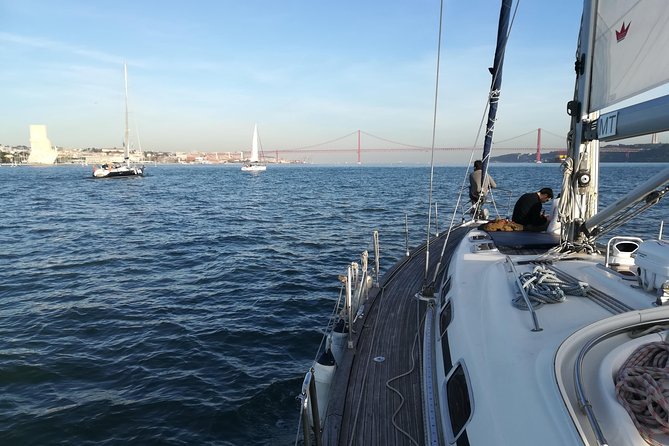
The included welcome drink sets the tone as you board. Wine tasting, Portuguese gastronomy, bottled water, and alcoholic beverages are also included, so this is more than a sightseeing ride with a drink handed over at the start.
The exact food selection is not specified, but the experience includes an opportunity to taste Portuguese food. Past arrangements have included wine and cheese, local canapés, and special drinks requested in advance, including caipirinhas. Treat those examples as possible arrangements, not a guaranteed menu.
The crew is one of the strongest parts of the experience. Luis has been praised for telling Lisbon’s story from a local perspective, while Luis and Fernando have hosted together. Bruno and Tomas have also been named as friendly hosts on particular outings. The crew assigned to your departure may differ.
The private setup matters here. Groups have used the boat for honeymoons, wedding anniversaries, birthdays, business gatherings, bachelor parties, and bachelorette parties. Larger private groups have also taken longer cruises, but this particular experience is about two and a half hours, so confirm the boat’s capacity and exact arrangement if your group is large.
Sunset is a popular choice because the river-facing monuments take on softer light. An afternoon sailing can work just as well if you want brighter photographs and a calmer sightseeing rhythm. The important point is to choose a departure that suits your mood, since the same route feels more social in daylight and more romantic as evening arrives.
Is $226.41 per person good value?
At $226.41 per person, this is not a budget way to see Lisbon. You are paying for a private experience, not simply a seat on a public ferry.
The value improves sharply when you are splitting the cost among a group and care about privacy, food, drinks, and personal service. For a honeymoon or milestone birthday, the boat can serve as both sightseeing and the main event. For a solo visitor or a couple focused mainly on seeing monuments cheaply, the price is harder to justify.
All fees and taxes, a local guide, the private tour, food, wine tasting, bottled water, and alcoholic beverages are included. Hotel pickup and drop-off are not included, so you need to make your own way to Avenida Brasília 5, 1350-353 Lisboa. The tour returns to that meeting point.
The mobile ticket is convenient, and confirmation is received at booking. Public transportation is nearby. Most people can participate, but the supplied details do not describe the boat’s exact accessibility setup, so ask before paying if you have mobility needs.
One important financial warning: this experience is non-refundable and cannot be changed for any reason. Only book once your plans and preferred departure time are firm.
Who should book this Lisbon sailing trip?
I would choose this for a small private group that wants a relaxed introduction to Lisbon rather than a packed list of indoor visits. It works especially well for a special occasion, since the food, wine, river views, and personal hosting give the outing a sense of occasion.
It is also a good match if you have already walked Lisbon’s center and want a different view of familiar sights. The boat adds geographic context to Belém, Alfama, Praça do Comércio, the bridge, and Christ-King.
Families can benefit from the change of pace, although the tour’s suitability for very young children is not specifically described. Business groups and friends can use the private setting for conversation as well as sightseeing.
I would not book it if you want extensive historical lectures, interior access to monuments, or the lowest possible cost. You will see many places, but the boat does not replace a visit to Belém Tower, Jerónimos Monastery, São Jorge Castle, the Cathedral, MAAT, or the museums.
Should you book Sight Sailing in Lisbon?
Book it if you value privacy, generous city views, and time to relax more than a bargain price. The Tagus gives you a clear view of Lisbon’s full waterfront, from the maritime monuments of Belém to the old quarters of Alfama and the modern buildings farther west.
The strongest choice is a special occasion or a group of several people who can share the cost. Choose a sunset departure if atmosphere matters most, and ask ahead about food or drink requests. Skip it if you would rather spend $226.41 on several land-based attractions.
For the right group, this is a pleasant way to get your bearings, raise a glass of Portuguese wine, and see Lisbon as a river city first.
FAQ
How long does the sailing experience last?
The sailing trip lasts approximately 2 hours and 30 minutes.
Where does the tour begin?
The meeting point is Avenida Brasília 5, 1350-353 Lisboa, Portugal.
Where does the tour finish?
The activity ends back at the meeting point.
Is this a private tour?
Yes. Only your group participates in the private tour or activity.
What is included in the price?
The price includes all fees and taxes, a private tour, a local guide, wine tasting, an opportunity to taste Portuguese food, bottled water, and alcoholic beverages.
Is hotel pickup and drop-off included?
No. Hotel pickup and drop-off are not included, so you must make your own way to and from the meeting point.
Can I cancel or change the booking?
No. The experience is non-refundable and cannot be changed for any reason. Confirmation is received at the time of booking.
Recently reviewed around Lisbon
- Lisbon: Catamaran Luxury Sunset and Wine Tour★ 5.0 · 119 reviews
- Lisbon’s authentic Food and Wine tour with a Winemaker★ 5.0 · 67 reviews
- Morning Sailing Tour in Tagus River from Lisbon★ 5.0 · 68 reviews
- Lisbon: Belem Walking Tour with Jeronimos Monastery Tks Included★ 5.0 · 115 reviews
- PRIVATE Unforgettable Full Day Tour to Sintra from Lisbon★ 5.0 · 236 reviews
- Discover Lisbon’s Alfama: Secrets of the Old Town★ 5.0 · 104 reviews
- Sesimbra Wild Beach Tour from Lisbon★ 5.0 · 57 reviews
- Private Jeep Tour from Lisbon – Arrábida, Sesimbra & Beach Picnic★ 5.0 · 48 reviews
Sailing, compared.

Coastline and Benagil Caves Tour by Catamaran
Read our review →
Daytime/Sunset/Night City Sailboat Tour with Drink
Read our review →
Sunset Catamaran Boat Tour with Music and Drinks
Read our review →
Funchal Bay: Dolphin & Whale Watch Luxury Catamaran Cruise
Read our review →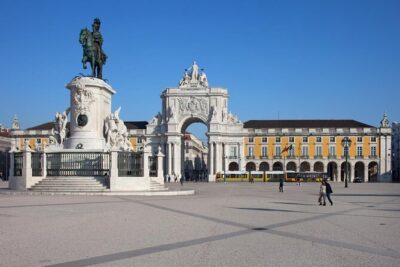
Browse the lists this tour appears in