
Reviewed · HISTORICAL TOURS
Porto:Private Tour of the Historic City in a Classic Ford T
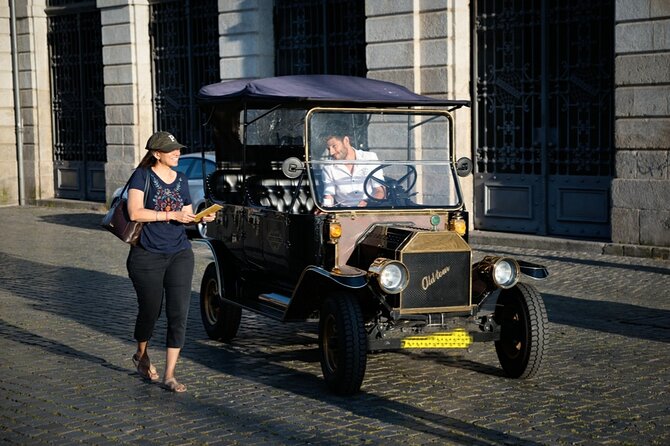
The most memorable part of this Porto tour is the vehicle itself: a charming Ford T-style electric car that carries your private group through steep streets and up to broad views over the Douro. Guides such as Gama, Rafaela, Daniella, and Maria have been praised for making the short ride lively, personal, and full of local stories.
I like the way the car reaches hills and narrow streets that can be tiring on foot, and I like the two planned viewpoint stops, which give you time for photos instead of a quick glance from the road. The main caution is important: since October 1, 2024, these vehicles have not been allowed in Porto’s downtown area, so the route may focus largely on Vila Nova de Gaia and views across to Porto.
In This Review
- Key points to know before you book
- Why this car tour works well in Porto
- Batalha Square and São João Theatre
- The Fernandina Wall and Porto’s medieval edge
- Serra do Pilar gives you the big picture
- Luís I Bridge, Jardim do Morro, and Maria Pia Bridge
- Clérigos Tower, the tile-covered church, and Porto Cathedral
- Miradouro da Vitória and the art of the photo stop
- What the private format adds
- The Porto or Gaia question
- Who should book this one-hour ride?
- Is the OldTour Porto experience worth it?
- FAQ
- How long does the tour last?
- How much does the tour cost?
- Is the tour private?
- What kind of vehicle is used?
- Is hotel pickup available?
- How can I identify the vehicle and guide?
- Is the tour offered in English?
- Are monument admission tickets included?
- Does the tour include stops for photographs?
- Can the car drive through central Porto?
Key points to know before you book
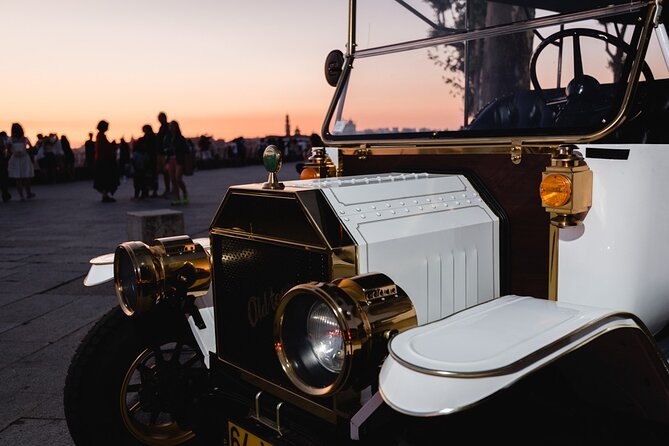
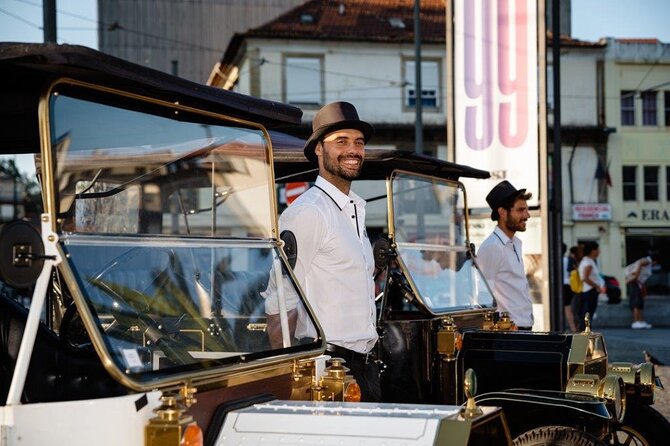
- Vintage style, modern power: The black, white, or dark-green car is a replica-style, 100% electric tuk-tuk rather than an original Ford Model T.
- A smart answer to Porto’s hills: You can cover major sights without walking every steep street between them.
- Private groups only: Each car carries a maximum of seven people, with your own guide and driver.
- Two proper photo stops: The tour includes two 10-minute stops at viewpoints.
- Gaia access matters: Current vehicle restrictions may prevent the car from entering central Porto.
- Best used early: I’d take this tour near the start of your stay, then return on foot to the places that catch your interest.
Why this car tour works well in Porto
Porto is compact on a map but demanding underfoot. Streets rise sharply from the Douro, cobbles can be awkward, and several of the best views sit well above the river. A small electric car lets you cover more ground with less effort, while the open, playful design makes the ride feel more special than a standard taxi.
You pay about $47.18 per person for roughly one hour. That is a fair price if you want a fast orientation, a private ride, and a guide who can adjust the pace for your group. It is less attractive if you want long visits inside monuments, because entry tickets are not included and most stops are for viewing from outside.
The strongest part of the experience is the guide. Gama has been praised for arriving on time, collecting passengers from a hotel, asking what they wanted to see, and choosing good photo locations. Rafaela is known for combining historical detail with a warm sense of humor, while Daniella has been singled out for making Gaia easy to explore without the usual uphill slog.
Your guide may be someone else, of course. The important point is that this is not a recorded sightseeing circuit. You can ask questions, request a drop-off near your next stop when practical, and get a local explanation of what you are seeing.
More City Tours in Porto
- The Unvanquished Tour in Porto City Center
★ 5.0 · 26,497 reviews - Porto: City Highlights 3-Hour Guided Electric Bike Tour
★ 4.8 · 3,092 reviews - Porto: City Train Tour, River Cruise & Wine Cellar
★ 3.9 · 2,601 reviews
Batalha Square and São João Theatre
The tour commonly begins around the historic center, including São João Theatre and Praça da Batalha. The theatre opened in 1898 and is one of Porto’s main cultural buildings, with a neoclassical exterior and an interior known for frescoes and ornate decoration. It holds about 1,200 people and hosts plays, opera, and concerts.
You should treat this as an exterior introduction unless you separately arrange a guided theatre visit. The building gives your guide an easy way to explain Porto’s cultural life, but the one-hour schedule does not allow time for a full interior tour.
Praça da Batalha is more than a traffic point. It links several useful parts of central Porto, including Rua de Santa Catarina and São Bento Station. The square also places the Teatro Nacional São João and Igreja da Santíssima Trindade close together, so you get a quick sense of how the city mixes public spaces, religious buildings, shops, and cafés.
The Fernandina Wall and Porto’s medieval edge
Fragments of Porto’s Fernandina Wall appear around the old city. Built during the 14th and 15th centuries under King Ferdinand, the fortification once ran for about three kilometers and included towers, gates, and defensive works.
Do not expect a complete circuit of medieval walls. You will see surviving sections and hear how they protected Porto from outside threats. The remains are especially useful as a reminder that the steep lanes were not laid out for modern traffic. They were shaped by defense, trade, and the river below.
This is one of the tour’s useful lesser-known stops. Many first-time visitors hurry toward the famous churches and bridges, then miss the fragments that explain how the old city developed.
Serra do Pilar gives you the big picture
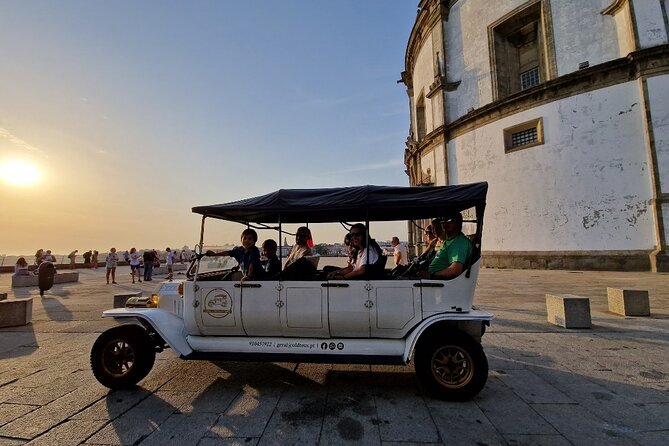
The 15-minute stop at Mosteiro da Serra do Pilar is one of the best uses of the tour’s limited time. The monastery sits above Vila Nova de Gaia, where its circular church and cloister form one of the area’s most distinctive monuments.
The church’s round plan reflects Mannerist design, and the site is part of the UNESCO World Heritage area. You get free admission according to the tour details, but the short stop is mainly about the setting, the architecture, and the view.
Bring your camera, but also look down and across. From here, the Douro, Porto’s old buildings, and the bridges fit into one broad scene. This is the kind of viewpoint that is easy to miss if you spend the day walking only along the river.
More Historical Tours in Porto
- Douro Valley: Historical Sites, Wine Experience, Lunch & Cruise
★ 5.0 · 5,133 reviews - Porto: Historic City Center Walking Tour
★ 4.7 · 1,172 reviews - Porto: An Intimate Fado Show in a Historical Tavern
★ 4.8 · 1,093 reviews - Porto: Historical Center Walking Tour
★ 4.8 · 898 reviews
Luís I Bridge, Jardim do Morro, and Maria Pia Bridge

The Luís I Bridge is the visual star of the ride. Opened in 1886, it links Porto and Gaia with a large metal structure on two levels. The upper deck gives pedestrians and vehicles a high crossing, while the lower level serves the riverside connection.
The supplied tour details identify Gustave Eiffel as the designer. The bridge is one of those places where scale is hard to grasp from a photograph. Seeing it from Jardim do Morro or the Gaia heights makes its span and steelwork easier to appreciate.
Jardim do Morro is a natural pause point. During the day, you can look over the river and city skyline. Around sunset, it becomes a popular place for the changing light over Porto. The tour does not promise a sunset departure, so think of this as a viewpoint rather than a guaranteed evening event.
The older Maria Pia Bridge adds a different kind of engineering story. Also associated with Gustave Eiffel, it opened in 1877 as a railway bridge and once carried trains between Porto and Gaia. It is no longer used for rail traffic, but its tall metal arch remains visible above the Douro.
I like having both bridges in the route because they show two stages of the city’s growth. The Luís I Bridge is still part of daily urban movement, while Maria Pia recalls the age when railways reshaped travel and trade.
Clérigos Tower, the tile-covered church, and Porto Cathedral

The ride also passes Porto’s major religious landmarks. At Clérigos Tower, your guide explains the architecture and the tower’s role in the city. The tower is one of Porto’s best-known markers, but this tour is not a tower-climbing visit. Admission to monuments and museums is not included, so you would need extra time and a separate ticket to go inside.
Another stop brings you to a church with a Baroque façade and a decorated interior featuring tiles. The blue-and-white tile tradition is one of Porto’s most recognizable visual signatures, and your guide can explain the religious order connected with the building. The supplied details do not identify this church by name, so confirm the exact stop with your guide if seeing a particular church matters to you.
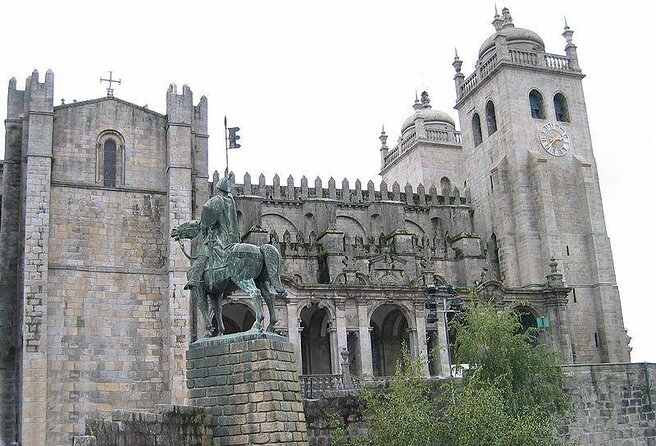
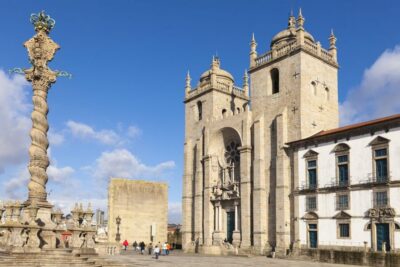
Porto Cathedral offers a different mood. Its Romanesque and Gothic forms reflect the city’s long religious and civic importance, while the cloisters may be part of the visit. Again, the tour price covers transport and guiding, not entry. In one hour, expect an outside explanation or a short look rather than enough time for a slow architectural study.
This is where I would set realistic expectations. The tour helps you decide which monuments deserve a return visit. It is not a substitute for spending an hour inside each one.
Miradouro da Vitória and the art of the photo stop
Miradouro da Vitória gives you one of the classic Porto views: the Douro below, colorful riverside buildings, and the bridges linking Porto with Gaia. The viewpoint is valuable because it compresses the city into a single picture, from the cathedral and old lanes down to the water.
The tour includes two 10-minute stops at viewpoints. That sounds brief, but it is enough for photographs and a quick orientation. You will not have time for a long café break or a leisurely walk at each location.
The guide often makes the difference here. Several guides have been praised for taking photos, pointing out good angles, and helping groups find the best place to frame the city. If you are traveling with family or as a couple, ask your guide to take a few pictures during the stops.
What the private format adds
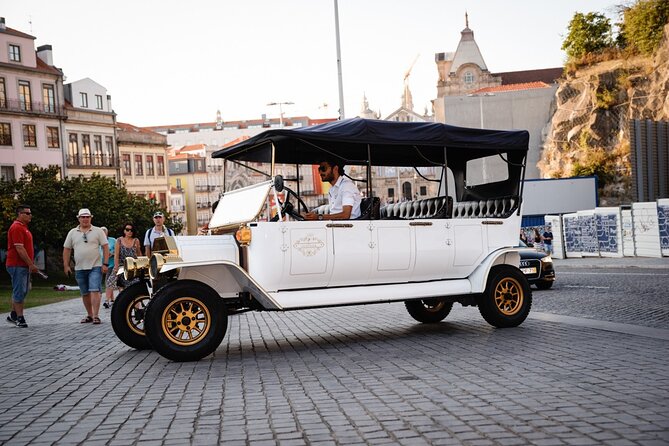
The maximum is seven people per car, and only your group participates. That matters in Porto, where a large vehicle can make narrow streets and quick stops awkward.
You can ask questions without holding up a busload of people. If you have a special interest in bridges, churches, local history, or viewpoints, tell your guide at the start. Gama has asked passengers about their priorities before setting off, and other guides have adjusted drop-offs or helped passengers continue to another part of town.
Pickup is offered in the historic center or at one of the listed meeting points. Look for the vintage-style vehicle in black, white, or dark green, and for guides identified with the name Oldtour. One practical warning: a pickup address can be confusing when streets meet at odd angles. Check the exact location and keep your phone available in case the guide sends a clarification.
The car is fully electric, which keeps the ride quieter than a fuel-powered vehicle. It also gives the experience a modern side beneath the old-fashioned body. One person noted that the suspension could use improvement, so expect a fun city ride rather than limousine comfort.
The Porto or Gaia question
This is the most important booking detail. The tour is presented as a Porto historic-city experience, but a current restriction has changed what the car can do. Since October 1, 2024, classic cars and tuk-tuks have not been allowed to drive in Porto’s downtown area.
That means you may remain on the Gaia side for much of the ride, looking across at Porto rather than driving through the center. You can still see the Luís I Bridge, Serra do Pilar, Jardim do Morro, Maria Pia Bridge, and the full Porto skyline. Afterward, it is easy to walk across the bridge into Porto, but the car itself may not take you to every central stop listed in the route.
The tour information still includes Porto sights such as Batalha, Clérigos, the cathedral, and Miradouro da Vitória. Because access rules can affect the route, confirm the day’s exact itinerary before you board. This avoids the main source of disappointment and helps you decide if the experience fits your plans.
Who should book this one-hour ride?
I would recommend it to first-time visitors who want an overview before exploring on foot. It is also a good choice for anyone who finds Porto’s hills difficult, for families who want a light introduction, and for people with only a short window in the city.
The private format suits couples and small groups who prefer conversation over a fixed bus narration. It can also work well for photographers, since the route is built around elevated views and the guides often help with pictures.
I would be more cautious if your main goal is entering monuments or spending time in Porto’s central streets. You will need separate visits for the theatre, churches, cathedral, and Clérigos Tower. I would also reconsider it if driving through downtown Porto is essential to you, since the current restriction may prevent that.
The tour is offered in English, includes private transportation, a guide-driver, and liability and personal injury insurance. Service animals are allowed, most people can participate, and confirmation arrives at booking. Free cancellation is available until 24 hours before the start time, which gives you some protection if your plans change.
Is the OldTour Porto experience worth it?
Book it if you want a cheerful, efficient introduction to Porto and Gaia, especially if steep streets are a concern. The best value comes from the private guide, the high viewpoints, and the chance to cover several districts in about an hour without exhausting your legs.
Before paying, confirm whether your departure will follow the Porto portion of the route or concentrate on Gaia. If you accept that limitation, this is a memorable way to get your bearings fast, collect useful history, and mark the places you want to revisit slowly.
FAQ
How long does the tour last?
The tour lasts approximately one hour.
How much does the tour cost?
The listed price is $47.18 per person.
Is the tour private?
Yes. Only your group participates, and each car carries a maximum of seven people.
What kind of vehicle is used?
The experience uses a vintage-style Ford T replica that is also described as a 100% electric tuk-tuk. The cars are black, white, or dark green.
Is hotel pickup available?
Pickup is offered in Porto’s historic center or at one of the mentioned meeting points.
How can I identify the vehicle and guide?
The vintage-style car is easy to spot, and the guides are identified with the name Oldtour.
Is the tour offered in English?
Yes, English is listed as an available language.
Are monument admission tickets included?
No. Tickets for museums, monuments, and other activities are not included.
Does the tour include stops for photographs?
Yes. It includes two 10-minute stops at viewpoints.
Can the car drive through central Porto?
Current restrictions introduced on October 1, 2024 prevent classic cars and tuk-tuks from driving in Porto’s downtown area. Confirm the exact route for your date, as the experience may focus on Vila Nova de Gaia and views across the river.
Recently reviewed around Porto
- Douro Valley Prime Tour: Wine Tastings, Boat & Lunch from Porto★ 5.0 · 572 reviews
- Port Wine Tour | 3 Cellars | 7 Tastings | 12 Participants Maximum★ 5.0 · 443 reviews
- PORTO city Walking Tour★ 5.0 · 132 reviews
- Private Vinho Verde Region Wine Tour from Porto Including Lunch★ 5.0 · 39 reviews
- Visit to Cockburn’s Cellars★ 5.0 · 526 reviews
- Wine Tasting with Tapas Walking Tour in Porto★ 4.5 · 544 reviews
- Porto to Lisbon with stop Aveiro-Fátima-Coimbra-Tomar-Nazaré-Óbidos★ 5.0 · 67 reviews
- 3 Hour Tuk tuk Tour in Porto★ 4.5 · 60 reviews
Historical Tours, compared.

Historical Sites, Wine Experience, Lunch & Cruise
Read our review →
Live Fado Show with Port Wine in Historic Center
Read our review →

Browse the lists this tour appears in