
Reviewed · TUK TUK TOURS
Lisbon Street Art – Private Guided Tour in a Electric Tuk Tuk
Lisbon’s street art is spread across steep hills, narrow lanes, viewpoints, and older neighborhoods. This private electric tuk-tuk tour saves you the uphill walking while bringing you close to works by Vhils, Bordalo II, Shepard Fairey, and other artists.
I especially like the way the route joins art with Lisbon’s history, from the portrait of poet Sophia de Mello Breyner Andresen to a tribute to fado singer Amália Rodrigues. I also like the flexible format: guides such as David, Andre, Susana, Tiago, and Rumi Miguel have tailored tours to people’s interests. The main thing to consider is the price, $101.97 per person, which makes the most sense for a small private group rather than a solo visitor on a tight budget.
In This Review
- Key points to know
- Why Lisbon’s street art works so well from a tuk-tuk
- Starting in Chiado and climbing toward Graça
- Shepard Fairey, Vhils, and the politics on the wall
- Graça and São Vicente: a changing urban gallery
- Bordalo II’s panda and Vhils’ tribute to Amália
- Portas do Sol and the final city view
- What the guide adds to the ride
- Is $101.97 per person good value?
- Practical details before you book
- Who should book this Lisbon art tour?
- Should you book it?
- FAQ
- How long does the street art tuk-tuk tour last?
- How much does the tour cost?
- Is the tour private?
- Is hotel pickup available?
- Where does the tour end?
- What language is the tour offered in?
- Which street artists can I see?
- Does the tour run every day?
- Can I cancel for a full refund?
Key points to know
- See more than you could comfortably cover on foot: The tuk-tuk handles Lisbon’s hills, narrow streets, cobblestones, and uneven pavement.
- Expect a mix of major works and lesser-known pieces: The route includes Vhils, Bordalo II, Shepard Fairey, Oze Arv, and André Saraiva.
- Your guide shapes the experience: This is a private tour, so you can ask for more art, more local history, or more city views.
- The best stops combine art and place: Graça, São Vicente, Portas do Sol, and the views over Lisbon give context to the murals.
- It is more than a photo ride: Commentary covers artists, politics, culture, and the story behind individual works.
- Plan for about two hours: Hotel pickup is available, and the tour returns to the meeting point in Chiado.
Why Lisbon’s street art works so well from a tuk-tuk
Lisbon is a good city for a moving art tour. Murals appear on side streets, blank walls, old industrial areas, and buildings tucked behind the main sightseeing routes. Some are easy to spot. Others would take a fair amount of searching, especially if you are trying to fit them around a short city visit.
The electric tuk-tuk gives you a practical advantage. Lisbon is hilly, and the old quarters have tight streets with cobblestones and uneven pavement. You can cover more ground without turning the outing into a demanding walk. The open-air ride also keeps the city in view as you move from one artwork to the next.
The private format matters. You are not following a fixed group at someone else’s pace. You can ask why an artist uses discarded materials, how a mural relates to Portuguese politics, or where a particular work fits into Lisbon’s culture. Guides have adjusted the route to suit different interests, which is useful if you already know Vhils but want to learn more about Bordalo II, or if you care as much about local history as the art.
The tour is offered in English and lasts about two hours. That is enough time for a strong introduction to Lisbon’s street art, but not enough to see every important wall in the city. Think of it as a focused overview with a few memorable stops, not a complete catalogue.
More Tuk Tuk Tours in Lisbon
- True 4Hour Private Tuk Tuk Tour: Discover Lisbon with a Local!
★ 5.0 · 8,008 reviews - Lisbon Highlights: Private Tuk Tuk Tour Adventure Sightseeing
★ 5.0 · 3,284 reviews - Welcome Lisbon Tour with Local Guide in Private Eco Tuk Tuk
★ 5.0 · 1,691 reviews
Starting in Chiado and climbing toward Graça
The meeting point is in Chiado, with hotel pickup available. Chiado is a practical starting area because it links the central city with the older neighborhoods on the hills. The tour ends back at the meeting point, unless your pickup arrangement provides a different practical plan.
One early stop is the Miradouro da Graça, also known as the Sophia de Mello Breyner Andresen viewpoint. The mural here is by Portuguese artist Daniel Eime and shows the poet Sophia de Mello Breyner Andresen, who had a close connection to Graça.
This is a useful introduction because the artwork is not simply decoration. It connects a living neighborhood to one of Portugal’s best-known literary figures. Sophia de Mello Breyner Andresen won major prizes, was translated into several languages, and now has this viewpoint named for her.
You get about 10 minutes at this stop. That is enough to see the portrait, hear the basic story, and take photographs. It is not a long visit, so you should not expect time for a full literary discussion or a relaxed café stop.
The viewpoint also gives the tour a wider purpose. Street art in Lisbon often speaks to local identity, politics, memory, or place. From the beginning, you are looking at art as part of the city rather than as a series of unrelated Instagram backdrops.
Shepard Fairey, Vhils, and the politics on the wall
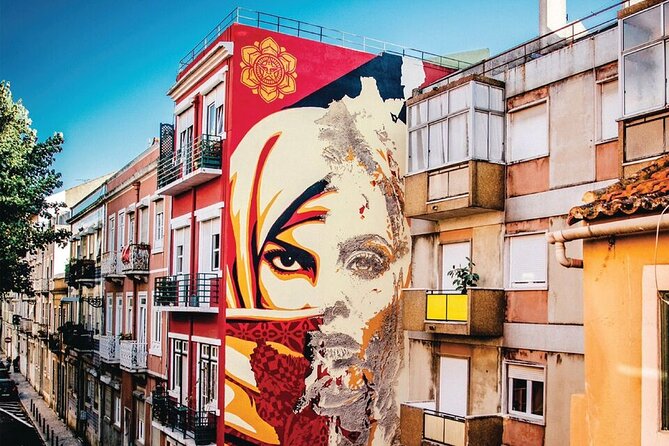
The next section gives the tour its strongest artistic and political focus. Works connected with Shepard Fairey and Vhils include pieces titled Carnation Revolution, Once Upon a Time, Fuel: Adapt, and Universal Personhood.
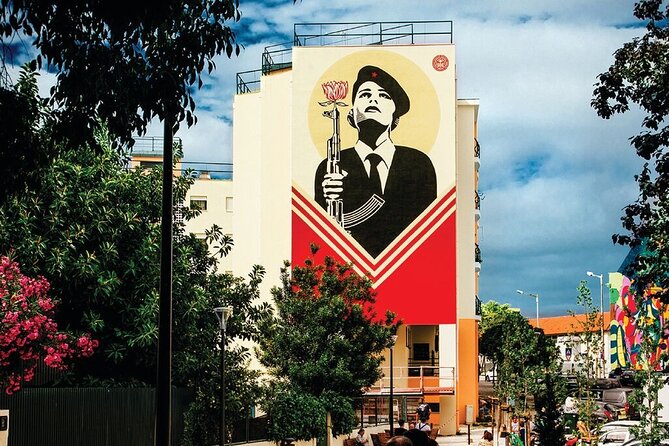
Shepard Fairey, also known as Obey Giant, is the American artist behind the famous Peace Guard mural. The work has become one of Lisbon’s most recognizable pieces of street art. Your guide points out the mural and explains why it carries more weight than a random painted wall.
The Carnation Revolution reference is especially important in Lisbon. The 1974 revolution ended decades of dictatorship in Portugal, and the carnation became a lasting symbol of that peaceful political change. You do not need a degree in Portuguese history to appreciate the work, but the background gives the image more force.
The collaboration between Fairey and Vhils also shows how Lisbon’s street art scene connects local artists with international names. Vhils is known for making portraits by cutting, scraping, or removing layers from walls rather than only adding paint. Seeing his work beside Fairey’s approach gives you a useful contrast in method and style.
This portion lasts about 30 minutes, making it the longest main stop. That extra time is welcome. You can look closely, hear how the pieces relate to one another, and ask questions instead of rushing from wall to wall.
The possible drawback is that street art changes. A wall can be painted over, weathered, blocked by vehicles, or altered by nearby construction. The experience depends on what remains visible on the day of your tour. Your guide’s local knowledge helps, but the city’s art is not a museum collection with permanent displays.
Graça and São Vicente: a changing urban gallery
The Graça and São Vicente area adds smaller or less formal works to the route. One piece is Alegria de um Caos Constante by Oze Arv. The title suggests joy within constant disorder, a fitting idea for a city where old streets, new art, worn walls, and daily life sit close together.
You also see an azulejo-style mural by André Saraiva. Lisbon is strongly associated with painted ceramic tiles, so this piece connects street art with a traditional Portuguese visual language. It is a good example of how contemporary artists can borrow familiar local forms without simply copying the past.
The planned time here is about 10 minutes. That makes this a quick look rather than a slow art lesson. Still, short stops can work well on a tuk-tuk tour because the route is designed to show several styles in a limited period.
I would pay attention to your guide’s explanation here. A wall may look playful at first glance, but the choice of symbols, materials, or location can tell you how the artist responds to the neighborhood. Guides including David, Andre, Susana, Tiago, and Rumi Miguel have been praised for explaining both the city and the artists, so ask questions if you want more than a quick identification.
More Lisbon trips worth a second look
- Lisbon: Private Guided Tuk-Tuk Tour with Hotel Pickup
★ 4.9 · 4,552 reviews - Private Lisbon Sightseeing Tuk-Tuk Tour: Alfama, Belém & More
★ 5.0 · 4,277 reviews - Lisbon: Private City Tour by Eco Tuk Tuk
★ 4.9 · 1,215 reviews - Lisbon: Private Sightseeing Tour in a Vintage Tuk Tuk
★ 4.9 · 1,057 reviews
Bordalo II’s panda and Vhils’ tribute to Amália
At Rua São Tomé 76, the tour turns to two especially distinctive works.
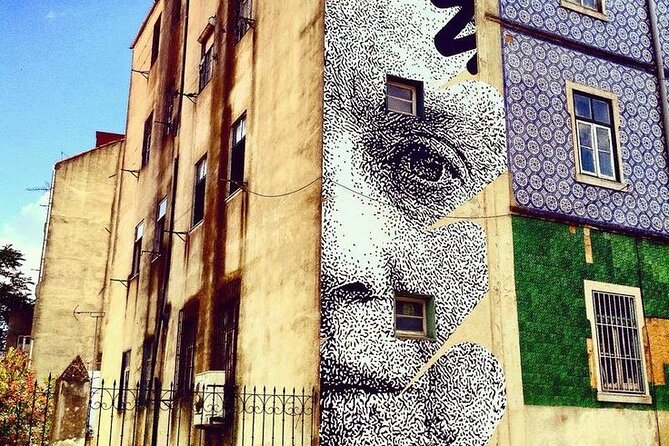
The first is Bordalo II’s panda, made for the exhibition Evilution. Bordalo II is known for building animal forms from discarded objects and waste materials. The panda reflects his concern with environmental damage and sustainability, while the use of old materials gives the piece a rough physical quality that ordinary paint cannot provide.
This is one of the places where a guide adds real value. Without context, you may see a large animal sculpture and move on. With an explanation of the materials and the idea behind Evilution, you can read it as a comment on consumption, waste, and the fragile place of wildlife.
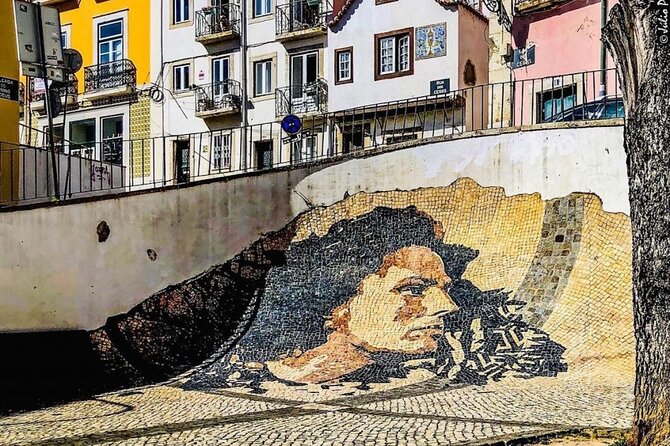
The second work is Vhils’ tribute to Amália Rodrigues, the great fado singer who died in 1999. This is a particularly Portuguese subject. Fado is closely linked with Lisbon, and Amália remains one of its best-known voices.
The artwork is made in the style of traditional Portuguese pavement, using small stone pieces rather than a standard painted surface. That choice makes the tribute feel tied to the streets themselves. You are not only seeing an image of Amália. You are seeing her represented through one of the materials and crafts most closely associated with Lisbon.
The stop lasts about 15 minutes. It is a good place to compare two different ideas: Bordalo II uses discarded materials to make an environmental point, while Vhils uses a traditional street material to honor a cultural icon.
Portas do Sol and the final city view
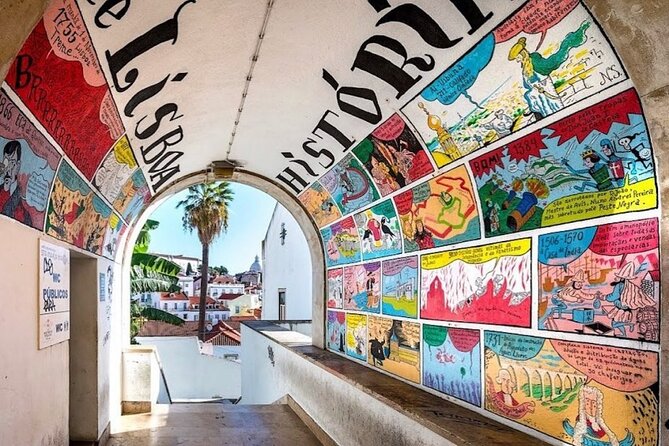
The last stop is the Portas do Sol viewpoint. This is one of the tour’s best chances to pause and see Lisbon from above. Beneath the viewpoint is a small archway painted with the history of Lisbon.
The stop lasts about 10 minutes, so the focus is simple: take in the view, look at the painted story beneath the viewpoint, and let the different parts of the tour come together. After seeing art in side streets and on worn walls, you finish with a broad view of the city.
That ending works well because street art can sometimes feel disconnected from the places where it appears. A viewpoint gives you a sense of the hills, neighborhoods, and dense urban setting that shape the art. It also gives you a strong final photo opportunity.
If photography matters to you, bring a phone or camera that is easy to use from the tuk-tuk and during short stops. The tour gives you several chances for pictures, but the schedule is active. You will get better results by being ready rather than spending each stop searching through your bag.
What the guide adds to the ride
The art is the reason to book, but the guide is what turns the outing into a tour rather than a transfer between murals. The guide explains the artists, the pieces, and the local setting. The commentary can also bring in politics, culture, and the history of Lisbon’s neighborhoods.
Different guides may lead the experience. David is noted for combining street art with city history, while Andre has adjusted the route to personal interests and included iconic sights and viewpoints. Susana has taken people into parts of the city different from those covered on earlier tours. Tiago has discussed the political and cultural influences visible in the art, and Rumi Miguel is himself an artist.
You should not assume a specific guide unless the provider confirms one at booking. Still, the range of guide experience is useful to know. If you want more detail about technique, say so. If you prefer a broader introduction to Lisbon, ask for more local context.
The private setup also helps families and small groups. Children must be accompanied by an adult, and only your group participates. Group discounts are available, so compare the total cost for your party rather than looking only at the individual rate.
Is $101.97 per person good value?
At $101.97 per person, this is not the cheapest way to see Lisbon’s murals. You are paying for a private vehicle, an English-speaking guide, door-to-door pickup availability, and the ability to cover several hilly areas in about two hours.
The value improves when you are traveling with a small group and want a tailored outing. Splitting the cost among several people can make the private format more reasonable, especially if walking uphill is difficult or you have limited time in Lisbon.
It is also good value for a first look at the city’s street art. A self-guided search would cost less, but you could easily miss works, waste time finding the right streets, or see the art without understanding its context. The tour puts major names such as Vhils, Bordalo II, and Shepard Fairey into one compact route.
I would be less likely to recommend it to a solo budget visitor who enjoys walking and has several days to explore. The price is easier to justify if you value convenience, commentary, and a private schedule.
Practical details before you book
The tour runs daily from 9:30 AM to 7:00 PM during the stated operating period of June 2, 2025 through June 1, 2026. You can start in Chiado, or arrange pickup at your hotel. The activity returns to the meeting point.
Confirmation is provided when you book. The meeting area is near public transportation, and most people can take part. The tour is offered in English.
Allow about two hours, but keep in mind that a private tour can sometimes be arranged for a longer duration. One past booking was extended to three hours, so you can ask the provider about options if the standard route feels too short.
Free cancellation is available up to 24 hours before the start time for a full refund. Changes or cancellations made within 24 hours are not accepted for a refund, and the cut-off follows Lisbon local time.
Who should book this Lisbon art tour?
I would choose this tour for a first visit to Lisbon if I wanted an easy introduction to both street art and the city’s older neighborhoods. It is also a smart choice for people who want to avoid a long uphill walk, families with limited sightseeing time, and small groups that can share the private cost.
It suits art fans who want to see major names but do not want a formal gallery tour. It also works for returning visitors. The city’s art route reaches areas you may not have covered on a first trip focused on castles, churches, and central squares.
You should skip it if your priority is a slow, specialist art lecture at each wall. The tour covers several areas in two hours, so some stops are brief. You should also think twice if you prefer to explore entirely on foot and are watching every euro.
Should you book it?
Book this electric tuk-tuk tour if you want to see a surprising amount of Lisbon in a short time, with an English-speaking guide who can explain the people, politics, and materials behind the art. The strongest reasons are the private format, the access to steep neighborhoods, and the range of artists, from Vhils and Bordalo II to Shepard Fairey and André Saraiva.
Before booking, confirm pickup details and ask about your guide if a particular style matters to you. For a small group, the price can be fair. For one person on a strict budget, walking and finding a few murals independently may be the better choice.
FAQ
How long does the street art tuk-tuk tour last?
The tour lasts approximately two hours.
How much does the tour cost?
The listed price is $101.97 per person.
Is the tour private?
Yes. Only your group participates in the activity.
Is hotel pickup available?
Yes. Pickup can be arranged at your hotel. The tour also starts in the Chiado area of Lisbon.
Where does the tour end?
The activity ends back at the meeting point in Chiado.
What language is the tour offered in?
The tour is offered in English.
Which street artists can I see?
The route includes works by Vhils, Bordalo II, Shepard Fairey, Daniel Eime, Oze Arv, and André Saraiva.
Does the tour run every day?
Yes. It is scheduled Monday through Sunday, from 9:30 AM to 7:00 PM, during the stated operating period.
Can I cancel for a full refund?
Yes. You can cancel at least 24 hours before the start time for a full refund. Cancellations or changes made less than 24 hours before the start time are not accepted for a refund.
More Street Art in Lisbon
- Lisbon: Street Art Tour
★ 4.9 · 1,324 reviews - Lisbon: Kickstart Street Art Walking Tour
★ 4.9 · 717 reviews - Lisbon: Street Art Tuk Tuk Tour
★ 4.9 · 372 reviews - LISBON Street Art Tour
★ 5.0 · 371 reviews
Recently reviewed around Lisbon
- Lisbon: Catamaran Luxury Sunset and Wine Tour★ 5.0 · 119 reviews
- Lisbon’s authentic Food and Wine tour with a Winemaker★ 5.0 · 67 reviews
- Morning Sailing Tour in Tagus River from Lisbon★ 5.0 · 68 reviews
- Lisbon: Belem Walking Tour with Jeronimos Monastery Tks Included★ 5.0 · 115 reviews
- PRIVATE Unforgettable Full Day Tour to Sintra from Lisbon★ 5.0 · 236 reviews
- Discover Lisbon’s Alfama: Secrets of the Old Town★ 5.0 · 104 reviews
- Sesimbra Wild Beach Tour from Lisbon★ 5.0 · 57 reviews
- Private Jeep Tour from Lisbon – Arrábida, Sesimbra & Beach Picnic★ 5.0 · 48 reviews
Tuk Tuk Tours, compared.

True 4Hour Private Tuk Tuk Tour: Discover Lisbon with a Local!
Read our review →
Lisbon Highlights: Private Tuk Tuk Tour Adventure Sightseeing
Read our review →
Discover Porto’s Highlights on a 2-Hour Private Electric Tuk Tuk
Read our review →
Welcome Lisbon Tour with Local Guide in Private Eco Tuk Tuk
Read our review →

Explore Lisbon by Tuk Tuk: History and Viewpoints
Read our review →
Historic Porto by Private Electric Tuk Tuk to Top Landmarks
Read our review →Browse the lists this tour appears in