
Reviewed · 1-DAY TOURS
Best of Braga and Guimaraes Day Trip from Porto
Braga’s grand Bom Jesus staircase and Guimarães’ medieval center give this day trip a fine introduction to northern Portugal. You get religious art, royal history, old stone lanes, and a glimpse of the Minho countryside without arranging several train rides or local transfers yourself. Guimarães is the real star, with a compact old town that is easy to explore on foot.
I like the balance between guided visits and free time. The tour includes Braga Cathedral and Guimarães Castle, then gives you time to eat and wander at your own pace. I also like the comfortable, air-conditioned minibus and the strong local storytelling from guides such as Castro, Christian, Philip, and José. The main drawback is the long day, especially if the group is conducted in both English and Spanish.
In This Review
- Key points to know before booking
- Why this northern Portugal day trip works
- Bom Jesus and its water-powered funicular
- Braga Cathedral, older than the nation
- One hour to eat and wander in Braga
- Guimarães, the birthplace of Portugal
- Guimarães Castle and the first royal story
- S. Miguel do Castelo and Guimarães old town
- Transport, group size, and the pace of the day
- Who should book this tour
- Should you book the Braga and Guimarães day trip?
- FAQ
- Where does the tour start and end?
- Is hotel pickup included?
- What is included in the price?
- How long does the day trip last?
- Can the tour be bilingual?
- Can I cancel for a full refund?
Key points to know before booking
- Bom Jesus uses a remarkable 19th-century funicular: Its 300-meter water-powered system was installed in 1882 and still operates on the same basic principle.
- Braga Cathedral predates Portugal: The cathedral was consecrated in 1089, before Portugal became an independent kingdom.
- Guimarães connects directly to Portugal’s beginnings: Afonso Henriques, the first king of Portugal, was born here.
- The tour includes two important admission tickets: Braga Cathedral and Guimarães Castle are covered in the price.
- Free time matters: You receive time in Braga and Guimarães for food, shops, photographs, and independent wandering.
- The group can reach 27 people: The minibus keeps the outing manageable, but it is not a private tour.
Why this northern Portugal day trip works
At $71.35 per person, this is a sensible way to see two major towns north of Porto in one day. You are paying for transport, a guide, the cathedral and castle admissions, and a walking tour through Guimarães. Lunch and personal purchases are extra, but the schedule gives you time to choose your own meal rather than tying you to a fixed restaurant.
I see the greatest value in the historical connection between the stops. Braga introduces Portugal’s long religious tradition, while Guimarães takes you to the early political story of the country. The guide fills in the miles between them with Portuguese history, cultural details, and observations about the Minho region.
This is not a slow village outing. It is a full sightseeing day, approximately nine hours, with an early start at 7:50 a.m. You meet near S. Bento Train Station at Calçada de Vandoma and return to the same meeting point. There is no hotel pickup or drop-off, so you need to make your own way to the start.
The experience has a 4.7 rating from 2,552 reviews, and 93 percent of people recommend it. The clearest pattern is the quality of the guides. Castro is praised for organization and warmth, Christian for his pride in Portuguese history, José for his personal attention and timing, and Philip for being patient and personable. The exact guide depends on the date, but the company clearly leans heavily on guide-led interpretation rather than simply driving you from sight to sight.
More Porto trips worth a second look
- From Porto: Braga and Guimarães Full-Day Trip
★ 4.6 · 3,951 reviews - Day Trip from Porto to Santiago de Compostela and Valença
★ 5.0 · 883 reviews - From Porto: Arouca 516 and Paiva Walkways Guided Day Trip
★ 4.9 · 456 reviews
Bom Jesus and its water-powered funicular
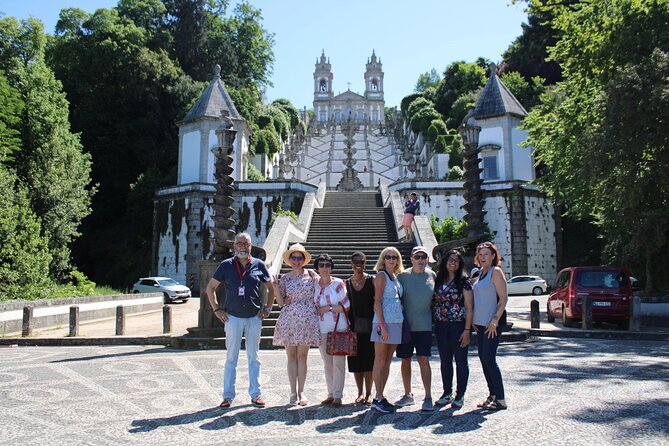
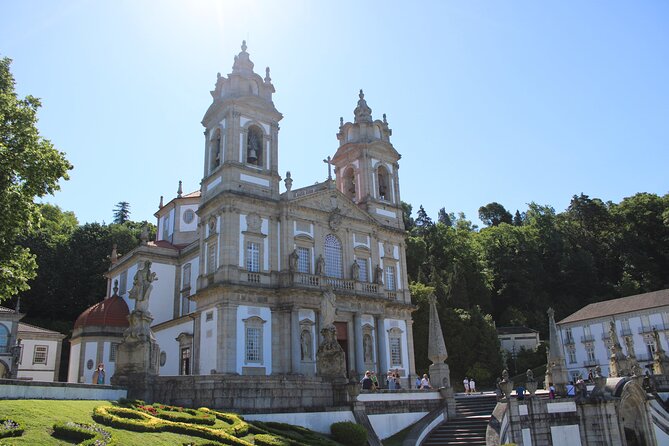
Braga’s Bom Jesus Sanctuary is the most dramatic opening stop. From below, the famous white staircase climbs the wooded hill toward the church, creating one of northern Portugal’s most recognizable views. You have about 30 minutes here, so this is a quick introduction rather than a full pilgrimage visit.
The staircase has 17 landings, each decorated around a religious theme. Fountains and statues represent the Stations of the Cross, the Five Senses, the Virtues, Moses receiving the Commandments, and the biblical figures linked to Jesus’ condemnation. Even if religious art is not your main interest, the layout makes the climb a visual lesson in Baroque symbolism.
At the top is the church designed by Carlos Amarante in an Italian-inspired Neoclassical style. The architecture is deliberately formal, yet it fits into the northern Portuguese setting. From the lower end of the staircase, look upward before moving on. The granite fountains, white church, and long central axis make more sense from that angle than they do when you are standing beside the church.
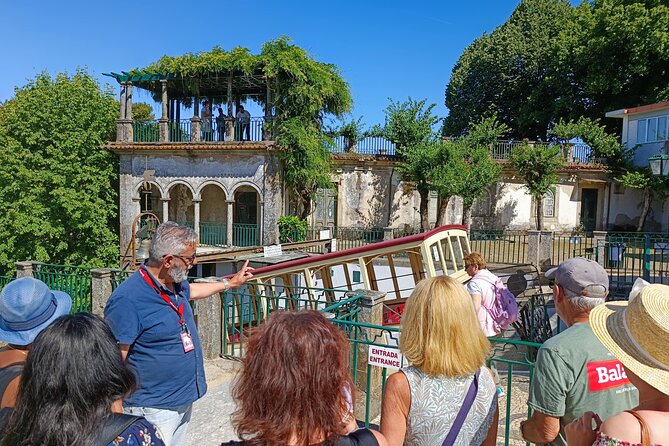
The funicular is the unusual engineering feature. Installed in 1882, it was the first of its type in Portugal and uses water power to move along the 300-meter route in about three minutes. The stop is called Bom Jesus Funicular, and the sanctuary entrance is included. Since the visit is short, ask your guide exactly how the group will use the funicular and how much time is available for the stairway and church.
Wear shoes with a secure sole. You may not climb every section of the staircase, but the site includes sloping paths, steps, and stone paving. Rain can make the area slippery, and northern Portugal is not always dry, even in seasons that look promising on a forecast.
Braga Cathedral, older than the nation
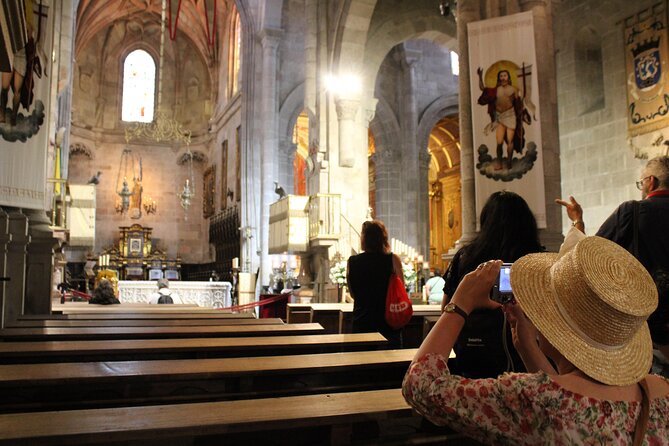
From Bom Jesus, the minibus takes you into Braga for a 30-minute visit to the Sé de Braga. This is not simply another old church. Construction began at the end of the 11th century, and the cathedral was consecrated in 1089, several decades before Portugal was founded as an independent country.
That date gives the building its force. You are looking at a place connected to the earliest period of Portuguese identity, when religious and political power were closely linked. Braga competed with Santiago de Compostela for influence, and its cathedral became the city’s central monument.
The Chapel of Kings contains the tombs of D. Henrique and D. Teresa, the parents of Afonso Henriques. That family connection links Braga directly to the next destination, Guimarães, where their son was born and where the story of the Portuguese kingdom took shape.
Your admission is included, and the guide gives context before or during the visit. Thirty minutes is enough to see the key areas, but not enough for a careful study of every chapel and architectural detail. If you are especially interested in religious art or medieval architecture, you may wish you had more independent time here.
One hour to eat and wander in Braga
After the cathedral, you get about an hour in Braga. Use it well. This is your chance to step away from the group, find a café or restaurant, browse local shops, or take a short walk through the city center.
The break is important because the day would feel overly managed without it. A guide may suggest a restaurant, and the food break can also be a useful chance to ask about Portuguese customs, local dishes, or the differences between Braga and Porto. You pay for lunch yourself.
One hour is enough for a meal and a quick look around, but it is not enough to cover every attraction in Braga. If you want a slow visit to the city, a longer stay in Braga would be better. On this trip, Braga functions as both a major historical stop and a practical pause before Guimarães.
The schedule can vary because of traffic and visit times. Keep an eye on your watch and return to the agreed meeting point promptly. A late return by one person can affect the whole group.
A different kind of day out, same corner of Portugal:
- The Unvanquished Tour in Porto City Center
★ 5.0 · 26,497 reviews - From Porto: Douro Valley w/ Boat Tour, Wine Tasting & Lunch
★ 4.7 · 19,061 reviews - Complete Douro Valley Wine Tour with Lunch, Wine Tastings and River Cruise
★ 5.0 · 12,920 reviews - Porto: Six Bridges Cruise
★ 4.2 · 11,680 reviews
Guimarães, the birthplace of Portugal
The drive from Braga to Guimarães is short, and the historical change is clear. Braga is an important religious center. Guimarães is tied to the formation of the Portuguese state.
Afonso Henriques, who became Portugal’s first king, was born here. The city is therefore often called the birthplace of Portugal, though the political story was built through many places and events. Your guide helps connect the local monuments to that larger story, which is one reason the bus commentary matters.
You have about two hours in Guimarães, including the castle, the small Church of S. Miguel do Castelo, and the historic center. That is a useful amount of time for a first visit. You get a guided framework, then enough room to look at details on your own.
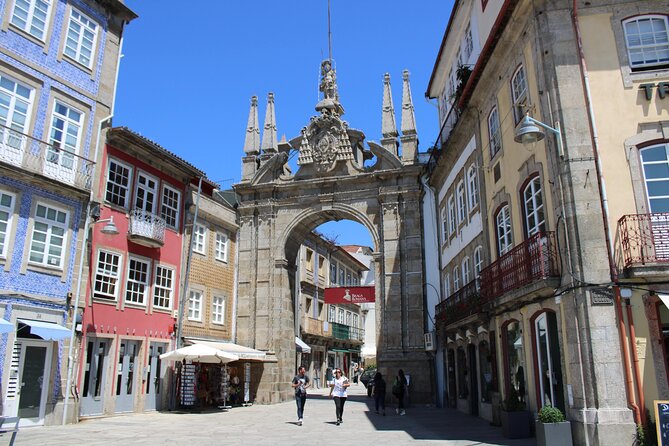
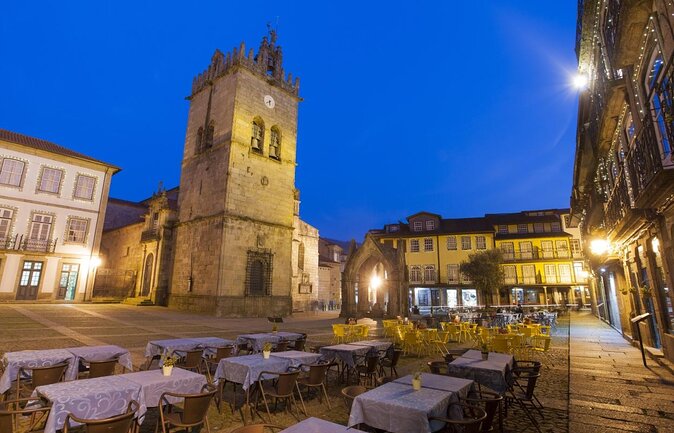
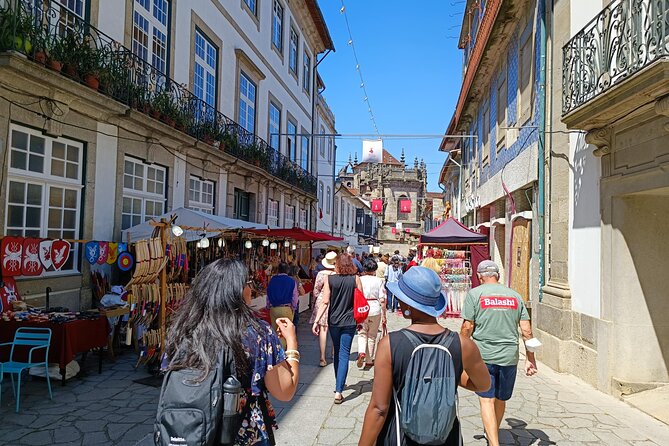
Guimarães is compact, so the walking portion is more rewarding than a quick bus tour would be. Expect stone paving, narrow streets, granite balconies, iron verandas, arches, old mansions, towers, and cloisters. The historic center was restored with attention to its original character and became a UNESCO World Heritage site in 2001.
Guimarães Castle and the first royal story
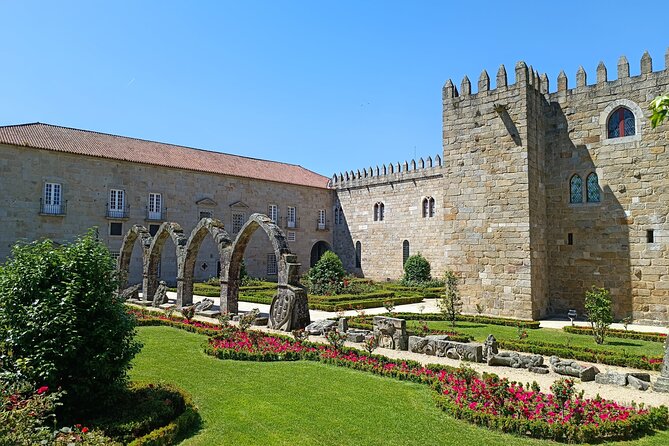
The castle visit lasts about 30 minutes and admission is included. Its walls and towers recall the defensive problems of the early medieval period, when raids came from Viking groups to the north and Muslim territories to the south.
The first castle on this site was ordered around 968 by Mumadona, Countess of Galicia, as a refuge for local people. Later, Count Henry ordered a larger and stronger structure. The square keep and four corner towers create the shape you see today.
Tradition holds that the building against the inner northern wall may have been the residence of Count Henry and the birthplace of Afonso Henriques. The exact claim is not strictly documented, but it gives the castle its emotional link to the foundation story of Portugal.
Set expectations correctly. The castle has limited access, and access to the walls is now prohibited. Some descriptions of the site may leave you expecting a walk along the ramparts, but you should not count on that. The castle is most valuable for its historical setting and exterior form, not for a long interior visit packed with rooms and furnishings.
This is the one stop where opinions may vary. If you love medieval fortifications, you will likely appreciate the keep, towers, and early national story. If you prefer furnished palaces or large museum displays, the castle may feel sparse. The guide’s explanation makes a real difference here.
S. Miguel do Castelo and Guimarães old town
The Church of S. Miguel do Castelo is a very brief stop, about 10 minutes. Built in the Romanesque style, it is small and plain compared with Bom Jesus or Braga Cathedral. Tradition says Count Henry built it in the 12th century and that Afonso Henriques was baptized here.
The church’s simple interior includes burials beneath the floor, linked to warriors from the period when Portugal was being formed. There is no need to expect an extended visit. Think of it as a quiet historical marker between the castle and the old town.
The historic center is where the afternoon gains its charm. Narrow lanes open into small squares, and old houses show off granite balconies, iron details, and covered passages. Historic buildings such as the Mota Prego house, Vila Flor Palace, and Toural Palace help explain why Guimarães feels coherent rather than scattered.
You receive a walking tour, but the exact balance between guided commentary and free time can depend on the guide and the group. Several guides, including José, have been praised for giving clear information while also allowing people to explore independently. That is the right approach here. Guimarães rewards pauses for photographs and small details more than a hurried checklist.
You may also use part of this time for lunch. The town is small enough to combine food with a short walk, though you should not try to fit in every shop and monument. If Guimarães captures your interest, consider returning for a longer visit from Porto.
Transport, group size, and the pace of the day
The air-conditioned minibus is a major practical benefit. You avoid figuring out separate connections between Porto, Bom Jesus, Braga, and Guimarães, and you can listen to background information while moving between sites. Some vehicles include Wi-Fi, though the supplied details do not guarantee it for every departure, so treat that as a possible extra rather than a reason to book.
The maximum group size is 27. That is far more personal than a large coach, but it is still a group experience. You will wait for people at meeting points, and the guide cannot tailor every minute to your interests.
The day’s pacing is generally sensible: a short visit at Bom Jesus, a focused cathedral stop, free time in Braga, then a larger block for Guimarães. It mixes sitting, walking, guided commentary, and independent time. Still, nine hours is a serious commitment. Rain, delays, or a bilingual presentation can make the schedule feel longer.
The tour may operate in one language or use a second language. If English is your booking language, check the wording carefully because the group may include both English and Spanish speakers. A bilingual tour can work well when the guide is organized, but every explanation takes longer and some people find the presentation less full.
Bad weather does not automatically cancel the outing. Bring rain protection and wear practical shoes. The sights remain worthwhile in wet weather, but the walking sections are less pleasant, particularly in Guimarães and around the Bom Jesus staircase.
Who should book this tour
I would choose this trip if you have limited time in Porto and want a guided introduction to northern Portugal. It is especially suitable if you enjoy medieval history, churches, architecture, scenic viewpoints, and old town walks. Solo visitors and first-time visitors can also benefit from the structure, transport, and included admissions.
Families and mixed-interest groups may like the variety. One person can focus on the castle, another on the cathedral, and everyone gets some free time rather than being guided every minute.
I would think twice if you have already spent a lot of time touring Portugal and prefer to set your own pace. One experienced visitor found the day pleasant but not especially revealing after extensive time elsewhere in the country. A private tour or a self-guided train trip with longer stays might suit you better.
I would also avoid booking it immediately before a flight or major evening plan. The advertised duration is approximately nine hours, and traffic or visit schedules can shift the return time. The tour may finish around late afternoon, but you should leave some flexibility.
Should you book the Braga and Guimarães day trip?
For $71.35, I think this is good value if you want both towns in one organized day. The included cathedral and castle tickets, air-conditioned transport, local guide, and Guimarães walking tour cover the costly and confusing parts of the outing.
Book it for the historical connection, not just for a quick photo at two old towns. You will get the most from it if you listen during the drives, ask questions, and use the free periods to wander beyond the main route. Check the bilingual possibility before paying, and plan for rain.
This is a strong choice for a first visit from Porto. It is less suitable for anyone wanting a slow, highly detailed study of either Braga or Guimarães. If that distinction fits your plans, the tour gives you a full and useful day beyond the city.
FAQ
Where does the tour start and end?
You meet at Calçada de Vandoma near S. Bento Train Station in Porto at 7:50 a.m. The tour ends back at the same meeting point.
Is hotel pickup included?
No. Hotel pickup and drop-off are not included, so you must reach the meeting point yourself.
What is included in the price?
The price includes air-conditioned minibus transportation, a professional destination guide, admission to Braga Cathedral, admission to Guimarães Castle, entrance to Bom Jesus Sanctuary, and a walking tour of Guimarães. Lunch and personal expenses are not included.
How long does the day trip last?
The duration is approximately nine hours. The exact timing can change because of local traffic, opening hours, and visit schedules.
Can the tour be bilingual?
Yes. Tours are usually conducted in one language, but a second language may be used. The tour information specifically notes that the group may include more than one language.
Can I cancel for a full refund?
You can cancel up to 24 hours before the experience start time for a full refund. Changes or cancellations made less than 24 hours before the start are not accepted for a refund.
Recently reviewed around Porto
- Bridges Cruise with World of Discoveries or Sunset Option★ 4.0 · 219 reviews
- Porto Card Walker (1, 2, 3 or 4 Days)★ 3.4 · 135 reviews
- Porto: 6 Bridges Yacht Cruise with Local Wine & Snacks★ 5.0 · 399 reviews
- Porto: 5D Flight over de City for all family.★ 4.0 · 281 reviews
- Porto:Aveiro, Cruise, Costa Nova & Capelha da Pedra Full Day★ 4.5 · 434 reviews
- Porto Private E-Bike Tour: Douro River, Parks & Beaches★ 4.7 · 104 reviews
- Porto: 3-Hour Walking City Tour & Lello Bookstore Visit★ 4.7 · 99 reviews
- Port Wine class with 3 or 5 Port tasting and pairings★ 4.9 · 441 reviews
1-Day Tours, compared.
Sintra and Cascais Small-Group Day Trip from Lisbon
Read our review →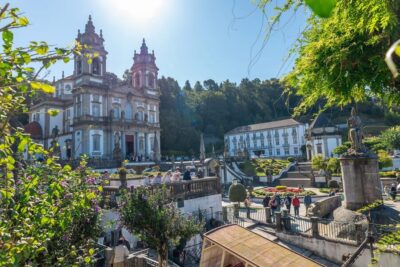
Three Cities in One Day: Porto, Nazare and Obidos from Lisbon
Read our review →

Day Trip from Porto to Santiago de Compostela and Valença
Read our review →
Arrabida and Sesimbra Small-Group Day Trip from Lisbon with Wine Tasting
Read our review →
Browse the lists this tour appears in